


Listen to the article
President Trump Unveils First Public Rendering of New White House Ballroom
President Donald Trump shared the first public rendering of a planned White House ballroom on Tuesday, describing the project as a historic addition that would “serve our Country well” for “centuries into the future.”
The rendering, posted on Truth Social, shows the ambitious project from the perspective of the Treasury Building. According to Trump, the plan involves replacing the existing East Wing with a new structure anchored by the White House’s first formal ballroom, designed to match the iconic mansion in both height and scale.
“If you notice, the North Wall is a replica of the North Facade of the White House, shown at the right hand side of the picture,” Trump explained in his social media post.
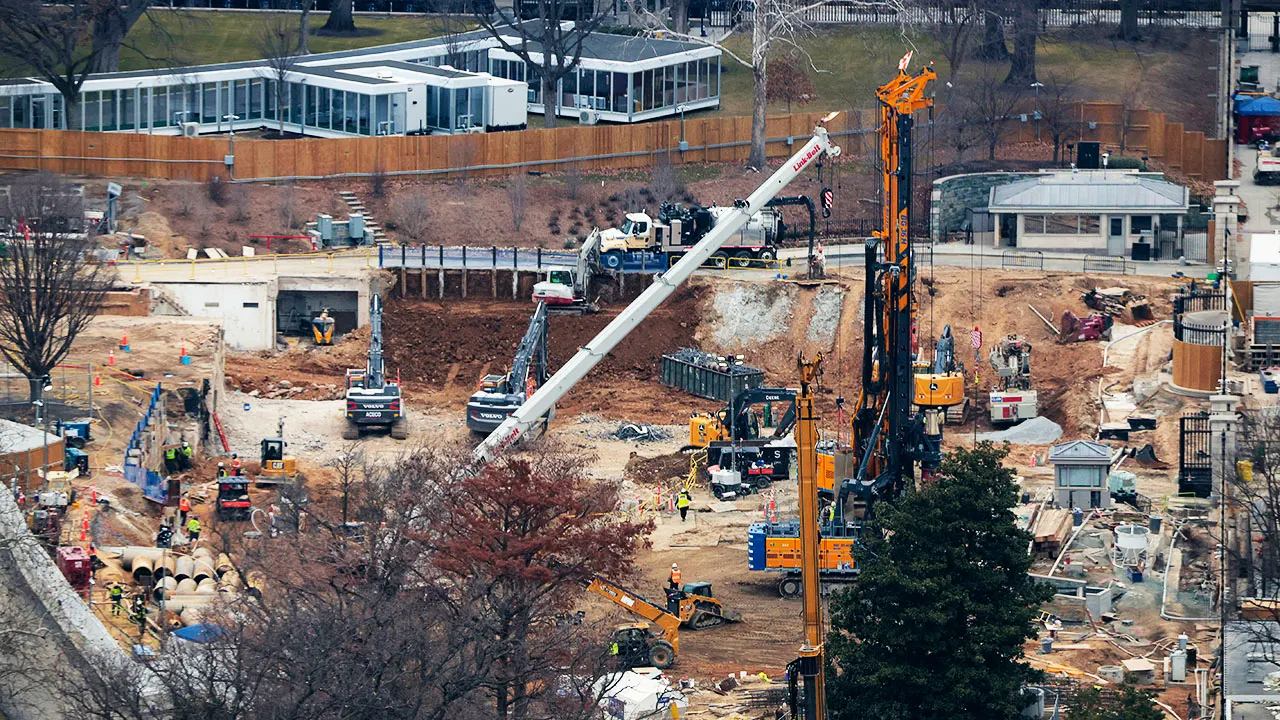
The sprawling 90,000-square-foot space is already under construction and is expected to cost more than $200 million. The administration previously stated that funding would come from Trump himself and private donors, rather than taxpayer money—a significant private investment in a federal landmark.
White House Press Secretary Karoline Leavitt announced the ballroom project on July 31, citing practical needs for the addition. “The White House is currently unable to host major functions honoring world leaders in other countries without having to install a large and unsightly tent approximately 100 yards away from the main building’s entrance,” Leavitt said during a press briefing.
The new ballroom will seat approximately 650 guests, providing a permanent, elegant solution for state dinners and diplomatic functions that have traditionally required temporary structures on the White House grounds.
The ballroom represents one of several architectural initiatives Trump has pursued since returning to office. Drawing on his background as a real estate developer, the president has launched multiple projects aimed at transforming Washington’s iconic landmarks and government buildings.
Just last weekend, Trump announced that the newly renamed Trump Kennedy Center will close later this year for a two-year renovation. In October, he unveiled plans for a monument commemorating America’s 250th anniversary in 2026—a structure inspired by Paris’s Arc de Triomphe that will welcome visitors crossing the Memorial Bridge from Arlington National Cemetery.
The White House itself has already undergone several Trump-directed aesthetic changes during his current term. These include adding golden accents to the Oval Office, installing a “walk of fame” along the colonnade outside the Oval Office, renovating the Lincoln bathroom, making changes to the Rose Garden, and placing two large American flags on the White House grounds.
The ballroom project stands out as the most substantial of these modifications, representing a permanent addition to the historic executive mansion that has served as the presidential residence since 1800. Architectural historians note that while the White House has been expanded several times throughout its history—including major renovations under Presidents Truman, Roosevelt, and Coolidge—the addition of a formal ballroom of this scale would be unprecedented.
Critics have questioned the appropriateness of such significant changes to historic federal properties, while supporters view the improvements as enhancing America’s ability to host world leaders with appropriate grandeur. The architectural style appears designed to complement the White House’s existing neoclassical aesthetic, maintaining visual consistency with the original building.
The administration has not announced an expected completion date for the ballroom, though construction is already underway.
Fact Checker
Verify the accuracy of this article using The Disinformation Commission analysis and real-time sources.

10 Comments
Replicating the North Facade of the White House as part of the new ballroom design is an interesting architectural choice. I’d be interested to hear more about the rationale behind that decision.
Overall, this is a significant and high-profile investment in the White House grounds. It will be important to ensure that it is carried out with transparency and accountability.
The $200 million price tag for this ballroom expansion is quite substantial. I’d be interested to know more about the private funding sources and how that process will be handled transparently.
Using private donations to fund a major public works project at the White House raises some questions about potential conflicts of interest or undue influence. Oversight will be crucial.
This is an ambitious and expensive project. I’m curious to see how it will be received by the public and whether it will live up to the administration’s claims of serving the country well for centuries to come.
Replacing the East Wing with a large new ballroom structure seems like a dramatic change. I wonder if there are concerns about preserving the historical integrity of the White House campus.
Architecturally, the design seems to aim for a grand, iconic look that matches the existing White House. But I wonder how functional and practical the new ballroom will be for events and gatherings.
Replacing the East Wing entirely is a bold move. I hope the new ballroom is thoughtfully integrated with the rest of the White House complex in terms of flow and accessibility.
A 90,000-square-foot ballroom is an enormous space. I’m curious to see how the administration plans to utilize it and whether it will meet a real need, or if it’s more of a vanity project.
Given the scale and cost of this project, I hope there is robust public input and scrutiny throughout the planning and construction process.