


Listen to the article
President Trump used his State of the Union address on Tuesday to honor extraordinary military courage, awarding the Medal of Honor to two American servicemen whose acts of valor span decades of U.S. military operations.
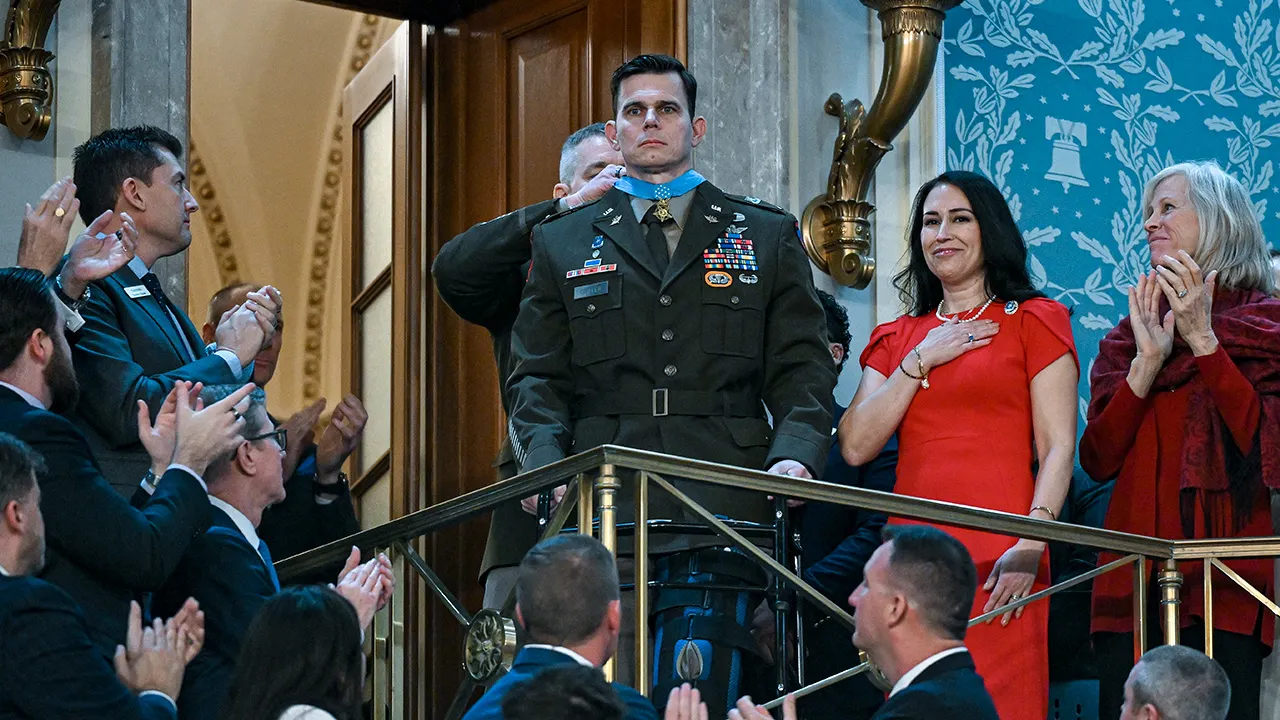
In an emotional ceremony during the address, U.S. Army Chief Warrant Officer Eric Slover received the nation’s highest military decoration for his heroism during a high-risk January raid targeting Venezuelan leader Nicolás Maduro.
According to the president’s account, Slover was piloting a Chinook helicopter transporting American forces into heavily fortified enemy territory under the cover of darkness when the aircraft came under intense machine gun fire from multiple directions.
“There were many heroes on that January raid to capture Maduro. Really great heroes. It was very dangerous,” Trump told lawmakers, describing the perilous mission that represents one of the administration’s most significant military operations in the Western Hemisphere.
Trump detailed how Slover maintained control of the aircraft despite sustaining severe injuries. “He absorbed four agonizing shots, shredding his leg into numerous pieces,” the president said, explaining that “the success of the entire mission and the lives of his fellow warriors hinged on Eric’s ability” to keep flying as blood “poured down the aisle” of the helicopter.
Slover, who is still recovering from his wounds, attended the State of the Union with his wife, Amy. His actions during the Venezuela operation underscore the administration’s more aggressive posture toward the Maduro regime, which the United States has long accused of human rights violations and anti-democratic practices.
The January raid targeting Maduro marks a significant escalation in U.S. policy toward Venezuela, which has suffered through years of economic collapse and political instability. While details of the operation remain classified, military analysts suggest it represents one of the most direct American interventions in Latin American affairs in recent decades.
In a move highlighting the timeless nature of military sacrifice, Trump also bestowed the Medal of Honor upon 100-year-old retired Navy Captain E. Royce Williams for extraordinary combat valor during a long-classified aerial battle from the Korean War.
Williams’ remarkable story remained hidden for decades due to Cold War sensitivities. In 1952, while flying a single F9F Panther jet from the USS Oriskany, Williams engaged and shot down four Soviet MiG-15 fighters during a 35-minute dogfight over the Sea of Japan. He accomplished this remarkable feat despite being heavily outnumbered and piloting an aircraft considered inferior in both speed and climbing ability.
At the time, the U.S. government classified the encounter to avoid escalating tensions with the Soviet Union, which was not officially acknowledged as a combatant in the Korean War. Williams’ heroism remained unrecognized for more than 70 years until his actions were finally declassified and formally acknowledged.
First Lady Melania Trump presented Williams with the medal as members of Congress from both parties rose in extended applause. The recognition of Williams’ actions represents the culmination of a years-long effort by military historians and veterans groups to secure proper recognition for his extraordinary courage.
The back-to-back Medal of Honor presentations underscored the administration’s emphasis on military service and provided rare moments of bipartisan unity during an otherwise politically charged address. As the presidential election season intensifies, Trump’s focus on military achievements highlights a core theme of his presidency and campaign messaging.
Military analysts note that the public recognition of these operations—particularly the Venezuela mission—signals the administration’s willingness to take more direct military action in regions traditionally considered within America’s sphere of influence. The raid targeting Maduro represents a significant departure from the diplomatic and economic pressure that has characterized much of U.S. policy toward Venezuela in recent years.
Trump’s address, which broke the record for the longest State of the Union in modern history, used these powerful personal stories to frame broader policy discussions on national security and America’s role in global affairs.
Fact Checker
Verify the accuracy of this article using The Disinformation Commission analysis and real-time sources.

27 Comments
Silver leverage is strong here; beta cuts both ways though.
The cost guidance is better than expected. If they deliver, the stock could rerate.
I like the balance sheet here—less leverage than peers.
Good point. Watching costs and grades closely.
Nice to see insider buying—usually a good signal in this space.
Good point. Watching costs and grades closely.
Good point. Watching costs and grades closely.
If AISC keeps dropping, this becomes investable for me.
Good point. Watching costs and grades closely.
The cost guidance is better than expected. If they deliver, the stock could rerate.
If AISC keeps dropping, this becomes investable for me.
Good point. Watching costs and grades closely.
Good point. Watching costs and grades closely.
If AISC keeps dropping, this becomes investable for me.
Good point. Watching costs and grades closely.
Good point. Watching costs and grades closely.
Silver leverage is strong here; beta cuts both ways though.
Good point. Watching costs and grades closely.
Uranium names keep pushing higher—supply still tight into 2026.
Good point. Watching costs and grades closely.
Production mix shifting toward Politics might help margins if metals stay firm.
Good point. Watching costs and grades closely.
Interesting update on Trump Presents Consecutive Medals of Honor During State of the Union Address. Curious how the grades will trend next quarter.
Good point. Watching costs and grades closely.
Good point. Watching costs and grades closely.
Silver leverage is strong here; beta cuts both ways though.
Good point. Watching costs and grades closely.