


Listen to the article
President Trump and Netanyahu Discuss Joint Strikes on Iran as Tensions Escalate
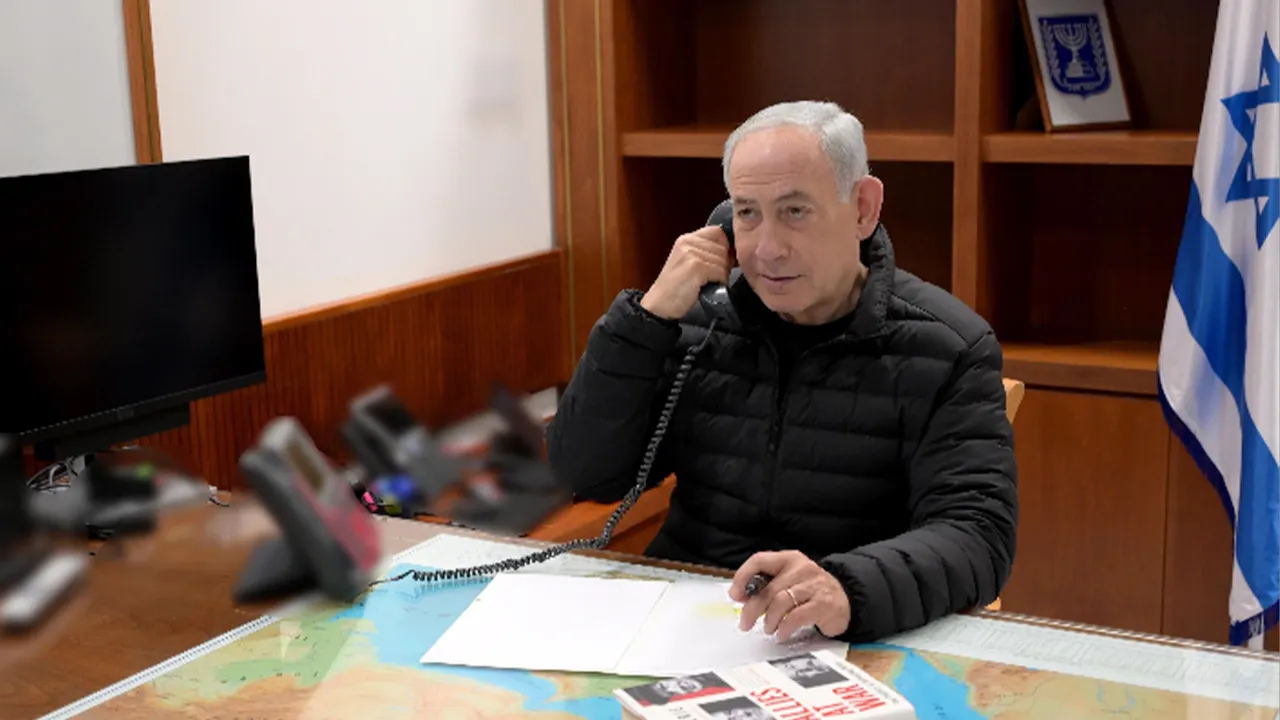
President Donald Trump spoke with Israeli Prime Minister Benjamin Netanyahu on Saturday following the launch of coordinated military strikes against Iran, according to White House Press Secretary Karoline Leavitt. The call came after a significant escalation in Middle East tensions that has drawn both support and criticism from U.S. lawmakers.
“President Trump monitored the situation overnight at Mar-a-Lago alongside members of his national security team,” Leavitt stated in a post on X. She confirmed that Trump had directly communicated with Prime Minister Netanyahu as operations unfolded.
In the early hours of Saturday morning, at approximately 2:30 a.m. Eastern Standard Time, Trump announced the military action through a video message on Truth Social. In a remarkable direct address to Iranian citizens, the President urged them to “seize control of your destiny” and suggested the strikes presented an opportunity for regime change.
“Stay sheltered. Don’t leave your home. It’s very dangerous outside. Bombs will be dropping everywhere. When we are finished, take over your government. It will be yours to take,” Trump stated in his message. “This will be, probably, your only chance for generations.”
The administration appears to have followed protocol regarding congressional notification. Secretary of State Marco Rubio provided briefings to the “Gang of Eight,” a bipartisan group of congressional intelligence leaders. According to Leavitt, Rubio “was able to reach and brief seven of the eight members” prior to the military action.
However, the operation has received pushback from some congressional leaders, particularly Democrats. Representative Jim Himes (D-Conn.), the ranking member on the House Intelligence Committee, released a strongly worded statement criticizing the strikes.
“Everything I have heard from the administration before and after these strikes on Iran confirms this is a war of choice with no strategic endgame,” Himes wrote. “Military action in this region almost never ends well for the United States, and conflict with Iran can easily spiral and escalate in ways we cannot anticipate.”
The military action comes after months of rising tensions with Iran. In June, the U.S. had previously launched strikes targeting aspects of Iran’s nuclear program, followed by a period of negotiations. The Trump administration had been clear in its demands that the Iranian regime must completely dismantle its nuclear infrastructure or face consequences.
The latest strikes appear to target multiple locations within Iran, with a focus on nuclear facilities and sites associated with the Islamic Revolutionary Guard Corps (IRGC). Iran has already launched retaliatory missile strikes against U.S. bases across the Middle East, according to military officials, marking a significant escalation in the conflict.
Regional security experts note that this direct confrontation between the U.S. and Iran represents one of the most serious military engagements between the two countries in decades. Oil prices have already begun to rise in response to the conflict, with analysts warning of potential disruptions to global energy markets if hostilities continue or expand.
In his address to the Iranian people, Trump framed the military action as support for potential internal change in Iran. “For many years, you have asked for America’s help, but you never got it. No President was willing to do what I am willing to do tonight. Now you have a President who is giving you what you want,” he stated.
The White House has indicated that Trump and his national security team will “continue to closely monitor the situation throughout the day” as events unfold. Military analysts suggest the coming hours will be critical in determining whether this exchange of strikes will escalate into a broader conflict or whether diplomatic channels might be engaged to de-escalate tensions.
Fact Checker
Verify the accuracy of this article using The Disinformation Commission analysis and real-time sources.

7 Comments
I’m curious to learn more about the specific targets and objectives of these strikes. Were they focused on Iranian military assets, nuclear facilities, or something else? The rhetoric about regime change is also concerning and could inflame tensions further.
The call between Trump and Netanyahu is significant, given their close personal and political ties. However, this raises concerns about potential conflicts of interest and whether broader US interests are being prioritized. Transparency around the decision-making process would be helpful in evaluating the merits of these actions.
It’s troubling to see the President monitoring this from his Mar-a-Lago resort. One would hope the highest levels of US leadership would be fully engaged in such a serious and delicate situation, not vacationing at a private club. This raises questions about the decision-making process and crisis management.
The coordination between the US and Israel on this strike is noteworthy. Netanyahu has long pushed for a harder line against Iran, so his involvement is not surprising. However, this raises questions about the broader geopolitical implications and whether this will further destabilize the region.
You raise a good point. The US-Israel alliance is a critical factor here, and it will be important to understand how this action fits into their broader strategic calculus vis-à-vis Iran.
This is certainly a major escalation in the ongoing tensions between the US and Iran. While the details are still unfolding, it’s concerning to see both sides ratcheting up the military actions. I hope diplomacy can prevail to deescalate the situation and avoid further bloodshed.
This situation is highly complex, with competing narratives and interests at play. While I understand the desire to take action against perceived threats, I worry that military strikes could lead to unintended consequences and a cycle of escalation. Careful diplomacy and de-escalation should be the priority.