


Listen to the article
NATO Chief to Meet with Trump Amid Alliance Tensions Over Iran War
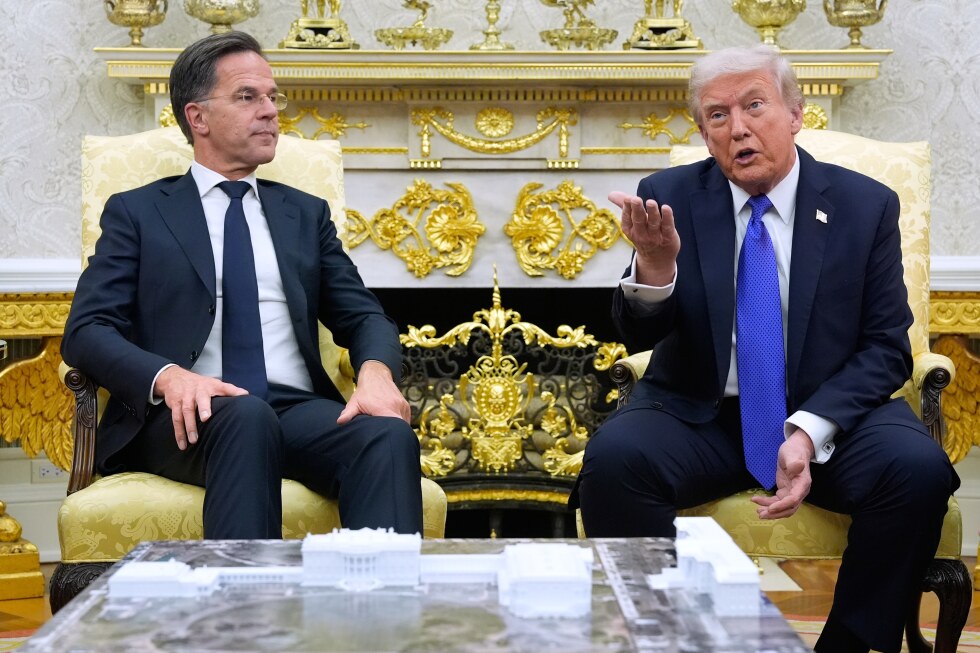
NATO Secretary-General Mark Rutte is scheduled to meet with President Donald Trump on Wednesday in Washington to address growing tensions between the U.S. and the military alliance over its response to the ongoing Iran conflict.
The closed-door meeting comes after Trump suggested the United States might consider withdrawing from the 75-year-old alliance after NATO member countries did not heed his call to help reopen the Strait of Hormuz, which Iran effectively closed, causing global gas prices to surge.
This diplomatic encounter takes place against the backdrop of a newly agreed two-week ceasefire between the U.S. and Iran announced late Tuesday. The fragile agreement includes provisions for reopening the vital shipping waterway and follows escalating rhetoric from Trump, who had threatened to strike Iran’s power plants and bridges, warning that “a whole civilization will die tonight.”
The plan to reopen the Strait of Hormuz remains unclear and is expected to dominate discussions between Trump and Rutte, with whom the president has previously maintained cordial relations. While the White House indicated the meeting would be private, the Trump administration has a history of opening such discussions to the press at the last minute.
Trump’s frustration with NATO predates the current conflict. Throughout his first term, he repeatedly criticized the alliance, established in 1949 as a bulwark against Soviet expansion. His renewed threats of withdrawal come despite congressional action in 2023 that legally prevents any U.S. president from pulling out of NATO without legislative approval.
The core of NATO’s collective security agreement is Article 5, which establishes that an attack on one member nation constitutes an attack on all 32 member countries. This provision has only been invoked once in NATO’s history—following the September 11, 2001, terrorist attacks on the United States.
Despite receiving this historic support, Trump has repeatedly complained during the current conflict that NATO has abandoned America. “Go to the strait and just take it,” Trump demanded last week, insisting that securing the Strait of Hormuz should not be America’s sole responsibility but rather the duty of countries dependent on its oil flows.
Republican Senate Minority Leader Mitch McConnell issued a statement Tuesday night defending the alliance, pointedly noting that “NATO allies sent their young servicemembers to fight and die alongside America’s own in Afghanistan and Iraq” after 9/11. McConnell urged Trump to be “clear and consistent,” adding that it’s not in America’s interest to “spend more time nursing grudges with allies who share our interests than deterring adversaries who threaten us.”
The relationship between the U.S. and NATO has already been strained over the past year as Trump returned to office, scaled back military support for Ukraine in its war against Russia, and even threatened to seize Greenland from Denmark, a NATO ally.
Trump’s irritation intensified when NATO members Spain and France restricted the use of their airspace and military facilities for U.S. operations in the Iran conflict. However, these and other nations have agreed to participate in an international coalition to secure the Strait of Hormuz once hostilities end.
British Prime Minister Keir Starmer, who has been a particular target of Trump’s criticism, plans to travel to the Gulf region Wednesday to support the ceasefire. The United Kingdom is currently developing a post-conflict security plan for the strait, a narrow waterway between Iran and Oman through which approximately one-fifth of the world’s oil supply passes.
If Rutte fails to address Trump’s concerns, questions remain about whether the administration would challenge the law prohibiting unilateral withdrawal from NATO. Notably, the legislation was championed by Trump’s current Secretary of State, Marco Rubio, during his time as a senator from Florida.
The outcome of Wednesday’s meeting could have significant implications for the future of transatlantic security cooperation and the stability of global energy markets as the Iran conflict enters this new, uncertain phase.
Fact Checker
Verify the accuracy of this article using The Disinformation Commission analysis and real-time sources.

6 Comments
The ceasefire between the U.S. and Iran is a positive step, but the situation remains fragile. Reopening the Strait of Hormuz will be a key focus, given its critical importance for global energy markets.
Interesting to see the tensions between the U.S. and NATO over the Iran conflict. Maintaining a unified alliance will be crucial, especially with the volatile situation in the Strait of Hormuz.
This meeting comes at a pivotal moment for the future of NATO. The alliance needs to demonstrate unity and strength, especially with the Iran situation escalating. I’m interested to see what transpires.
Trump’s past cordial relations with Rutte may help, but there are clearly deep divisions within NATO over how to handle the Iran crisis. I hope they can find common ground and a way forward.
Withdrawing from NATO would be a major geopolitical shift. I’m curious to see how Trump and Rutte navigate these complex alliance dynamics and find a way to keep the coalition together.
Agreed. NATO is an important bulwark against global instability, so finding a diplomatic solution is crucial.