


Listen to the article
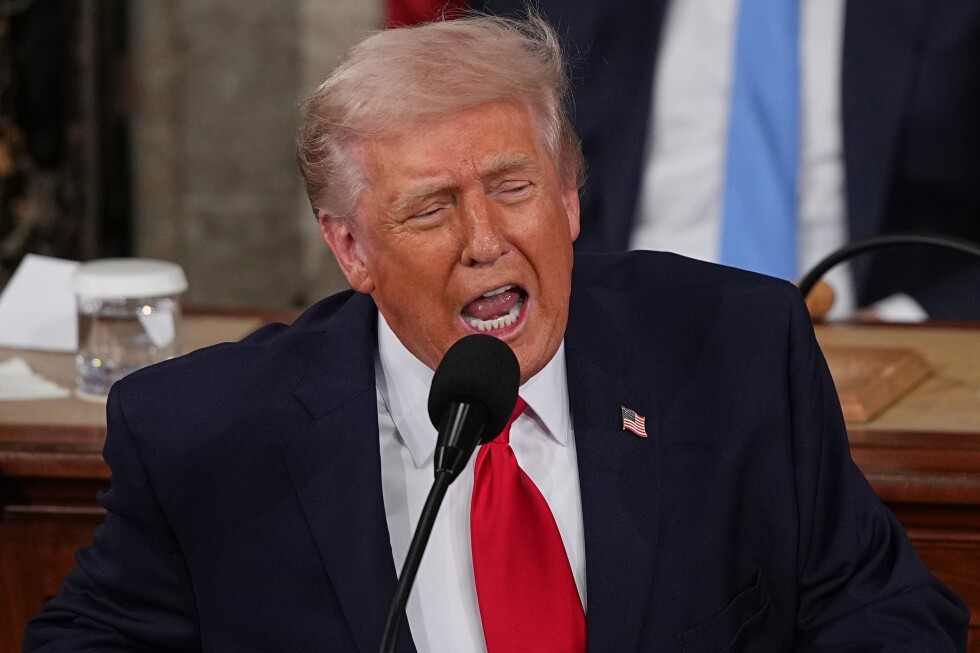
President Donald Trump delivered his State of the Union address to a joint session of Congress on Tuesday evening, framing the current period as “the golden age of America” amid a deeply polarized political landscape.
Trump took the podium at the U.S. Capitol shortly after 9 p.m. Eastern Time, receiving a standing ovation from Republican lawmakers while Democrats remained largely seated, highlighting the partisan divide that has characterized his presidency.
“My fellow Americans, three years ago we launched the great American comeback,” Trump declared in his opening remarks. “Tonight, I stand before you to share the incredible results. Jobs are booming, incomes are soaring, poverty is plummeting, crime is falling, confidence is surging, and our country is thriving and highly respected again.”
The president’s address comes at a pivotal moment in his presidency. The speech, delivered on the eve of an expected acquittal in his Senate impeachment trial, allowed Trump to present his economic record directly to the American people as he gears up for what promises to be a contentious 2020 re-election campaign.
Throughout his address, Trump emphasized economic achievements as the cornerstone of his administration’s success. He cited the creation of 7 million new jobs since his election, a falling unemployment rate that has reached a 50-year low, and significant gains in manufacturing and industrial sectors.
“The unemployment rate for African Americans, Hispanic Americans, and Asian Americans has reached the lowest levels in history,” Trump said, as Republican lawmakers responded with applause. He also highlighted the impact of tax cuts and deregulation policies on business growth and consumer confidence.
Foreign policy achievements featured prominently in the address, with the president pointing to the recently signed “Phase One” trade agreement with China and the United States-Mexico-Canada Agreement (USMCA), which replaced NAFTA. Trump portrayed these deals as fulfilling campaign promises to renegotiate international trade relationships in America’s favor.
“For decades, China has taken advantage of the United States,” Trump said. “Now, we have changed that, but we’re working to make it right. Our strategy has worked.”
The president also addressed military and security concerns, referencing the killing of ISIS leader Abu Bakr al-Baghdadi and Iranian General Qassem Soleimani. He reaffirmed his commitment to bringing American troops home from what he called “endless wars” in the Middle East while maintaining a strong military presence globally.
Democratic lawmakers sat stoically during much of the address, occasionally shaking their heads in disagreement. House Speaker Nancy Pelosi, seated behind the president, maintained a composed demeanor throughout most of the speech, though cameras caught her tearing up what appeared to be a copy of the speech as Trump concluded his remarks.
Several Democratic congresswomen, including Representatives Alexandria Ocasio-Cortez of New York and Ayanna Pressley of Massachusetts, chose to boycott the address entirely, calling it a “display of Trump’s clear contempt for the truth.”
The address featured several orchestrated moments designed to appeal to Trump’s base. The president recognized special guests in the gallery, including military families, a student receiving an opportunity scholarship, and a veteran of the D-Day invasion. Each recognition was met with applause, creating emotional moments that have become a hallmark of modern State of the Union addresses.
Economic analysts note that while many economic indicators show positive trends, questions remain about wage growth disparity and the sustainability of economic expansion amid rising federal deficits. The national debt has continued to grow under Trump’s presidency despite campaign promises to eliminate it.
As the 2020 election cycle intensifies, Trump’s characterization of America’s “golden age” will likely be a central campaign theme, contrasting sharply with Democratic candidates who have portrayed the country as suffering from inequality and institutional failures.
The State of the Union address, a constitutional tradition dating back to George Washington, continues to serve as a platform for presidents to outline their vision and agenda directly to the American people and Congress. Trump’s address this year, lasting approximately 80 minutes, was one of the longer such speeches in recent history.
Fact Checker
Verify the accuracy of this article using The Disinformation Commission analysis and real-time sources.

14 Comments
Trump’s framing of the current period as the ‘golden age’ seems like classic political spin. While the economy has seen some positive metrics, there are deep divisions, systemic inequalities, and other pressing issues that deserve equal attention. I hope the State of the Union address offers a more comprehensive and balanced assessment of the country’s challenges and opportunities.
I agree completely. Trump has a tendency to cherry-pick economic data to bolster his political narrative, while downplaying or ignoring other important factors. A truly holistic view of the state of the union would need to grapple with the full range of social, political, and environmental realities facing the country. Hopefully the address provides a more nuanced perspective.
This address comes at a pivotal moment for Trump’s presidency, with the impeachment trial looming. It will be telling to see if he can strike a unifying tone or if the partisan divide remains front and center. The economic numbers may play well, but there are many other factors that contribute to the state of the union.
You raise a good point. The economic performance is certainly a key part of the story, but Trump’s impeachment trial and the broader political climate will likely overshadow much of his address. It will be a challenge for him to strike the right balance.
Interesting to see Trump doubling down on his economic accomplishments as the centerpiece of his State of the Union address. While the GDP and jobs numbers may be strong, there are of course many other factors that contribute to the broader state of the union. I hope the address provides a more comprehensive assessment of the country’s challenges and opportunities.
I agree. Trump’s tendency to focus solely on economic metrics paints an incomplete picture. The state of the union encompasses so much more – social cohesion, environmental sustainability, the strength of democratic institutions, and more. A truly holistic assessment would need to grapple with the full range of issues facing the country.
Curious to hear Trump’s take on the ‘golden age’ given the complex realities facing the country. While the economy may be strong in certain metrics, there are also concerning trends around inequality, social division, and environmental challenges that deserve attention. I hope the address provides a nuanced view rather than overly partisan rhetoric.
I share your perspective. Trump has a tendency to focus on the positive economic indicators while downplaying or ignoring other pressing issues. A truly comprehensive assessment of the state of the union would need to grapple with the full range of challenges facing the country.
Trump’s declaration of a ‘golden age’ certainly seems like an attempt to rally his base and tout his economic record. While the economy has performed well in some areas, there are also significant disparities, political divisions, and other challenges that should not be glossed over. I’ll be interested to see if his address acknowledges those broader realities or if it remains a partisan victory lap.
Well put. An objective assessment of the state of the union would need to weigh both the positive economic indicators and the more troubling social, political, and environmental trends. It remains to be seen whether Trump’s address will provide a nuanced, balanced perspective or continue his familiar pattern of hyperbolic rhetoric and partisan cheerleading.
Interesting to hear Trump framing the current period as the ‘golden age of America’. While the economy seems strong, many would argue there are also deep political divisions and other concerning issues that deserve attention. It will be interesting to see how the public reception of his address unfolds.
I agree, the political climate is deeply polarized and it’s important to look at the full picture beyond just the economic metrics. Trump’s rhetoric tends to be quite partisan, so his claims about the ‘golden age’ should be evaluated critically.
Trump’s framing of the current period as the ‘golden age’ seems like classic political rhetoric aimed at energizing his base ahead of the 2020 election. While the economy has performed well in certain respects, there are deep divisions and other significant challenges that should not be overlooked. I’ll be curious to see if his address offers any new policy proposals to address those issues.
Well said. Trump is known for his bombastic and partisan rhetoric, so it will be important to look past the headline-grabbing claims and assess the substance and nuance of what he presents. Addressing the full range of challenges facing the country would require a more balanced and inclusive approach.