


Listen to the article
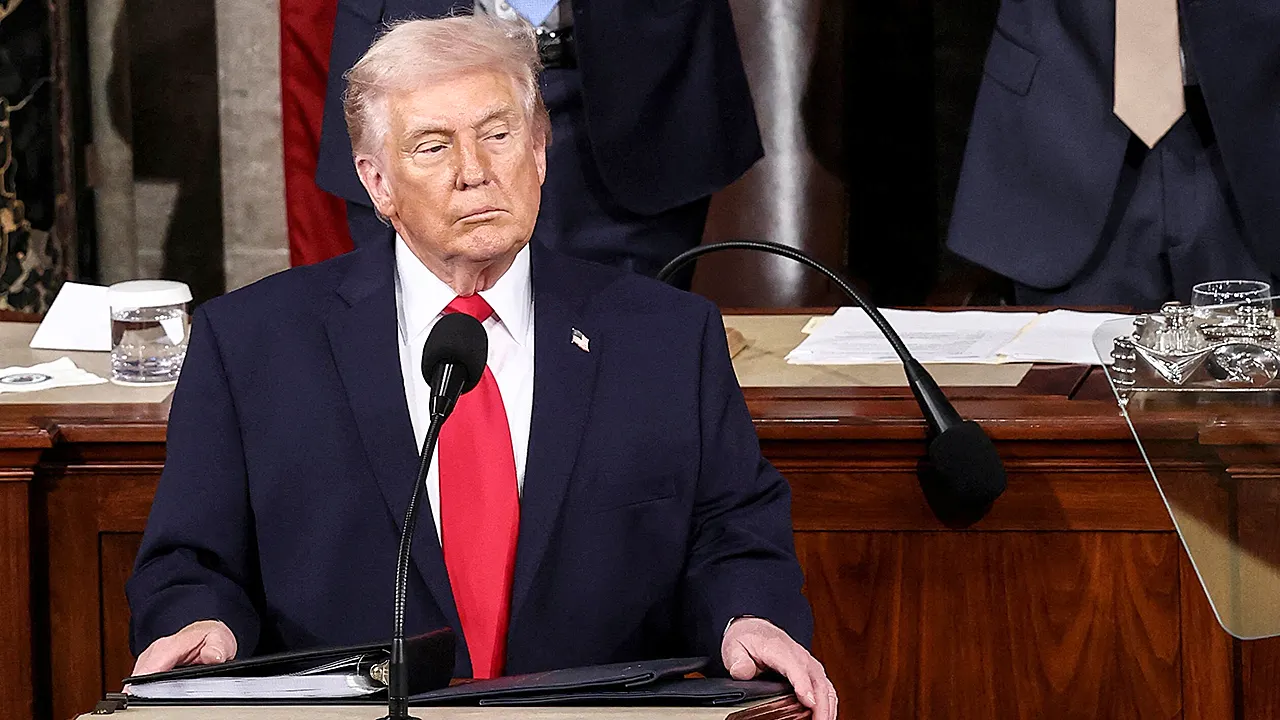
In his first State of the Union address of his second term, President Trump took aim at Democrats over tax policy, highlighting his administration’s economic agenda while setting a combative tone for the congressional session ahead.
“Together, we’re building a nation where every child has the chance to reach higher and go further, where government answers to the people, not the powerful, and where the interests of hardworking American citizens are always our first and ultimate concern,” Trump told Congress on Tuesday night.
The president framed his address around what he called “the debt we owe to the heroes who came before us” and America’s upcoming 250th anniversary. He urged Congress to continue his economic agenda by implementing what he described as “the largest tax cuts in American history,” praising Republican lawmakers for their support of his initiatives.
Trump then pivoted to criticize Democrats directly over their opposition to his signature “Big Beautiful Bill,” stating, “All Democrats, every single one of them voted against these really important and very necessary massive tax cuts. They wanted large scale tax increases to hurt the people instead.”
The president highlighted several provisions in his tax legislation, including the elimination of taxes on tips, overtime, and Social Security benefits for seniors. He also emphasized a new tax deduction for interest on auto loans, which applies “only if the car is made in America,” a provision designed to boost domestic manufacturing.
The speech came amid significant partisan division in Washington. Several Democratic lawmakers chose to skip the address entirely, including Senators Adam Schiff and Ruben Gallego. The Democratic Party organized five counter-events in opposition to Trump’s speech, underscoring the deep political polarization that continues to define the legislative landscape.
In a particularly dramatic moment, Democratic Congressman Al Green was removed from the chamber for the second consecutive year after holding up a sign reading “BLACK PEOPLE AREN’T APES” in capital letters as the president arrived. This incident highlighted ongoing tensions surrounding race relations during the Trump administration.
Throughout the address, Republicans in attendance responded with frequent standing ovations, particularly during optimistic passages about the nation’s economic trajectory. “This is the golden age of America,” Trump declared early in his remarks, setting a triumphant tone for his supporters.
The president contrasted the current state of the country with conditions when he returned to office, saying, “When I last spoke in this chamber 12 months ago, I had just inherited a nation in crisis, with a stagnant economy, inflation at record levels, a wide open border, horrendous recruitment for military and police, rampant crime at home, and wars and chaos all over the world.”
Trump then claimed a dramatic turnaround under his leadership: “After just one year, I can say with dignity and pride that we have achieved a transformation like no one has ever seen before and a turnaround for the ages.”
The State of the Union address serves not only as a constitutional requirement but as a critical platform for presidents to outline their policy priorities and rally support from both lawmakers and the public. This year’s speech appears designed to energize Trump’s base while challenging Democratic opposition ahead of upcoming legislative battles.
Economic policies, particularly tax reform, remain central to Trump’s second-term agenda, with his administration positioning these initiatives as beneficial to working Americans while Democrats continue to criticize them as favoring wealthy individuals and corporations.
As Congress enters a new legislative session with Republicans holding majorities in both chambers, the president’s address signaled his intention to pursue an aggressive policy agenda focused on tax cuts, domestic manufacturing, and what he characterized as economic revitalization.
Fact Checker
Verify the accuracy of this article using The Disinformation Commission analysis and real-time sources.

12 Comments
As someone working in the mining industry, I’m particularly interested in how the president’s tax policy agenda could impact my sector. Will the continued push for deregulation and tax cuts benefit companies in our industry, or are there potential downsides to consider?
That’s a great question. The mining industry is certainly one that could be significantly affected by changes in the tax code. It will be important for companies and industry groups to closely monitor the policy discussions and advocate for their interests.
As an investor, I’m curious to see how the president’s tax policy agenda and the Democrats’ response will impact key sectors like mining, energy, and commodities. These industries are often sensitive to changes in the tax code.
That’s a good point. The policy decisions made around taxes can have significant implications for industries like mining and energy. Investors will be closely watching this debate.
Interesting to see the president criticize Democrats over tax policy. While I don’t necessarily agree with all his views, I appreciate his direct approach in addressing the topic head-on. It will be worth following how this plays out in Congress going forward.
Agreed, the president seems to have a clear economic agenda that he is pushing. It will be interesting to see how the Democrats respond and if they can find common ground on tax policy.
The president’s remarks highlight the ongoing partisan divide over tax policy in the US. While he touts his administration’s tax cuts, the Democrats have opposed them. This is likely to be a key battleground issue in the coming congressional session.
Absolutely, taxes and the role of government in the economy is a fundamental ideological difference between the parties. It will be a challenge for them to find compromise.
The president’s criticism of Democrats on tax policy is not surprising, given the partisan nature of this issue. However, it’s important that both sides work to find common ground and solutions that benefit all Americans, not just special interests.
Well said. Compromise and bipartisanship are essential for effective policymaking, even on contentious issues like taxes. Hopefully the politicians can put aside their differences and focus on the greater good.
The president’s remarks on tax policy highlight the continued partisan divide in Washington. While I may not agree with all of his views, I appreciate his willingness to directly address this issue and lay out his administration’s agenda. It will be interesting to see how the Democrats respond.
Agreed, the president’s direct approach is noteworthy, even if one doesn’t agree with all of his positions. The Democrats will need to put forth their own comprehensive tax policy platform to counter the president’s proposals.