


Listen to the article
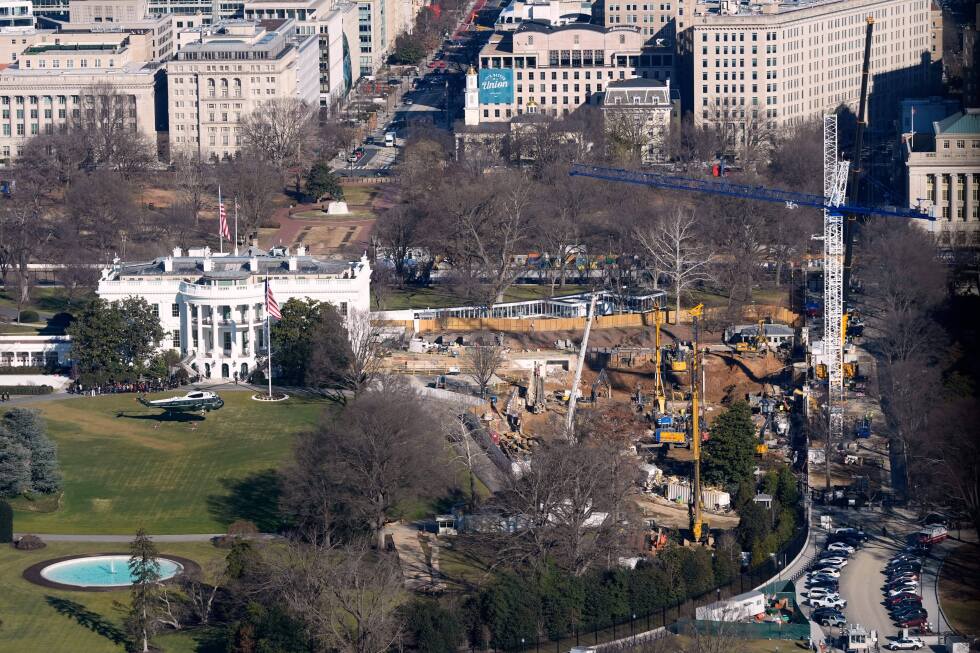
Some of Donald Trump’s handpicked appointees who have a say in his White House ballroom project raised questions Thursday about its “immense” design and scale, while still broadly endorsing the president’s vision for a massive expansion.
During the Commission on Fine Arts discussion, which included a review of mostly negative public comments, commissioners showed no immediate opposition to Trump’s overall plan. However, the meeting highlighted the political controversy surrounding the project since the president approved the demolition of the East Wing and unveiled designs that would more than double the White House’s previous square footage.
“This is an important thing to the president. It’s an important thing to the nation,” said the commission’s new chairman, Rodney Mims Cook Jr., in the panel’s first public hearing on Trump’s proposal.
Cook acknowledged longstanding concerns about White House event space, noting, “You can’t have the United States of America entertaining people in tents.” He emphasized the challenge was determining “if we can do this in a way that this building remains” true to its fundamental character while addressing “what the president wants us to do.”
After lead architect Shalom Baranes presented renderings during the online meeting, commissioners requested 3D scale models of the White House complex with the proposed addition for a future in-person session. Baranes confirmed the models would include the U.S. Treasury Department building and the Eisenhower Executive Office Building that flank the presidential mansion.
The scale of the project has raised significant concerns. Baranes confirmed the total addition would be almost 90,000 square feet, with the ballroom itself accounting for 22,000 square feet. For context, the White House was approximately 55,000 square feet before the East Wing, originally built in 1902 and expanded in the 1940s, was demolished.
Thomas Luebke, the commission’s executive director, reported that public comments received ahead of the meeting were “almost all” negative “in some way,” criticizing either the process, the design, or both. Even comments that praised certain design elements still noted that “the scale appears oversized, making the main structure dominated.”
Addressing these criticisms, Baranes emphasized that current plans call for setting back the addition’s north boundary from the existing North Portico, with the top of the new structure aligned with the primary facade of the White House residence. This design choice aims to preserve the view of the White House from Pennsylvania Avenue.
“It’s immense,” Cook told Baranes regarding the proposed 10-column, multistory porch on the south side of the addition that resembles the Treasury Department more than the White House. “If the president just wants cover, do you think you might be able to tone down that element?”
The architect responded: “We looked at ways of covering it at different scales with different numbers of columns, and there’s a president’s desire to proceed with this one.”
The meeting was part of a series with the Fine Arts panel and the National Capital Planning Commission, both of which play critical roles in approving federal construction projects in Washington.
Meanwhile, historic preservationists have taken legal action to halt the $400 million project. U.S. District Judge Richard Leon heard arguments Thursday from attorneys representing the government and the National Trust for Historic Preservation but didn’t issue an immediate ruling. Leon, a George W. Bush appointee, indicated he hopes to decide on the request for a preliminary injunction next month, though he acknowledged his decision will likely face appeals.
The plaintiff’s attorney, Thad Heuer, argued that the president—a temporary occupant of the White House—required congressional approval before initiating a project of this magnitude and cost. “He isn’t the landlord,” Heuer said. “He is a steward.”
In response, government lawyer Jacob Roth contended that the president possesses statutory authority and broad discretion to modify the White House. He warned that halting the project midway would create problems, including security concerns for the president. “I don’t think there’s any question that this modernization is in the public’s interest,” Roth told the judge.
While the legal challenge progresses, the Trump administration remains committed to the project. White House spokesman Davis Ingle stated, “President Trump is working 24/7 to Make America Great Again, including his historic beautification of the White House.”
Fact Checker
Verify the accuracy of this article using The Disinformation Commission analysis and real-time sources.

10 Comments
While the president’s desire for a larger and more modern event space is understandable, the commission must carefully weigh the historical significance and visual integrity of the White House. Any proposed changes should be meticulously evaluated to ensure they don’t compromise the building’s iconic status.
Agreed. The White House is a national treasure, and its architectural identity should be the guiding principle, not just the administration’s preferences. The commission has a responsibility to uphold the building’s legacy.
I’m curious to hear more about the specific design plans and how they would impact the overall aesthetic of the White House. While the president’s vision may be grand, the commission should carefully evaluate whether it aligns with the building’s architectural integrity.
Absolutely. Seeing physical models and renderings will be crucial for assessing the visual impact of any proposed changes. Transparency and public input will also be important in this process.
Interesting to see the debate around the scale and design of the White House ballroom project. While the president’s vision is ambitious, it’s important to balance that with preserving the historic character of the building. Curious to see how the commission navigates this challenge.
Agreed, it’s a delicate balance. The White House is an iconic landmark, so any changes need to be carefully considered.
The White House ballroom project is clearly a high-profile and politically charged issue. I hope the commission can approach it in an objective, non-partisan manner, focusing on preserving the building’s historic character while addressing the president’s stated needs.
That’s a good point. Maintaining a balanced, non-partisan perspective will be key, even with the political sensitivities involved. The commission’s role should be to provide thoughtful, expert guidance on the architectural implications.
The White House is more than just a building – it’s a symbol of American democracy. Any proposed expansions or renovations should be approached thoughtfully to ensure they complement the existing architecture and don’t detract from the structure’s historical significance.
Well said. Preserving the White House’s character and legacy should be the top priority, even as the administration looks to address long-standing event space challenges.