


Listen to the article
A massive sewage spill in the Potomac River has escalated into a political confrontation between President Donald Trump and Maryland Governor Wes Moore, as an estimated 240 million gallons of waste continue to contaminate one of the region’s most vital waterways.
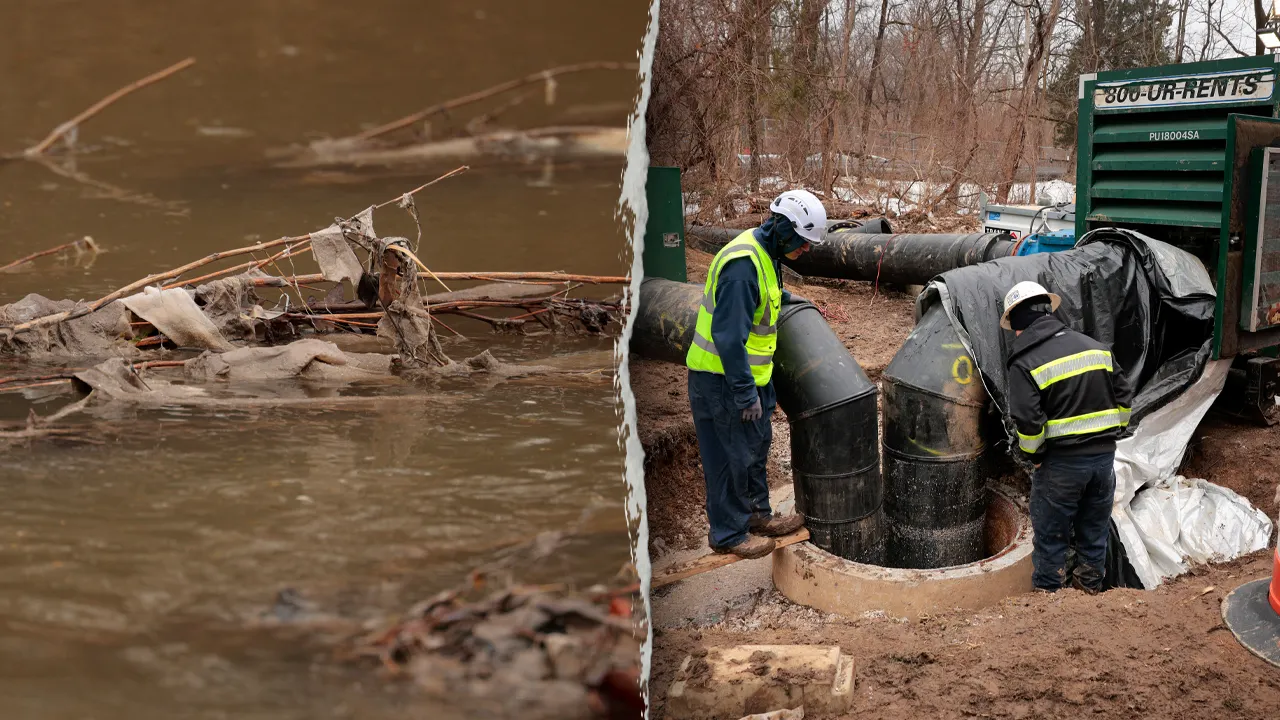
The rupture in a major sewage pipe interceptor near Cabin John, Maryland, was first detected on security cameras along the Clara Barton Parkway on January 19. DC Water crews have since redirected much of the spillage into the paralleling Chesapeake & Ohio Canal to minimize the environmental impact.
The damaged infrastructure normally transports wastewater from communities near Dulles International Airport to Washington’s Blue Plains Advanced Wastewater Treatment Plant in Anacostia. The failure has instead sent untreated sewage directly into the Potomac River, causing E. coli levels to surge dramatically.
President Trump took to Truth Social late Monday to announce federal intervention, characterizing the situation as “a massive ecological disaster” resulting from “gross mismanagement of local Democrat leaders, particularly Governor Wes Moore, of Maryland.”
“I am directing Federal Authorities to immediately provide all necessary Management, Direction, and Coordination to protect the Potomac, the Water Supply in the Capital Region, and our treasured National Resources in our Nation’s Capital City,” Trump stated. He added that he “cannot allow incompetent Local ‘Leadership’ to turn the River in the Heart of Washington into a Disaster Zone.”
The President also referenced the prolonged timeline and ballooning costs associated with rebuilding the collapsed Francis Scott Key Bridge on the Baltimore Beltway, suggesting it demonstrates a pattern of administrative failure under Moore’s leadership.
Moore’s administration swiftly countered Trump’s assertions. Spokesperson Ammar Moussa claimed the President had his “facts wrong—again,” emphasizing that “the federal government has been responsible for the Potomac Interceptor, which is the origin of the sewage leak” since the last century.
“For the last four weeks, the Trump Administration has failed to act, shirking its responsibility and putting people’s health at risk,” Moussa said. He noted that the President’s Environmental Protection Agency “explicitly refused to participate” in a recent legislative hearing about cleanup efforts.
The environmental impacts extend well beyond the immediate spill area. Maryland’s Department of Environment has issued an emergency closure for shellfish harvesting as far south as the Harry Nice Bridge, approximately 60 miles downstream from Washington, where U.S. 301 crosses between Maryland and Virginia.
Maryland state Delegate Linda Foley, whose district lies just upstream from the spill, characterized the situation during an Annapolis hearing as “one of the worst ecological disasters in the eastern part of the United States.”
The jurisdictional complexity complicates response efforts. Unlike most waterways that serve as state boundaries, Maryland controls nearly the entire Potomac River rather than sharing jurisdiction with Virginia down the center line.
Trump also mentioned that the Federal Emergency Management Agency (FEMA) will coordinate response efforts, though he noted the agency is currently affected by a partial government shutdown impacting the Department of Homeland Security, meaning many workers may go unpaid during the crisis response.
David Gadis, CEO of DC Water, addressed public concerns in an open letter, acknowledging that the Potomac River is a “shared treasure” and that “any event that threatens its health understandably causes concern, frustration, and a sense of loss.” He outlined the utility’s priorities as “containment, environmental monitoring, and stabilization,” and emphasized ongoing coordination with partners at all levels of government.
As remediation efforts continue, the sewage spill has become the latest flashpoint in an increasingly tense relationship between federal and state authorities, with the health of a crucial waterway and the region’s drinking water supply hanging in the balance.
Fact Checker
Verify the accuracy of this article using The Disinformation Commission analysis and real-time sources.

17 Comments
If AISC keeps dropping, this becomes investable for me.
Nice to see insider buying—usually a good signal in this space.
Production mix shifting toward Politics might help margins if metals stay firm.
Uranium names keep pushing higher—supply still tight into 2026.
Good point. Watching costs and grades closely.
Uranium names keep pushing higher—supply still tight into 2026.
I like the balance sheet here—less leverage than peers.
Exploration results look promising, but permitting will be the key risk.
Good point. Watching costs and grades closely.
Interesting update on Trump Announces Federal Response to Potomac Sewage Spill, Criticizes Maryland Governor. Curious how the grades will trend next quarter.
Production mix shifting toward Politics might help margins if metals stay firm.
Good point. Watching costs and grades closely.
Good point. Watching costs and grades closely.
I like the balance sheet here—less leverage than peers.
If AISC keeps dropping, this becomes investable for me.
Good point. Watching costs and grades closely.
Good point. Watching costs and grades closely.