


Listen to the article
Trump Escalates Pressure on European Leaders in Greenland Acquisition Bid
President Donald Trump has intensified diplomatic pressure on European leaders as he pursues the acquisition of Greenland, with French President Emmanuel Macron becoming a particular focus of his negotiating tactics. The strategic maneuvering has unfolded during Trump’s recent attendance at the World Economic Forum in Davos, Switzerland, where global leaders gathered to discuss international economic issues.
Prior to a breakthrough announced Wednesday, Trump had threatened to impose escalating tariffs on eight European nations if no agreement on Greenland was reached by February 1. The proposed tariffs would have started at 10% on goods from Denmark, France, Germany, Finland, the Netherlands, Norway, Sweden, and the United Kingdom, potentially increasing to 25% by June if negotiations remained stalled.
“All the United States is asking for is a place called Greenland,” Trump declared during his Davos address, emphasizing America’s historical connection to the territory. “Where we’ve already had it as a trustee, but respectfully returned it back to Denmark not long ago after we defeated the Germans, the Japanese, the Italians and others in World War II.”
The president has framed the potential acquisition as a matter of national security, citing Greenland’s strategic position between the United States, Russia, and China. “No nation or group of nations is in any position to be able to secure Greenland other than the United States,” Trump asserted during his speech.
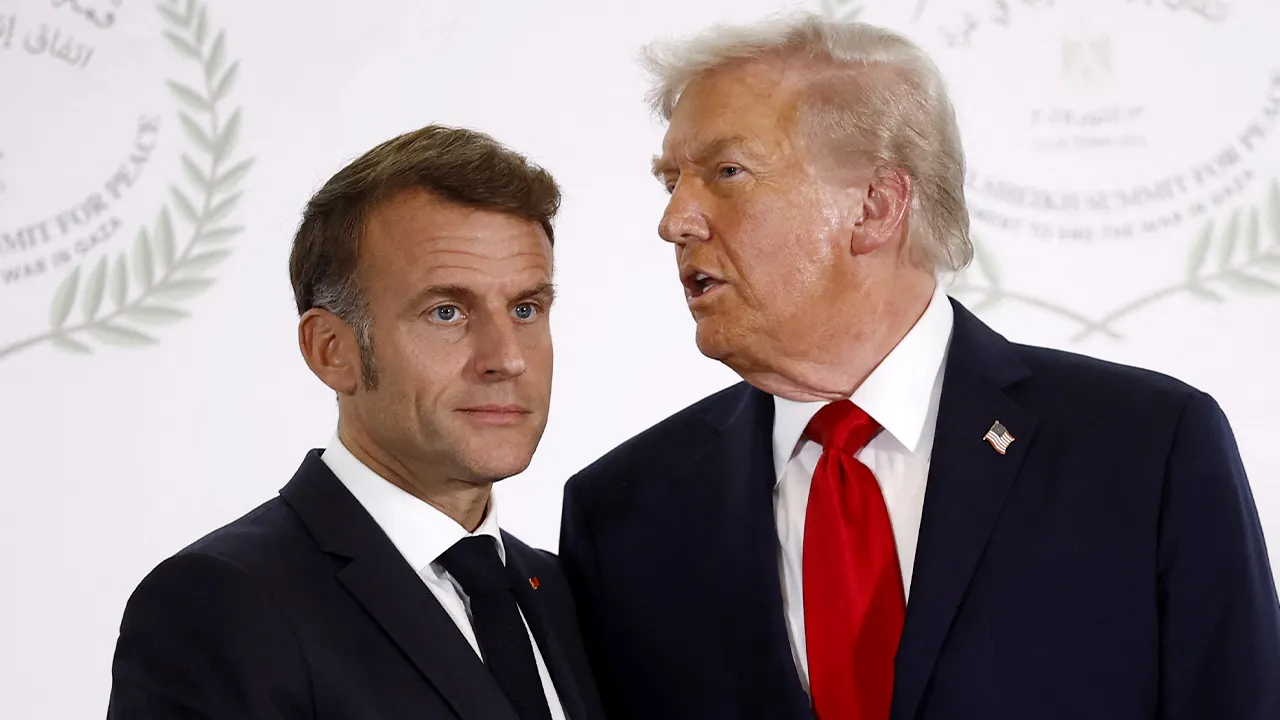
In what appears to be a calculated diplomatic tactic, Trump has repeatedly singled out Macron in public forums. During a January 6 meeting with House Republican lawmakers, Trump imitated the French leader’s accent while recounting past negotiations over drug prices. He performed a similar impression during a White House healthcare roundtable on January 16, demonstrating what he characterized as his “deal-maker-in-chief” approach.
Tensions escalated when Trump publicly shared private text messages from Macron on social media. In the revealed message, Macron expressed confusion about Trump’s Greenland initiative, writing: “I do not understand what you are doing on Greenland.” When questioned about publishing the private communication, Trump told The New York Post, “It just made my point. They’re saying, ‘Oh gee, let’s have dinner, let’s do this, let’s do that.’ It just made my point.”
The French president has pushed back against Trump’s approach. Speaking at Davos, Macron pledged that France would stand up to “bullies” and called U.S. threats to impose tariffs for territorial gain “fundamentally unacceptable.”
“Competition from the United States of America through trade agreements that undermine our export interests, demand maximum concessions, and openly aim to weaken and subordinate Europe,” Macron said, “combined with an endless accumulation of new tariffs that are fundamentally unacceptable – even more so when they are used as leverage against territorial sovereignty.”
Further friction emerged when Macron declined Trump’s invitation to join the Gaza Board of Peace, a new oversight body related to the Gaza peace plan developed by the Trump administration in 2025. The French president’s office stated that the proposal “raises serious questions, in particular with respect to the principles and structure of the United Nations, which cannot be called into question.”
Trump responded forcefully to the rejection, suggesting he could “put a 200% tariff on his wines and champagnes and he’ll join,” while also inaccurately claiming Macron would soon leave office. Macron’s term actually extends until 2027, although he cannot run for a third consecutive term under French law.
A potential breakthrough emerged Wednesday when Trump announced he would delay implementing the threatened tariffs, citing progress in negotiations. “Based upon a very productive meeting that I have had with the Secretary General of NATO, Mark Rutte, we have formed the framework of a future deal with respect to Greenland and, in fact, the entire Arctic Region,” Trump wrote on Truth Social.
The Greenland negotiations are occurring against a backdrop of other international developments, including the U.S. military’s capture of Venezuelan dictator Nicolás Maduro and his wife in early January, which preceded intensified discussions about acquiring the Arctic territory from Denmark.
As the February 1 deadline approaches, global markets remain watchful of how these high-stakes diplomatic negotiations will unfold and what the economic implications might be for transatlantic trade relations.
Fact Checker
Verify the accuracy of this article using The Disinformation Commission analysis and real-time sources.

10 Comments
Greenland has significant strategic value in terms of natural resources and Arctic positioning. The US is clearly keen to expand its influence in the region, but Denmark and the EU will likely resist ceding control of the territory.
This negotiation will be an interesting test of wills between the US and Europe. Both sides have important interests at stake, so I expect tough bargaining ahead.
This is an intriguing development in the global race for Arctic dominance. Greenland’s resources and geostrategic location make it a prime target, but the US will have to tread carefully to avoid alienating its European partners.
The US is clearly determined to gain more influence in the Arctic region. But the potential fallout from a trade war with Europe is a major risk factor that Trump will have to weigh carefully.
The US push for Greenland underscores the growing geopolitical tensions over the Arctic as climate change opens up new economic opportunities. It will be fascinating to see how this high-stakes negotiation unfolds between the Trump administration and European leaders.
This is a delicate balancing act for the US. Greenland’s value is clear, but antagonizing key European allies could backfire strategically. Trump will need to find a diplomatic solution that works for all sides.
This is an interesting geopolitical move by the US, leveraging trade as a bargaining chip to acquire Greenland. It will be important to see how European leaders respond and whether they are willing to negotiate on this sensitive territorial issue.
It seems like a high-stakes gambit by Trump, using tariffs as leverage. I wonder how this will impact broader US-EU relations if negotiations become protracted.
Acquiring Greenland would be a major geopolitical win for the US, but the price tag of potential trade wars with key European allies is very high. Trump is really putting his negotiating skills to the test here.
It’s a bold move by Trump, but I’m curious to see if he can pull it off without seriously damaging US-EU relations. The strategic value of Greenland may not be worth that cost.