


Listen to the article
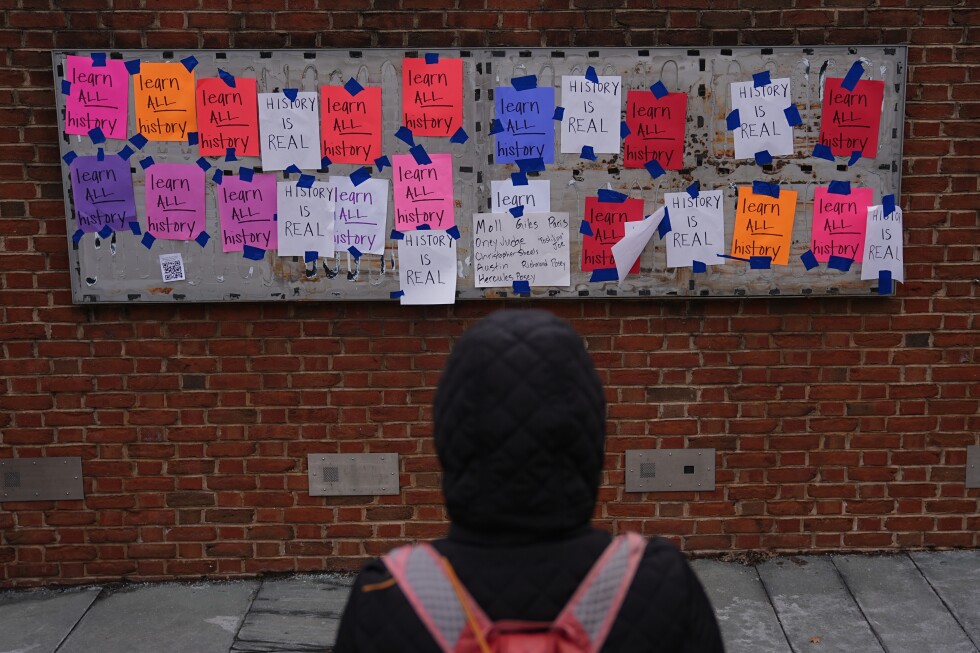
On Presidents Day, a federal judge ordered the Trump administration to restore an exhibit about nine enslaved people owned by George Washington at his former Philadelphia residence, following its removal last month.
Judge Cynthia Rufe ruled that the National Park Service must reinstate the explanatory panels at Independence National Historical Park while a legal challenge to their removal continues. The site marks where George and Martha Washington lived with their slaves in the 1790s when Philadelphia briefly served as the nation’s capital.
The city of Philadelphia filed suit in January after park officials removed the panels in response to a Trump executive order aimed at “restoring truth and sanity to American history.” The order directed the Interior Department to ensure national sites do not display elements that “inappropriately disparage Americans past or living.”
In her strongly worded ruling, Judge Rufe, a George W. Bush appointee, invoked George Orwell’s “1984,” comparing the administration’s actions to the novel’s totalitarian Ministry of Truth. “This Court is now asked to determine whether the federal government has the power it claims — to dissemble and disassemble historical truths when it has some domain over historical facts,” she wrote. “It does not.”
During a January hearing, Rufe had characterized Justice Department arguments as “dangerous” and “horrifying” when government lawyers asserted that Trump officials could selectively choose which aspects of U.S. history to display at National Park Service sites.
The Philadelphia exhibit is one of several sites where the administration has quietly removed content about enslaved people, LGBTQ+ individuals, and Native Americans. Similar removals have occurred at Grand Canyon National Park, where signage discussing how settlers displaced Native American tribes was taken down, and at the Stonewall National Monument, where a rainbow flag was recently removed and references to transgender people deleted from official webpages.
Created about two decades ago through collaboration between Philadelphia and federal officials, the exhibit included biographical information about each of Washington’s nine enslaved individuals, including Oney Judge and Hercules, both of whom eventually escaped to freedom.
Judge was born into slavery at Washington’s Mount Vernon plantation and escaped from the Philadelphia house in 1796, fleeing to New Hampshire. Washington had her declared a fugitive and published advertisements seeking her capture. Hercules escaped in 1797 after being taken to Mount Vernon, eventually reaching New York City where he lived under the name Hercules Posey.
The historical significance of the site extends beyond the presidential narrative. In 2022, the National Park Service supported including the location in a national network of Underground Railroad sites due to Judge’s escape, making the removal particularly problematic. Judge Rufe noted that removing materials about Judge “conceals crucial information linking the site to the Network to Freedom.”
When park service employees removed the exhibit on January 22, they used crowbars to take down the plaques, leaving only the names of the enslaved individuals—Austin, Paris, Hercules, Richmond, Giles, Moll, Joe, Christopher Sheels, and Oney Judge—engraved in a cement wall.
The Interior Department did not immediately respond to requests for comment on the ruling, which was delivered while government offices were closed for the Presidents Day holiday. Federal officials may appeal the decision, though the judge did not specify a timeline for the exhibit’s restoration.
The ruling was celebrated by local politicians and Black community leaders, many of whom had gathered at the site to rally for the exhibit’s return. State Representative Malcolm Kenyatta, a Philadelphia Democrat, framed the decision as a victory against attempts to “whitewash our history.”
“Philadelphians fought back, and I could not be more proud of how we stood together,” Kenyatta said, highlighting the community’s resistance to what many viewed as an erasure of important historical truths about slavery in early America.
Fact Checker
Verify the accuracy of this article using The Disinformation Commission analysis and real-time sources.

6 Comments
Interesting that the Trump administration tried to remove this historical exhibit on Washington’s slaves. Glad the courts stepped in to restore it – we shouldn’t whitewash or downplay the realities of slavery in America’s founding.
While the Trump administration may have wanted to avoid “inappropriately disparaging” the nation’s history, erasing exhibits about slavery is simply rewriting the past to suit a particular agenda. We must confront all aspects of our history, not selectively curate it.
This ruling highlights the importance of preserving honest historical narratives, even when they’re uncomfortable. Removing educational displays about slavery and its role in shaping America is a disservice to the public.
I agree. Hiding or minimizing the uncomfortable truths of history does nothing to advance our understanding or promote reconciliation.
Good to see the courts stepping in to protect historical accuracy and transparency, even when it paints an unflattering picture of figures like Washington. Learning from the full scope of our history is essential for progress.
This ruling is a win for truth and accountability. Trying to scrub away the realities of slavery and its role in America’s founding is misguided and dangerous. We must face our past honestly if we hope to build a more just future.