


Listen to the article
Conservation Groups Sue Trump Administration Over Alleged Censorship in National Parks
Conservation and historical organizations have filed a lawsuit against the Trump administration, alleging that National Park Service policies are systematically removing historically accurate and scientifically valid exhibits from America’s national parks.
The lawsuit, filed in Boston, claims that directives from President Donald Trump and Interior Secretary Doug Burgum have forced park service staff to censor or remove exhibits about slavery, climate change, and other topics deemed politically sensitive. According to the plaintiffs, these actions violate the parks’ educational mission and public trust.
In a parallel legal action, LGBTQ+ rights advocates and historic preservationists sued the park service for removing a rainbow Pride flag from the Stonewall National Monument in New York, a site commemorating a pivotal moment in the modern LGBTQ+ rights movement. The flag, installed in 2022, was the first Pride banner to fly permanently on federal land.
The disputed changes stem from Trump’s executive order aimed at “restoring truth and sanity to American history” at national museums, parks, and landmarks. The order directed the Interior Department to ensure these sites do not display elements that “inappropriately disparage Americans past or living.” Following this directive, Burgum ordered the removal of what he termed “improper partisan ideology” from public exhibits under federal control.
According to the lawsuit, the campaign to review interpretive materials has intensified recently, resulting in the removal of numerous exhibits addressing slavery, civil rights, Indigenous peoples’ history, and climate science—what the plaintiffs describe as “core elements of the American experience.”
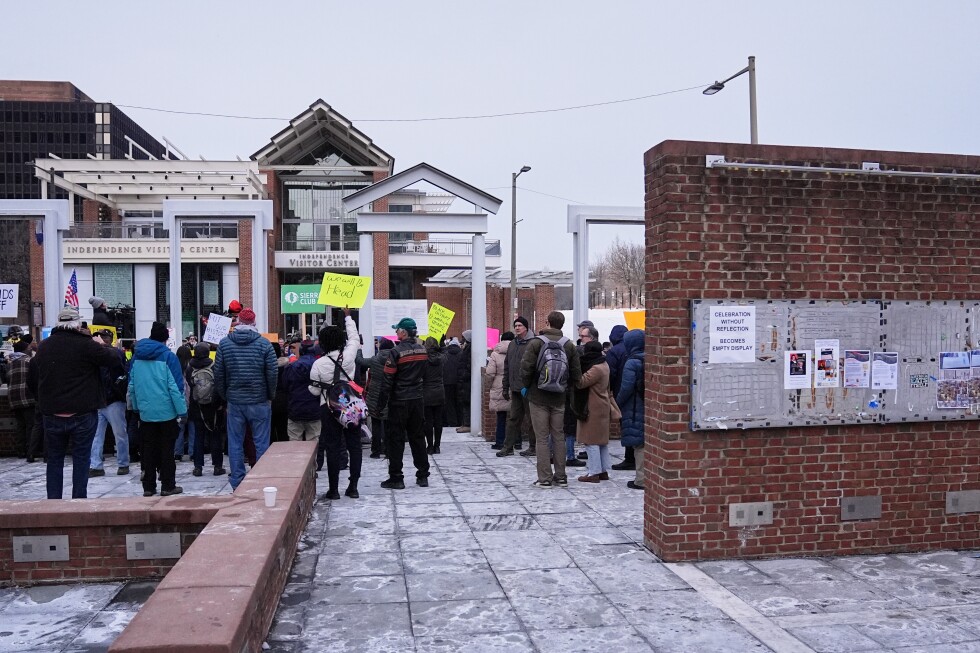
The legal action comes on the heels of a federal judge’s order requiring the restoration of an exhibit about nine people enslaved by George Washington at his former home in Philadelphia. U.S. District Judge Cynthia Rufe, an appointee of Republican President George W. Bush, issued the order on Presidents Day. In her written decision, Rufe quoted George Orwell’s “1984” and compared the Trump administration’s actions to the novel’s totalitarian Ministry of Truth.
Beyond Philadelphia, the plaintiffs cite numerous other examples of concerning removals. At the Selma to Montgomery National Historic Trail in Alabama, officials have reportedly flagged approximately 80 items for removal. The permanent exhibit at Brown v. Board of Education National Historical Park in Kansas has been targeted because it mentions “equity.” At Grand Canyon National Park, signage describing how Native American tribes were pushed “off their land” for the park’s establishment has disappeared. At Glacier National Park in Montana, materials explaining the effects of climate change and its role in the disappearance of glaciers have reportedly been ordered removed.
“Censoring science and erasing America’s history at national parks are direct threats to everything these amazing places, and our country, stand for,” said Alan Spears, senior director of cultural resources at the National Parks Conservation Association, one of the organizations behind the lawsuit.
The coalition of plaintiffs includes the National Parks Conservation Association, American Association for State and Local History, Association of National Park Rangers, and Union of Concerned Scientists.
The Interior Department has appealed the court’s ruling in the Philadelphia case, claiming that updated interpretive materials “providing a fuller account of the history of slavery at Independence Hall would have been installed in the coming days” had the court not intervened.
White House spokeswoman Taylor Rogers dismissed the new lawsuit as premature and “based on inaccurate and mischaracterized information,” stating that while the Department of the Interior is reviewing exhibits “in accordance with the president’s executive order,” actions have not yet been finalized.
Regarding the Stonewall flag removal, the park service cited a January memo limiting the agency to displaying Interior and POW/MIA flags, with exemptions for providing “historical context.” The lawsuit argues that the Pride flag provided such context and notes that the park service continues to make exceptions for other banners, including Confederate flags, that help explain certain sites’ history.
Jeff Mow, who retired in 2022 as superintendent at Glacier National Park, expressed concern about the impact of Trump’s order on the Park Service’s educational mission. “The park service has always taken great pride in its scholarly research, its focus on telling the truth,” he said, calling the order a “disservice” to the public.
“You cannot tell the story of America without recognizing both the beauty and the tragedy of our history,” said Skye Perryman, president and CEO of Democracy Forward, which filed the lawsuit on behalf of the advocacy groups.
Fact Checker
Verify the accuracy of this article using The Disinformation Commission analysis and real-time sources.

15 Comments
While I’m generally wary of overly partisan rhetoric, the alleged actions do seem to align with a broader pattern of the current administration downplaying or distorting scientific and historical facts. Objective assessments are crucial.
I’m curious to learn more about the specific changes being made and the rationale behind them. While scientific and historical accuracy is crucial, there may be nuances we’re missing. A balanced, fact-based approach is needed.
That’s a good point. We should withhold judgment until more details emerge. Transparent public dialogue on these matters is important for maintaining trust in our national park system.
As someone who enjoys visiting national parks, I’m troubled by these reports. The parks should be bastions of truth and education, not political battlegrounds. I hope a resolution can be found that restores public trust.
I share your sentiment. Our national parks belong to all Americans, and their purpose should transcend partisan agendas. Finding a nonpartisan path forward is essential.
This issue underscores the importance of robust civic engagement and oversight when it comes to our public lands. We the people have a stake in ensuring our national parks uphold democratic values of openness and truth.
Lawsuits can be a blunt instrument, but if the allegations are substantiated, they may be necessary to protect the integrity of our national parks. I hope this leads to meaningful reforms, not just short-term fixes.
Well said. The stakes are high, and the outcome of this case could set an important precedent for the future management of our parks and public spaces.
This is a complex issue with valid concerns on multiple sides. While I’m generally skeptical of broad claims of censorship, the specifics of the alleged changes warrant careful scrutiny. Transparency and fairness should be the guiding principles.
Concerning if true. Our national parks should accurately reflect history and science, not censor inconvenient facts. I hope this lawsuit leads to a fair and transparent review process for exhibit changes.
Agreed. Censorship in our public lands would be a troubling development. Let’s hope the courts can provide some much-needed oversight and accountability.
The removal of the Pride flag from the Stonewall National Monument is particularly concerning. That site holds immense historical significance for the LGBTQ+ community. Erasing that representation sets a troubling precedent.
I agree. Commemorating diverse histories and identities is vital for an inclusive, representative park system. Any moves to whitewash that should be strongly opposed.
As someone with a background in environmental science, I’m deeply troubled by any attempts to remove or distort scientific information in our national parks. Those spaces should be beacons of factual, evidence-based education.
I agree wholeheartedly. Our national parks must uphold the highest standards of scientific integrity and educational mission, regardless of political winds. Anything less is a betrayal of their purpose.