


Listen to the article
The Trump administration has formally removed the lesser prairie chicken from federal protection, siding with three states and industries that argued the bird was improperly listed under the Endangered Species Act. The U.S. Fish and Wildlife Service announcement on Thursday confirms a recent Texas court ruling that effectively ended federal safeguards for the species.
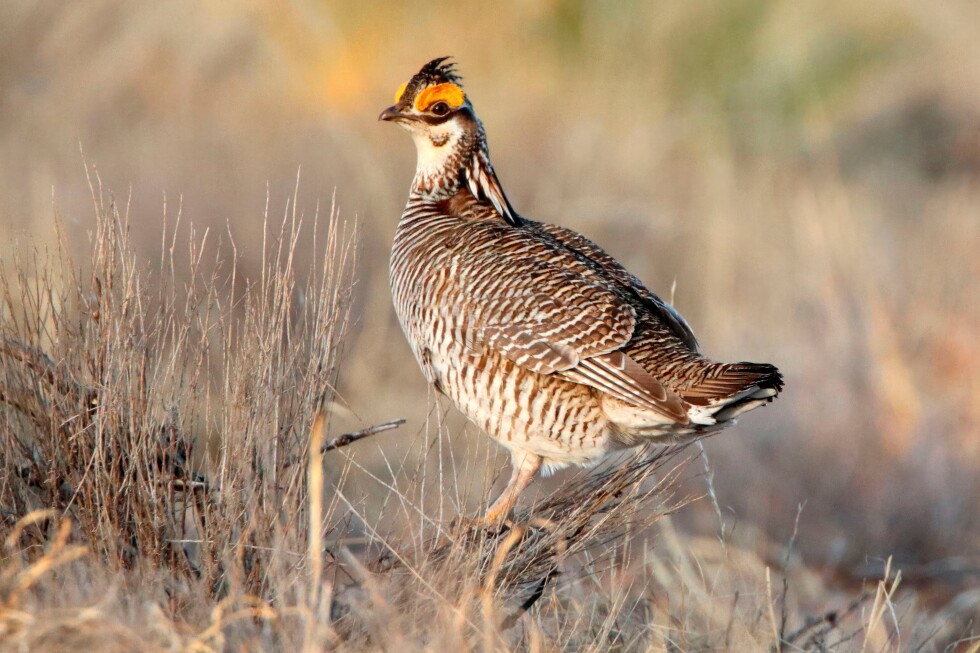
Once numbering in the millions, the ground-dwelling bird is now reduced to approximately 30,000 across parts of Colorado, Kansas, New Mexico, Oklahoma, and Texas. The species is known for its elaborate mating dances, where males perform distinctive warbling, clucking, and stomping displays to attract females—rituals that wildlife enthusiasts prize and that have inspired traditional dances among Native American tribes.
The lesser prairie chicken’s path to protection has been fraught with legal challenges. In 2014, it was initially listed as threatened, but that designation was overturned by a federal judge in Midland, Texas in 2015 after petroleum developers successfully argued that existing conservation measures were sufficient.
In 2022, the Biden administration attempted to reinstate protections, classifying the bird as threatened in the northern parts of its range across Colorado, Kansas, Oklahoma, and Texas, while designating it as endangered in southern populations in New Mexico and Texas.
This action prompted immediate legal pushback from Kansas, Oklahoma, and Texas, alongside industry groups including the Permian Basin Petroleum Association and National Cattlemen’s Beef Association, which challenged the listing.
After President Trump took office in 2023, the Fish and Wildlife Service reassessed its position and ultimately conceded that it lacked justification for separating the lesser prairie chicken into two distinct population segments—a key foundation of the Biden-era protection strategy.
U.S. District Judge David Counts, presiding in Midland, formalized this reversal in an August ruling, writing that “Fish and Wildlife’s concession points to serious error at the very foundation of its rule.” The decision was celebrated by Texas officials, including the state’s oil and gas regulatory authorities.
Texas Land Commissioner Dawn Buckingham praised the delisting in a statement, saying, “It will ensure American oil and gas production in the Permian Basin remains robust and our economy steadfast.”
The Permian Basin, which spans parts of western Texas and southeastern New Mexico, is one of the most productive oil and gas regions in the United States, producing over 5 million barrels of oil per day. Industry stakeholders have long maintained that endangered species protections place undue burdens on energy development in the region.
When protected, landowners, energy companies, and ranchers were required to implement measures to avoid disrupting the birds’ habitat, particularly their breeding grounds. These requirements included limitations on development during mating seasons and mandatory buffer zones around leks, the specialized areas where mating displays occur.
Conservation biologists have documented steady declines in lesser prairie chicken populations due to habitat fragmentation and loss. Agricultural expansion, oil and gas development, and renewable energy projects have all contributed to the diminishing grassland habitat these birds require.
Environmental organizations have expressed dismay at the decision. Jason Rylander, legal director at the Center for Biological Diversity’s Climate Law Institute, vowed to continue the legal fight, stating, “It’s shameful that the Trump administration sees fit to sacrifice these magnificent birds for oil and gas industry profit. Lesser prairie chickens may be lost forever without Endangered Species Act protections.”
The delisting represents another chapter in the ongoing tension between economic development and wildlife conservation in the American West, where multiple use mandates for public lands often pit extractive industries against environmental protection. Wildlife advocates argue that without federal intervention, voluntary conservation efforts are unlikely to reverse the species’ decline.
Fact Checker
Verify the accuracy of this article using The Disinformation Commission analysis and real-time sources.

14 Comments
The delisting of the lesser prairie chicken is disappointing. This unique bird with its elaborate mating dances deserves protection, especially as its population has declined so dramatically. Balancing conservation with industry needs is always a challenge, but we must do more to preserve vulnerable species.
I agree, the loss of biodiversity is a serious concern. Hopefully alternative solutions can be found that allow for sustainable development while still protecting important species like the lesser prairie chicken.
This is a complex issue with valid arguments on both sides. However, the cultural and ecological significance of the lesser prairie chicken should not be overlooked. I hope the administration can work with stakeholders to find a balanced approach that allows for sustainable development while also protecting this unique species.
This is a complex issue with valid arguments on both sides. While the economic interests of states and industries are understandable, the cultural and ecological value of the lesser prairie chicken should not be overlooked. More collaborative efforts may be needed to find a balanced approach.
You raise a good point. With open dialogue and creative problem-solving, it may be possible to accommodate development needs while also preserving this unique prairie bird.
This is a complex issue, but I believe the conservation of the lesser prairie chicken should be prioritized. Its elaborate mating dances are a natural wonder, and the species plays an important ecological role. Surely a compromise can be reached that allows for sustainable development while protecting this vulnerable bird.
The removal of protections for the lesser prairie chicken is disappointing. This bird’s elaborate mating dances are a natural wonder, and its decline is a concerning loss of biodiversity. I hope the administration will reconsider this decision and work towards a more balanced approach that preserves the ecological and cultural value of this species.
It’s a shame to see the Trump administration roll back protections for the lesser prairie chicken. These birds play an important role in their ecosystem and their impressive mating rituals are part of the natural heritage we should work to conserve.
I agree, the ecological and cultural significance of the lesser prairie chicken is important. Hopefully the Biden administration can find a way to reinstate suitable protections for this species.
The delisting of the lesser prairie chicken is concerning. While economic considerations are understandable, we have a responsibility to protect vulnerable species and maintain biodiversity. I hope alternative solutions can be found that balance development with conservation efforts.
The delisting of the lesser prairie chicken is concerning. While I understand the economic factors at play, the cultural and ecological value of this unique species should not be overlooked. I hope the administration will reconsider this decision and work towards a more balanced approach.
The delisting of the lesser prairie chicken is concerning. While economic interests are understandable, we have a responsibility to protect vulnerable species and preserve biodiversity. I hope alternative solutions can be found that balance development with conservation.
It’s disappointing to see the Trump administration remove protections for the lesser prairie chicken. This bird’s elaborate mating rituals are a natural treasure that we should work to preserve. I hope the Biden administration can find a way to reinstate suitable safeguards for this vulnerable species.
The loss of protections for the lesser prairie chicken is disappointing. This unique bird deserves to be safeguarded, given its cultural significance and dwindling population. I hope the administration will reconsider this decision and work to find a more balanced approach.