


Listen to the article
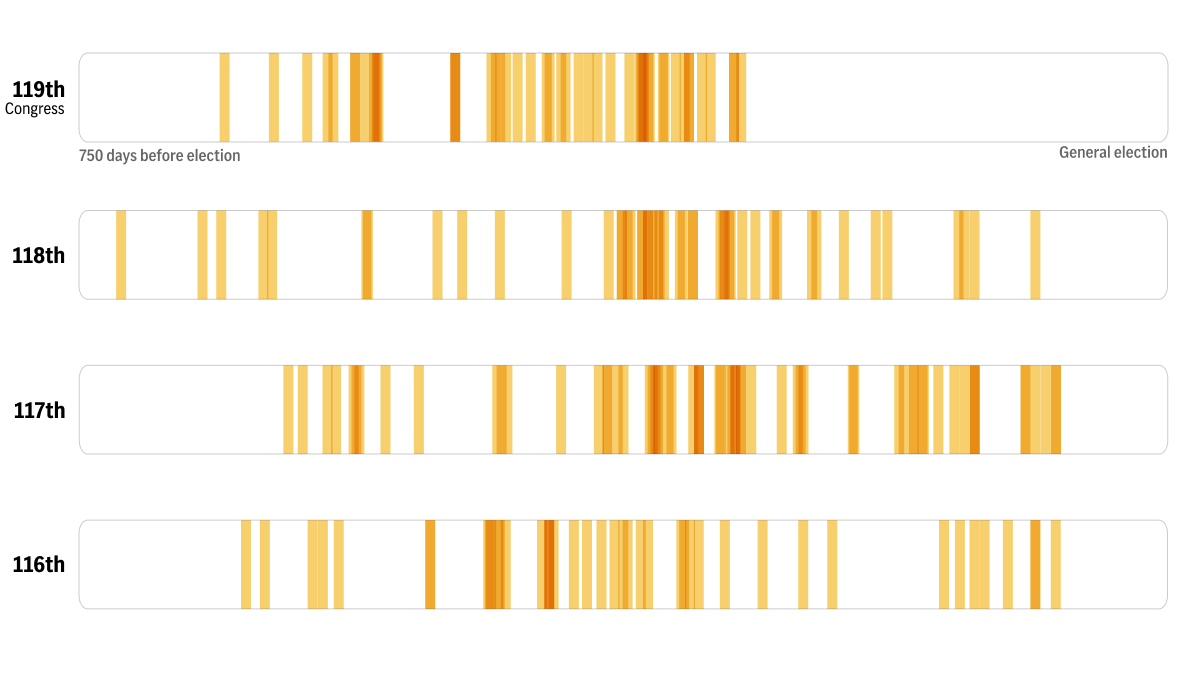
Congressional retirement data provides a revealing window into the changing landscape of the U.S. House of Representatives, with important implications for party control and legislative priorities in upcoming sessions.
According to official records maintained by the U.S. House of Representatives Press Gallery, retirement patterns are meticulously tracked through what insiders call the “casualty list” – a comprehensive accounting of members who will not return for the next congressional term. The current data builds upon historical retirement information that has been compiled through the 113th Congress (2013-2015), with earlier records preserved through the Internet Archive.
The Press Gallery employs specific criteria when categorizing departing representatives. The official records make important distinctions between members who are retiring at the end of their term versus those who die in office or resign before completing their term. Most representatives who resign mid-term are excluded from retirement tallies, reflecting the technical difference between retirement and resignation.
This distinction creates some notable categorization nuances. For instance, prominent Democrats like Adam Schiff of California, who left to pursue a Senate seat, and Republican Kelly Armstrong of North Dakota, are classified as having resigned rather than retired because they departed several weeks before their final terms officially concluded.
Conversely, five representatives who announced retirements during their final term but resigned just three days before that term officially expired are still classified as “retiring.” This group includes Republican Candice Miller of Michigan from the 114th Congress, Democrat Michelle Lujan Grisham of New Mexico from the 115th, Democrats Mike Doyle of Pennsylvania and G.K. Butterfield of North Carolina from the 117th, and Democrat Jeff Jackson of North Carolina from the current 118th Congress.
The timing of retirement announcements often carries significant political weight, potentially influencing everything from fundraising dynamics to candidate recruitment efforts. These announcement dates are collected through a manual process that draws upon news reports and official press releases, ensuring accuracy in the historical record.
Another important tracking distinction involves representatives who announce plans to run for another office. Even if these members later withdraw from those races, the official records still categorize them based on their initial stated intentions. This approach helps maintain consistency in the data while acknowledging the fluid nature of political ambitions.
The tracking of congressional retirements serves multiple purposes for political analysts, party strategists, and historians. Retirement patterns can signal changing party dynamics, shifting electoral environments, or broader demographic transitions within Congress. A surge in retirements from one party, for instance, might indicate members’ pessimism about their party’s prospects in upcoming elections.
The current Congress has seen its share of high-profile retirements and resignations, continuing trends that have characterized recent congressional turnover. These departures come at a time of significant polarization in the House, where razor-thin margins have elevated the importance of each individual seat in determining majority control.
For political scientists and election forecasters, this retirement data represents a crucial indicator when projecting future House composition. Open seats typically attract more competitive races than those with incumbents, making retirement decisions a key factor in assessing which party might control the chamber after the next election cycle.
The meticulous documentation of these transitions ensures that researchers and the public have access to accurate historical records of congressional membership changes, contributing to transparency in our democratic institutions.
Fact Checker
Verify the accuracy of this article using The Disinformation Commission analysis and real-time sources.

18 Comments
I like the balance sheet here—less leverage than peers.
The cost guidance is better than expected. If they deliver, the stock could rerate.
Nice to see insider buying—usually a good signal in this space.
Good point. Watching costs and grades closely.
Nice to see insider buying—usually a good signal in this space.
Good point. Watching costs and grades closely.
I like the balance sheet here—less leverage than peers.
I like the balance sheet here—less leverage than peers.
Good point. Watching costs and grades closely.
The cost guidance is better than expected. If they deliver, the stock could rerate.
Good point. Watching costs and grades closely.
Good point. Watching costs and grades closely.
Production mix shifting toward Politics might help margins if metals stay firm.
Exploration results look promising, but permitting will be the key risk.
Uranium names keep pushing higher—supply still tight into 2026.
Good point. Watching costs and grades closely.
Exploration results look promising, but permitting will be the key risk.
Uranium names keep pushing higher—supply still tight into 2026.