


Listen to the article
In a significant rebuke to presidential power, the Supreme Court ruled Friday that President Donald Trump lacks the authority to impose tariffs under the International Emergency Economic Powers Act (IEEPA). The 6-3 decision immediately drew praise from Democratic leaders, who framed the ruling as a victory for American consumers while highlighting the complex political dynamics surrounding trade policy.
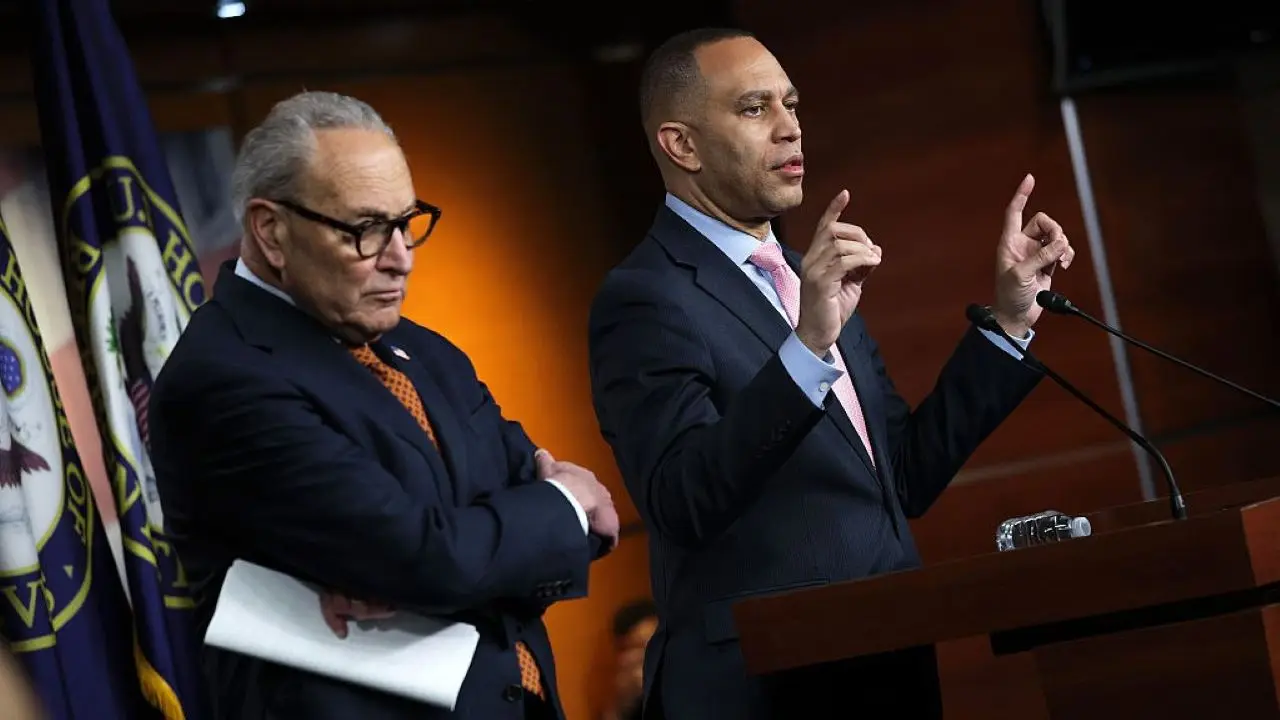
“The Supreme Court decision striking down the harmful Trump tariffs is a big victory for the American people. And another crushing defeat for the wannabe king,” declared House Minority Leader Hakeem Jeffries in a statement following the announcement.
Senate Minority Leader Chuck Schumer similarly celebrated the ruling, writing on social media: “Trump’s illegal tariff tax just collapsed. He tried to govern by decree and stuck families with the bill. Enough chaos. End the trade war.”
The Court determined that while the IEEPA grants presidents powers to “regulate” transactions with foreign entities during “unusual and extraordinary threats,” this authority falls short of including tariff powers. The decision undermines a key economic strategy of Trump’s presidency that had brought in substantial revenue—$30.4 billion in January alone and approximately $124 billion over the past fiscal year, according to Treasury Department data.
Democrats have consistently criticized Trump’s tariff strategy as an unauthorized tax burden on American consumers. Rep. Brendan Boyle of Pennsylvania, the top Democrat on the House Budget Committee, called the ruling “a victory for every American family paying higher prices because of Trump’s tariff taxes,” arguing it rejected “Trump’s attempt to impose what amounted to a national sales tax on hardworking Americans.”
Rep. Don Beyer of Virginia, who chairs the New Democrat Coalition on Trade & Tariffs Task Force, was equally pointed: “[Trump] has repeatedly disregarded the Constitution to unilaterally impose sweeping tariffs without credible reason or cause, crushing American consumers and small businesses under these new taxes to help pay for giveaways to his wealthy friends.”
However, the Democratic celebration comes amid a complex political history regarding tariffs. Former Speaker Nancy Pelosi once advocated for using tariffs against China, noting in earlier congressional debates that “the average U.S. MFN [Most Favored Nation] tariff on Chinese goods coming into the United States is 2%, whereas the average MFN tariff on U.S. goods going into China is 35%.”
Furthermore, when Democrats controlled both chambers of Congress during President Joe Biden’s administration, they largely left Trump’s first-term tariffs against China in place, suggesting a more nuanced party position on trade policy than current rhetoric might indicate.
At least one House Republican pointed out this apparent contradiction, telling Fox News Digital: “It is interesting how Democrats are upset that foreigners are being taxed yet they are promoting tax increases across the board, and they never reduced taxes on overtime, tips, or Social Security when they were in power in 2021 and 2022.”
The ruling represents a significant limitation on presidential authority in an area where executive power has gradually expanded over decades. Trump had positioned tariffs as both a revenue generator and a diplomatic tool, arguing they would enable the country to achieve more of its goals abroad while bringing in additional funds.
Rep. Pramila Jayapal of Washington summarized the Democratic view of the constitutional implications: “They affirmed what we’ve been saying this whole time: Only Congress has the power to impose taxes, which includes Trump’s reckless tariffs.”
The Supreme Court’s decision will likely shape trade policy approaches for years to come, requiring presidents to work more closely with Congress on tariff strategies rather than relying on emergency powers to implement them unilaterally. For businesses engaged in international commerce, the ruling provides some clarity on the limits of executive authority in an area that has created significant market uncertainty in recent years.
Fact Checker
Verify the accuracy of this article using The Disinformation Commission analysis and real-time sources.

9 Comments
Interesting update on Supreme Court Blocks Trump Tariffs, Drawing Democratic Praise Despite Party’s History on Trade. Curious how the grades will trend next quarter.
Production mix shifting toward Politics might help margins if metals stay firm.
I like the balance sheet here—less leverage than peers.
The cost guidance is better than expected. If they deliver, the stock could rerate.
Good point. Watching costs and grades closely.
Good point. Watching costs and grades closely.
Exploration results look promising, but permitting will be the key risk.
Good point. Watching costs and grades closely.
Interesting update on Supreme Court Blocks Trump Tariffs, Drawing Democratic Praise Despite Party’s History on Trade. Curious how the grades will trend next quarter.