


Listen to the article
Philadelphia Reinstalls Exhibit on Washington’s Enslaved People Amid Legal Battle
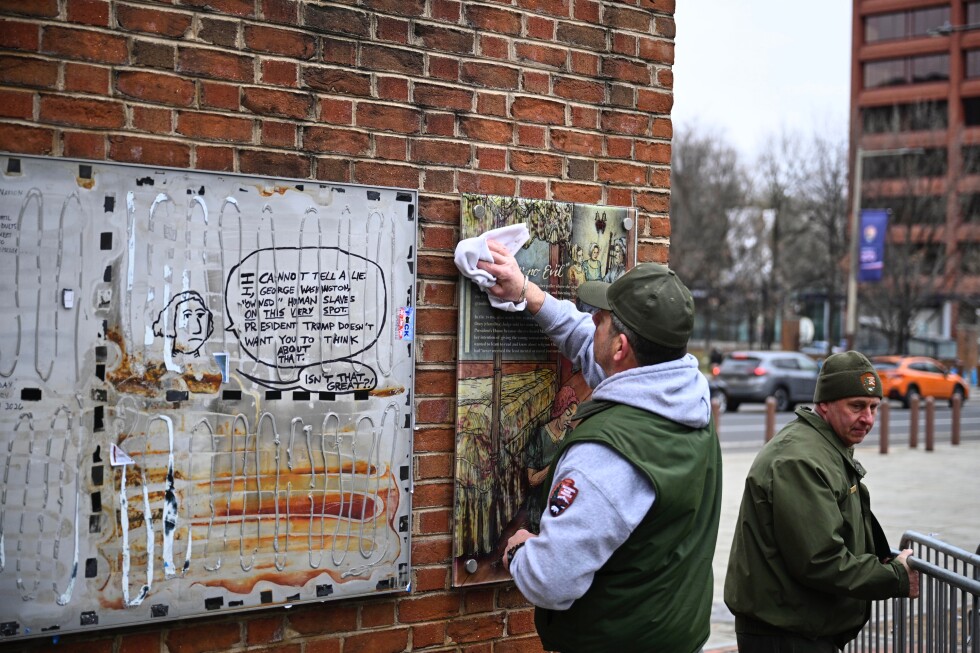
An exhibit chronicling the lives of nine enslaved individuals owned by President George Washington in Philadelphia was reinstalled Thursday, despite an ongoing legal dispute between city officials and the Trump administration.
The display, which had been a fixture at Independence Mall for two decades, was unexpectedly removed last month following an executive order by President Donald Trump. The removal prompted the city of Philadelphia to file a lawsuit seeking the exhibit’s restoration, resulting in a federal judge setting a Friday deadline for its complete reinstatement.
Philadelphia Mayor Cherelle Parker, the first Black woman elected to lead the city, visited the President’s House site Thursday morning to express gratitude to National Park Service workers as they carefully lifted panels back into place.
“I want you to know I’m grateful,” Parker told the workers, who responded, “It’s our honor.” The restoration work is expected to continue through Friday to meet the court-ordered deadline.
The Trump administration’s executive order called for “restoring truth and sanity to American history” at national museums, parks, and landmarks. Government attorneys have argued that federal authorities have sole discretion over content displayed at Park Service properties.
“Although many people feel strongly about this slavery exhibit one way, other people may disagree or feel strongly another way,” Assistant U.S. Attorney Gregory in den Berken stated during a January court hearing. “Ultimately, the government gets to choose the message it wants to convey.”
Senior U.S. District Judge Cynthia Rufe, who is overseeing the case, sharply criticized these arguments as “dangerous” and “horrifying.” While the exhibit remained absent, educators brought students to reflect on the missing history, and supporters posted messages such as “Washington owned slaves here” on the vacant walls.
The Philadelphia case has highlighted similar concerns at other historical sites where content about enslaved people, LGBTQ+ communities, and Native Americans has reportedly been removed under the current administration, raising accusations of historical erasure.
In a 40-page opinion issued symbolically on Presidents’ Day, Judge Rufe, an appointee of Republican President George W. Bush, drew comparisons between the Trump administration’s actions and the totalitarian regime depicted in George Orwell’s “1984.”
“If the President’s House is left dismembered throughout this dispute, so too is the history it recounts,” Rufe wrote. She warned that replacing the exhibits with “an alternative script” would constitute “an even more permanent rejection of the site’s historical integrity.”
The judge granted an injunction ordering the exhibit’s restoration while the lawsuit continues, and prohibited Trump officials from creating new interpretations of the site’s history. The Interior Department had reportedly planned an alternative display “providing a fuller account of the history of slavery at Independence Hall,” though details of this plan remain unclear.
Government lawyers requested on Wednesday that the restoration order be suspended during their appeal process. The U.S. Attorney’s Office declined to comment on the restoration work.
The original exhibit includes biographical information about nine individuals enslaved by George and Martha Washington at the presidential mansion: Austin, Paris, Hercules, Christopher Sheels, Richmond, Giles, Oney Judge, Moll and Joe.
Philadelphia resident Jabari Cherry, who visited the site Thursday, expressed relief at the exhibit’s return. “When the exhibit was taken down, it was very devastating for the city. It was very devastating to me personally. I value the visibility of Black history, which is American history. So I’m really happy that it’s restored.”
The timing of the controversy is particularly significant as Philadelphia prepares to welcome millions of visitors for the 250th anniversary of the nation’s founding in 1776.
“A lot of people are going to be coming through these streets,” noted Tatiana Alvarez, a visitor from Los Angeles. “It’s a very historic town, but it’s important that we acknowledge the history of America — all of our history — whether that’s easy or the difficult history that is tackled here.”
Fact Checker
Verify the accuracy of this article using The Disinformation Commission analysis and real-time sources.

9 Comments
This exhibit sounds like an impactful way to educate people about the harsh realities of slavery in early America. It’s good to see it being restored, despite the legal dispute.
While the legal battle is concerning, I’m glad the city is taking action to ensure this important exhibit is available to the public. Confronting our history, even the difficult parts, is essential for progress.
Removing historical exhibits like this is a worrying trend. We must preserve access to information that sheds light on our past, even when it’s uncomfortable.
This is a sensitive but important topic. It’s good to see the exhibit reinstalled, as it helps shed light on a difficult chapter in US history that should not be forgotten.
Preserving historical artifacts and exhibits, even those that deal with uncomfortable truths, is crucial for understanding our past and guiding our future.
I’m glad the city of Philadelphia is taking a stand to ensure this educational exhibit is available for visitors. Acknowledging the harsh realities of slavery is an important part of reckoning with our nation’s history.
It’s concerning that the Trump administration tried to remove this exhibit. Censoring history does not help us learn from past mistakes.
Reinstalling this exhibit is a positive step, though the legal battle is troubling. Exhibits that honestly confront the legacy of slavery are vital for promoting understanding and reconciliation.
I hope the court ruling leads to a permanent resolution, so the public can continue to access and reflect on this important historical display.