


Listen to the article
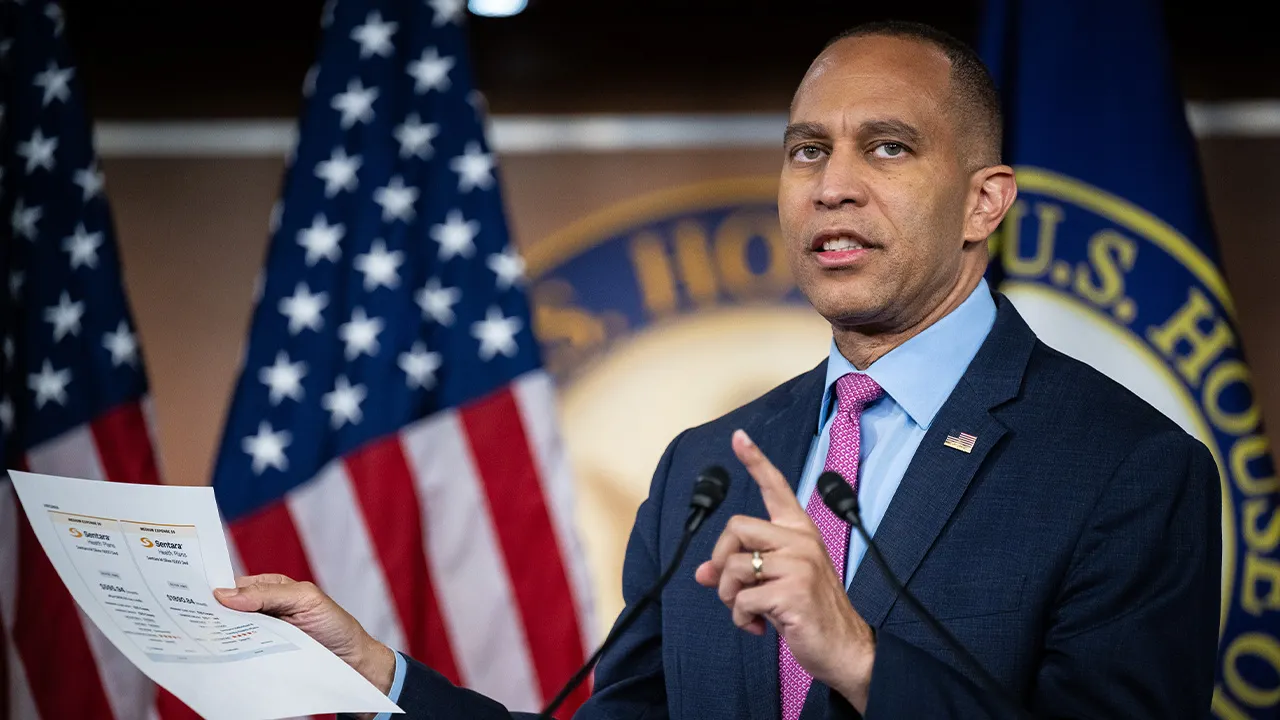
A Senate Republican has accused House Minority Leader Hakeem Jeffries of being excluded from government funding negotiations due to bruised ego, as Congress navigates the aftermath of a partial government shutdown that lasted four days.
Sen. Roger Marshall (R-Kan.) suggested Wednesday that Jeffries was “butt hurt” about not being included in the deal brokered between Senate Minority Leader Chuck Schumer (D-N.Y.) and President Donald Trump, which ultimately led to the passage of a funding package in the House on Tuesday.
“He’s butt hurt that President Trump didn’t call him, too,” Marshall told Fox News Digital. “But I think that’s on Schumer.”
The House passed a five-bill funding package along with a two-week extension for the Department of Homeland Security (DHS). While the legislation successfully moved through the chamber, Jeffries and most House Democrats opposed it, with only 21 Democrats breaking ranks to vote in favor.
Marshall described how the funding deal came together during a meeting in the Oval Office last week as the deadline approached. According to the senator, Trump called Schumer directly to negotiate terms while top Senate Republicans were present.
“The president says, ‘Get Schumer on the phone.’ They get Schumer on the phone. They broker a deal,” Marshall recounted. “So really, it’s on Schumer that he agreed to this deal, really, before bringing Hakeem in. And really it comes down to that Hakeem’s feelings are butt hurt, and to him, he’s fighting for his political life and really struggling.”
The agreement funds 11 of the 12 federal agencies under Congress’s purview, but DHS funding remains unresolved. The political impasse over the agency highlights deeper divisions between the parties on immigration enforcement policies.
Senate Democrats have demanded that the previously negotiated bipartisan bill to fund DHS be reconsidered following the fatal shooting of Alex Pretti during an immigration operation in Minneapolis. They’re seeking additional restrictions and reforms for Immigration and Customs Enforcement (ICE) operations.
The temporary two-week continuing resolution (CR) for DHS has raised concerns among Republicans that Congress will find itself in the same deadlocked position when the short-term funding expires. The abbreviated timeframe leaves little room to resolve significant differences on one of the most politically contentious funding issues.
Senate Majority Leader John Thune (R-S.D.) indicated that Senator Katie Britt (R-Ala.), who chairs the Homeland Security Appropriations Subcommittee, would lead negotiations with Senate Democrats on the DHS funding bill. However, Thune acknowledged that President Trump would ultimately be the deciding factor in any agreement.
“Ultimately, that’s going to be a conversation between the President of the United States and the Democrats here in the Senate,” Thune said.
Schumer pushed back on this characterization, insisting that Thune needs to be directly involved in the talks. “If Leader Thune negotiates in good faith, we can get it done,” Schumer said. “We expect to present to the Republicans a very serious, detailed proposal very shortly.”
The temporary resolution of the broader government shutdown represents a political victory for Trump, who demonstrated his continued influence over congressional negotiations despite not holding office. The direct engagement between Trump and Schumer, bypassing House Democratic leadership, underscores the complex power dynamics at play in Washington.
The focus now shifts to the negotiations over DHS funding, which will test whether lawmakers can find common ground on immigration enforcement policies — an issue that has consistently proven difficult to resolve in recent years. With only two weeks before funding expires again, the pressure remains high to avoid another partial shutdown affecting one of the government’s most critical security agencies.
Fox News Digital reached out to both Schumer and Jeffries for comment, but no responses were included in the report.
Fact Checker
Verify the accuracy of this article using The Disinformation Commission analysis and real-time sources.

10 Comments
Partisan divisions and bruised egos seem to be getting in the way of effective governance yet again. While I’m glad they were able to pass a funding bill and avoid a shutdown, the acrimony between the leaders is concerning. Voters deserve representatives who can put politics aside and work together for the good of the country.
The senator’s comments about Jeffries being ‘butt hurt’ are certainly colorful, if a bit crude. But they do seem to speak to the high tensions and jockeying for position that can occur in these political negotiations. I hope both sides can find a way to move past the personal grievances and focus on the substantive policy issues at hand.
Well said. Maintaining professionalism and civility, even in the heat of partisan disagreements, is crucial for effective governance. Hopefully the leaders can find a way to work together constructively going forward.
This incident underscores the ongoing dysfunction and lack of bipartisanship in Congress. While I’m glad they were able to avoid a government shutdown, the partisan sniping and accusations of ‘hurt feelings’ are dismaying. Voters deserve representatives who can put the country’s interests ahead of their own egos and political agendas.
Interesting to see the political dynamics at play here. It seems the Senate Republican’s comments on Jeffries’ exclusion from the negotiations suggest some hurt feelings and bruised egos. I wonder what the full backstory is on the negotiations and how the various party leaders positioned themselves.
Yes, it’s always intriguing to see the interplay between congressional leaders, especially when it comes to high-stakes budget negotiations. The senator’s comments about Jeffries being ‘butt hurt’ indicate there may be more going on behind the scenes than the public narrative.
The senator’s rather colorful description of Jeffries’ reaction is certainly eye-catching. While the language may be a bit undiplomatic, it does seem to speak to the high emotions and jockeying for position that can occur in these high-stakes political negotiations. I’m curious to hear Jeffries’ side of the story.
This episode highlights the importance of inclusive, transparent negotiations when it comes to critical government funding decisions. Excluding key congressional leaders like Jeffries, even if unintentional, can breed resentment and undermine the process. Hopefully lessons can be learned for smoother future talks.
This funding deal highlights the partisan divisions that continue to plague Congress. While it’s good they were able to pass a bill and avoid a prolonged shutdown, the opposition from Jeffries and most House Democrats suggests ongoing tensions. I wonder if this will impact future negotiations.
You make a fair point. Partisan gridlock seems to be the norm these days in Washington. It will be interesting to see if this incident colors future budget and funding talks, or if the two sides can find ways to compromise.