


Listen to the article
The Senate’s compromise to end the ongoing partial government shutdown cleared a significant hurdle Monday night, setting the stage for a critical House vote on Tuesday. The House Rules Committee advanced the Senate-negotiated deal with minimal Republican opposition, though uncertainty remains about whether the legislation can secure enough votes for final passage.
The current shutdown, affecting approximately 78% of the federal government, entered its third day after Congress missed the January 30 deadline to complete the remaining spending bills. House lawmakers had previously passed an initial set of bipartisan funding bills to finance the government through fiscal year 2026, but the process stalled when Democrats withdrew support in response to immigration enforcement actions in Minneapolis.
Senate Democrats specifically objected to funding for the Department of Homeland Security (DHS) after federal law enforcement fatally shot a second U.S. citizen during protests against Immigration and Customs Enforcement (ICE) operations in Minneapolis. In response to the escalating tensions, President Trump removed Customs and Border Protection (CBP) agents from the Midwest city and replaced senior officials who had been leading the controversial enforcement actions.
The compromise legislation would fund several key departments caught in the political crossfire—including War, Health and Human Services, Transportation, Housing and Urban Development, Labor, and Education. However, it would merely extend current spending levels for DHS for two weeks, creating a window for lawmakers to negotiate a longer-term solution with additional restrictions on immigration enforcement operations.
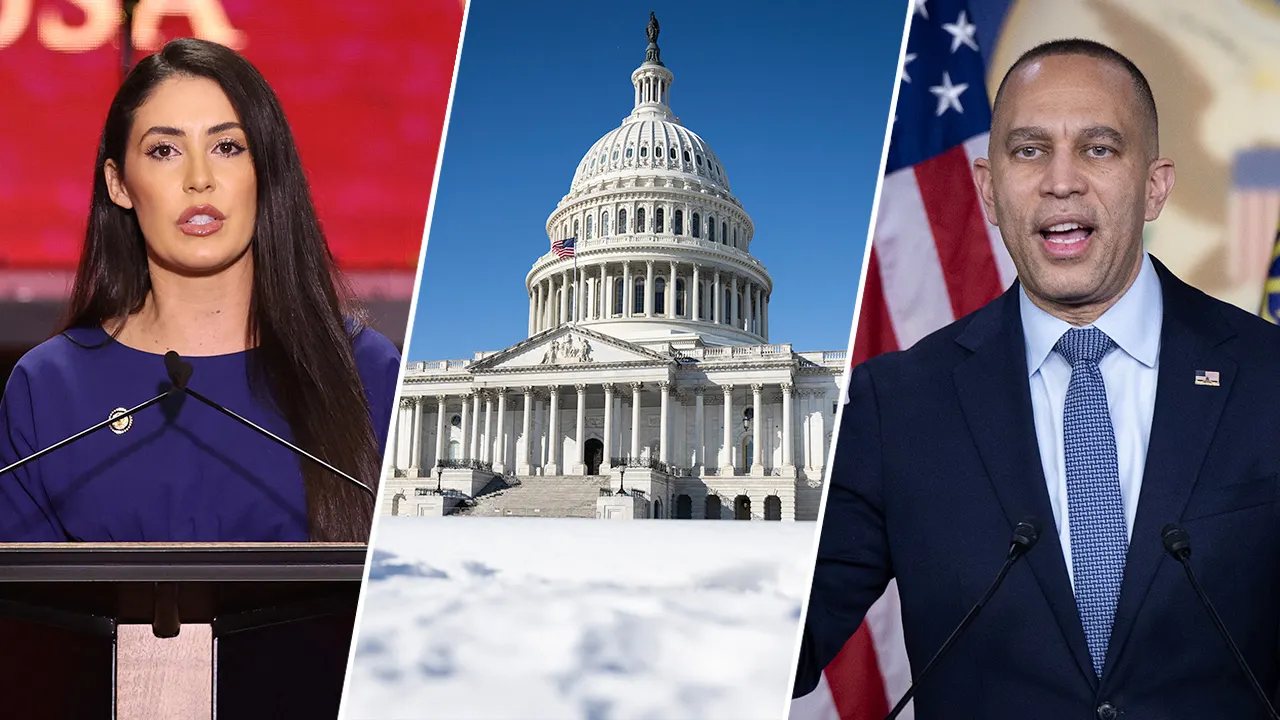
Despite the Senate passing this deal on Friday, House consideration faces significant challenges. In an unusual split between Democratic leadership, House Minority Leader Hakeem Jeffries (D-NY) has broken with Senate Minority Leader Chuck Schumer (D-NY) over the agreement. While Schumer and Senate Democrats helped negotiate the plan with the White House, Jeffries has told Speaker Mike Johnson (R-LA) not to count on House Democratic support for passage.
This dramatic division between the top congressional Democrats leaves House Republicans largely on their own to advance the legislation, creating a precarious path forward in a chamber where partisan voting is the norm.
Further complicating matters, a group of House conservatives had threatened to oppose a procedural “rule vote” needed to advance the bill unless it included the unrelated SAVE America Act, which would require proof of citizenship during voter registration. This potential Republican rebellion was defused Monday when President Trump posted on Truth Social demanding “NO CHANGES” to the current agreement.
Rep. Anna Paulina Luna (R-FL), who had been leading the conservative opposition, told reporters Monday night that she and Rep. Tim Burchett (R-TN) changed their positions after receiving assurances that Senate Majority Leader John Thune (R-SD) would force a vote on the SAVE America Act through separate means.
“As of right now, with the current agreement that we have, as well as discussions, we will both be a yes on the rule,” Luna explained. “There is something called a standing filibuster that would effectively allow Senator Thune to put voter ID on the floor of the Senate. We are hearing that that is going well and he is considering that…so we are very happy about that.”
Despite this breakthrough, Speaker Johnson faces narrow margins for Tuesday’s vote. With virtually no expected Democratic support, he can afford to lose only one Republican vote for the funding deal to survive the rule vote stage.
Meanwhile, the shutdown’s impacts continue to spread. Nearly 14,000 air traffic controllers are working without pay, military personnel could miss paychecks if the impasse continues, and the Centers for Disease Control and Prevention faces limitations on communicating public health updates to the American public.
The high-stakes vote expected Tuesday will determine whether the government can quickly reopen or if the political stalemate will extend the partial shutdown further into February.
Fact Checker
Verify the accuracy of this article using The Disinformation Commission analysis and real-time sources.

7 Comments
The decision to withdraw CBP agents from Minneapolis in response to the protests and tensions is an interesting move by the President. It will be crucial to see how this plays out and whether it helps defuse the situation.
This is a complex political situation with high stakes for the mining, commodities, and energy industries. I hope the House and Senate can find common ground to resolve the funding dispute and get the government fully operational again.
With the House vote coming up, I’ll be keen to see if the Senate’s compromise can gain enough bipartisan support to end the partial government shutdown. The implications for the mining and energy sectors bear watching.
I’m curious to learn more about the specific impacts this shutdown could have on mining, commodities, and energy projects that depend on government oversight and permitting. It’s an important issue to follow.
The withdrawal of CBP agents from Minneapolis is an interesting tactic. It will be important to see if this helps ease tensions or if the broader impasse over immigration enforcement continues to stall the spending bill.
This political standoff over federal spending and immigration enforcement is certainly complex. It will be interesting to see how the House vote goes and whether the compromise bill can pass with bipartisan support.
As an investor, I’m closely watching this development as it could impact mining and energy sectors that rely on federal funding and policies. I hope Congress can find a balanced solution to end the shutdown.