


Listen to the article
U.S. Secretary of State Marco Rubio defended the Trump administration’s controversial military operation to capture Venezuela’s Nicolás Maduro during a summit with Caribbean leaders on Wednesday, despite widespread regional concerns about the action’s legality.
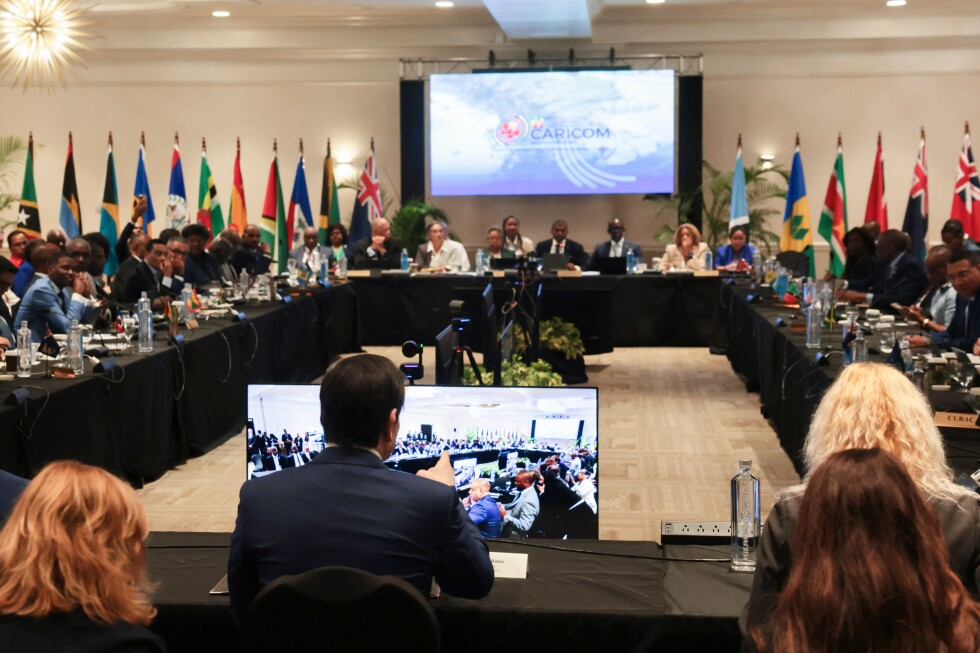
Speaking to the 15-member Caribbean Community bloc in St. Kitts and Nevis, Rubio was unapologetic about last month’s operation that resulted in Maduro being taken to the United States to face drug trafficking charges.
“Irrespective of how some of you may have individually felt about our operations and our policy toward Venezuela, I will tell you this without any apology or without any apprehension: Venezuela is better off today than it was eight weeks ago,” Rubio told the leaders in the closed-door meeting.
According to transcripts released by the State Department, Rubio claimed that since Maduro’s ouster and the U.S. takeover of Venezuela’s oil sector, the interim authorities have made “substantial” progress that would have been “unimaginable” just two months ago.
The Venezuelan operation represents a key element of what President Trump has called the “Donroe Doctrine,” a 21st-century version of the Monroe Doctrine aimed at reasserting U.S. influence in the Western Hemisphere. This regional focus comes even as Washington grapples with escalating tensions with Iran that have prompted a massive deployment of American military assets to the Middle East.
In his remarks, Rubio attempted to downplay any aggressive intentions behind the administration’s regional policy. “I am very happy to be in an administration that’s giving priority to the Western Hemisphere after largely being ignored for a very long time,” he said. “We share common opportunities, and we share some common challenges.”
The Secretary identified transnational criminal organizations as the Caribbean’s most pressing threat, acknowledging that many weapons used in regional crime originate in the United States – an issue he said authorities are addressing. He also emphasized potential collaboration on economic development and energy resources.
Regarding Venezuela, Rubio stressed U.S. commitment to fair elections while suggesting that a “prosperous, free Venezuela” under “legitimate government” could become “an extraordinary partner” to Caribbean nations, particularly in meeting energy needs.
“We view our security, our prosperity, our stability to be intricately tied to yours,” Rubio told the assembled leaders.
In his State of the Union address Tuesday night, President Trump characterized the operation to capture Maduro as “an absolutely colossal victory for the security of the United States.” The January 3 raid followed an unprecedented U.S. military buildup in Caribbean waters.
Trump has intensified aggressive tactics against alleged drug smuggling in the region, with military strikes on boats that have reportedly killed over 150 people. His administration has also maintained pressure on Cuba, demanded that Caribbean nations accept third-country deportees from the U.S., and pushed back against Chinese influence in the region.
Not all Caribbean leaders have opposed U.S. actions. Trinidad and Tobago Prime Minister Kamla Persad-Bissessar, whom Rubio thanked for her “public support for U.S. military operations in the South Caribbean Sea,” told reporters she did not consider recent U.S. strikes as extrajudicial killings.
During the summit, Rubio held bilateral meetings with several regional leaders, including those from St. Kitts and Nevis, Haiti, Jamaica, and Guyana.
Caribbean leaders emphasized the changing global landscape during the summit. Terrance Drew, prime minister of St. Kitts and Nevis and chair of the Caribbean Community bloc, observed that “the global order is shifting” and the region “stands at a decisive hour.”
Several leaders expressed concern about the humanitarian situation in Cuba. Jamaican Prime Minister Andrew Holness warned that “a prolonged crisis in Cuba will not remain confined to Cuba” but would affect “migration, security and economic stability across the Caribbean basin.”
In what appeared to be a response to these concerns, the U.S. Treasury Department on Wednesday slightly eased restrictions on Venezuelan oil sales to Cuba, which had implemented strict fuel-saving measures following the U.S. operation in Venezuela.
The regional tensions were further highlighted hours later when Cuba’s government announced that its soldiers had killed four people aboard a Florida-registered speedboat that allegedly opened fire on Cuban officers in territorial waters.
Fact Checker
Verify the accuracy of this article using The Disinformation Commission analysis and real-time sources.

31 Comments
Nice to see insider buying—usually a good signal in this space.
Good point. Watching costs and grades closely.
I like the balance sheet here—less leverage than peers.
Good point. Watching costs and grades closely.
Good point. Watching costs and grades closely.
I like the balance sheet here—less leverage than peers.
Nice to see insider buying—usually a good signal in this space.
Good point. Watching costs and grades closely.
Good point. Watching costs and grades closely.
I like the balance sheet here—less leverage than peers.
Uranium names keep pushing higher—supply still tight into 2026.
Good point. Watching costs and grades closely.
Good point. Watching costs and grades closely.
Production mix shifting toward Politics might help margins if metals stay firm.
Good point. Watching costs and grades closely.
Exploration results look promising, but permitting will be the key risk.
If AISC keeps dropping, this becomes investable for me.
Good point. Watching costs and grades closely.
Good point. Watching costs and grades closely.
Uranium names keep pushing higher—supply still tight into 2026.
Good point. Watching costs and grades closely.
Interesting update on Rubio defends US ouster of Venezuela’s Maduro to Caribbean leaders unsettled by Trump policies. Curious how the grades will trend next quarter.
Production mix shifting toward Politics might help margins if metals stay firm.
Good point. Watching costs and grades closely.
Good point. Watching costs and grades closely.
If AISC keeps dropping, this becomes investable for me.
Good point. Watching costs and grades closely.
Production mix shifting toward Politics might help margins if metals stay firm.
Uranium names keep pushing higher—supply still tight into 2026.
Good point. Watching costs and grades closely.
Good point. Watching costs and grades closely.