


Listen to the article
Secretary of State Marco Rubio has defended the controversial U.S. operation that led to the capture of former Venezuelan President Nicolas Maduro, dismissing international criticism by stating the action served America’s national interests.
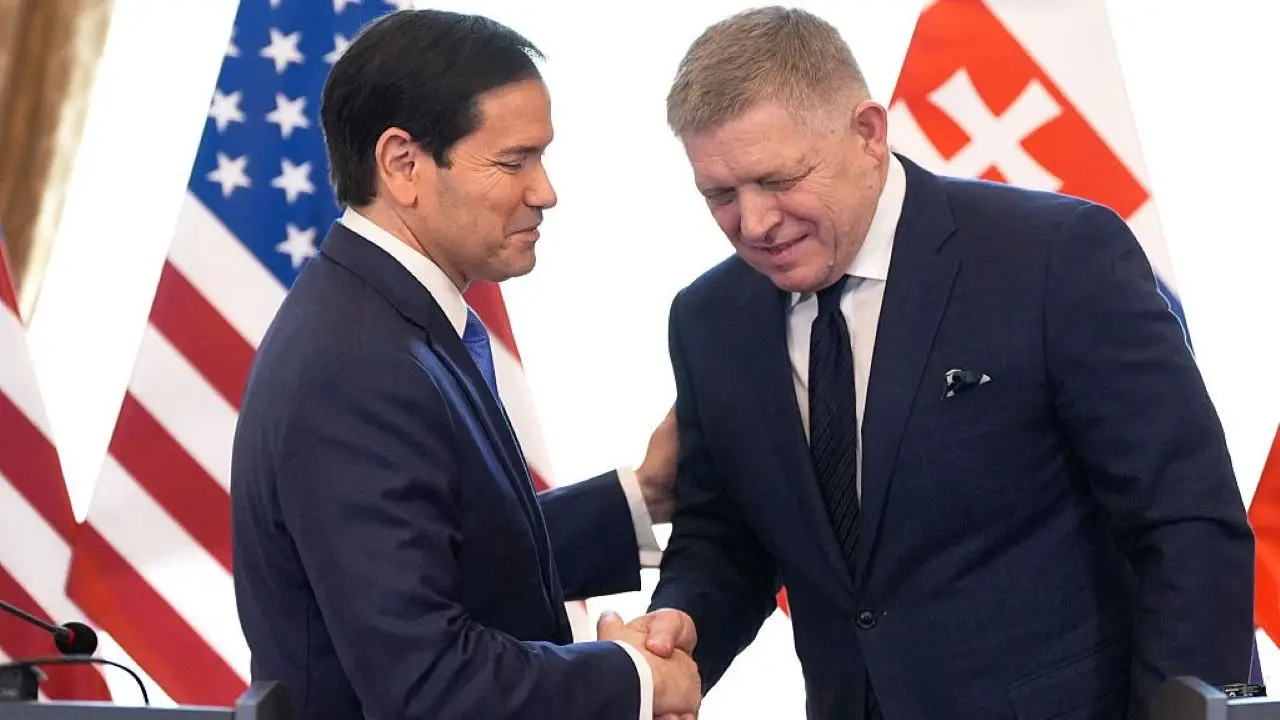
During a joint press conference with Slovakian Prime Minister Robert Fico, Rubio addressed the issue head-on after a reporter referenced Fico’s previous criticism of the U.S. operation. Rubio challenged what he perceived as an attempt to create friction between the two leaders.
“I think you asked him a question in order to, like, see if you can get him against us, or something,” Rubio said. “A lot of countries didn’t like what we did in Venezuela. That’s okay. That was in our national interest.”
The Secretary emphasized that disagreements on specific policies shouldn’t undermine broader diplomatic relationships. “I’m sure there’s something you may do one day that we don’t like, and we’ll say we didn’t like that you did this,” he told Fico. “So what? That doesn’t mean we’re not going to be friends, we’re not going to be partners.”
Rubio characterized the operation as both “successful” and “necessary,” describing Maduro as a “narco-terrorist” who had rejected multiple offers from the United States. He highlighted what he sees as positive developments in Venezuela following Maduro’s removal.
“Look what’s happened in Venezuela in the six weeks since he’s been gone,” Rubio stated. While acknowledging the country still has “a long way to go,” he asserted that “Venezuela is much better off today than it was six weeks ago.”
The operation to capture Maduro has drawn mixed reactions internationally, with even some U.S. allies expressing reservations about the military action on foreign soil. However, the Biden administration has maintained that the operation was justified under international law due to Maduro’s involvement in drug trafficking activities directly affecting the United States.
President Donald Trump recently praised the military’s execution of the operation during remarks at Fort Bragg, North Carolina. Trump recounted the speed and efficiency with which U.S. special forces captured Maduro from his heavily-armed military compound.
“It was a matter of minutes before Maduro was on a helicopter being taken out of there,” Trump said. “They had to go through steel doors. The steels were like it was paper-maché… These guys blasted through every door.”
The operation has significant geopolitical implications for Venezuela and the broader Latin American region. For years, the Maduro regime faced accusations of human rights abuses, election fraud, and enabling widespread corruption that contributed to Venezuela’s economic collapse. Once one of Latin America’s wealthiest nations with the world’s largest proven oil reserves, Venezuela has seen millions of its citizens flee the country amid hyperinflation and severe shortages of food, medicine, and other basic necessities.
Following the operation, the State Department confirmed it has sent a “limited number” of personnel to Caracas to work on resuming diplomatic relations with Venezuela. These efforts signal a potential new chapter in U.S.-Venezuela relations after years of tensions.
Maduro currently faces serious federal charges in the United States, including narco-terrorism conspiracy, cocaine-trafficking conspiracy, and weapons-related offenses. He is being held at the Metropolitan Detention Center in New York City while awaiting trial.
The case represents an extraordinary example of U.S. military and law enforcement action against a sitting foreign leader, raising questions about sovereignty and international norms that continue to reverberate through diplomatic channels worldwide.
Fact Checker
Verify the accuracy of this article using The Disinformation Commission analysis and real-time sources.

10 Comments
Rubio’s defense of the Venezuela operation suggests the U.S. sees it as a strategic move, but the international criticism indicates there are significant concerns about the methods and potential consequences. This situation underscores the challenges of navigating complex geopolitical issues.
You make a fair point. Balancing national interests with diplomatic obligations is an ongoing challenge, and this case illustrates the need for transparency and multilateral dialogue to address such sensitive matters.
Rubio’s stance highlights the delicate balance between national interests and diplomatic relations. While some may disagree with the U.S. approach, his point about countries needing to accept differences on specific policies has merit. This situation underscores the challenges of navigating global affairs.
Indeed, these types of foreign policy decisions often involve difficult tradeoffs. It will be interesting to see how this plays out in the broader geopolitical landscape.
This situation highlights the complexities of global diplomacy and the competing priorities of different nations. While the U.S. may believe the Venezuela operation was necessary, the criticism from other countries suggests there are differing views on the legitimacy and implications of such actions.
Absolutely, managing international relations requires nuance and compromise. It will be worth following how this dynamic evolves and whether the U.S. can build broader support for its approach.
The confrontational tone between the U.S. and some international critics is concerning, but Rubio’s emphasis on serving America’s national interests is understandable. The ‘narco-terrorist’ label for Maduro is quite serious – I wonder what specific evidence supports that characterization.
You raise a good point. It will be important for the U.S. to provide a transparent justification for this operation and the associated claims about Maduro’s involvement in illicit activities.
Interesting to see Rubio’s defense of the U.S. operation in Venezuela. While some may criticize the confrontational approach, it seems Rubio believes it was necessary to serve American interests. Curious to hear more details on why he considers Maduro a ‘narco-terrorist’.
I agree, the geopolitical dynamics at play here are complex. It will be important to understand the full context and rationale behind this operation to evaluate its merits and implications.