


Listen to the article
In a striking display of economic impact, President Donald Trump’s State of the Union address resonated strongly with Republican and Independent voters when he highlighted his administration’s economic achievements, according to a recent voter panel analysis.
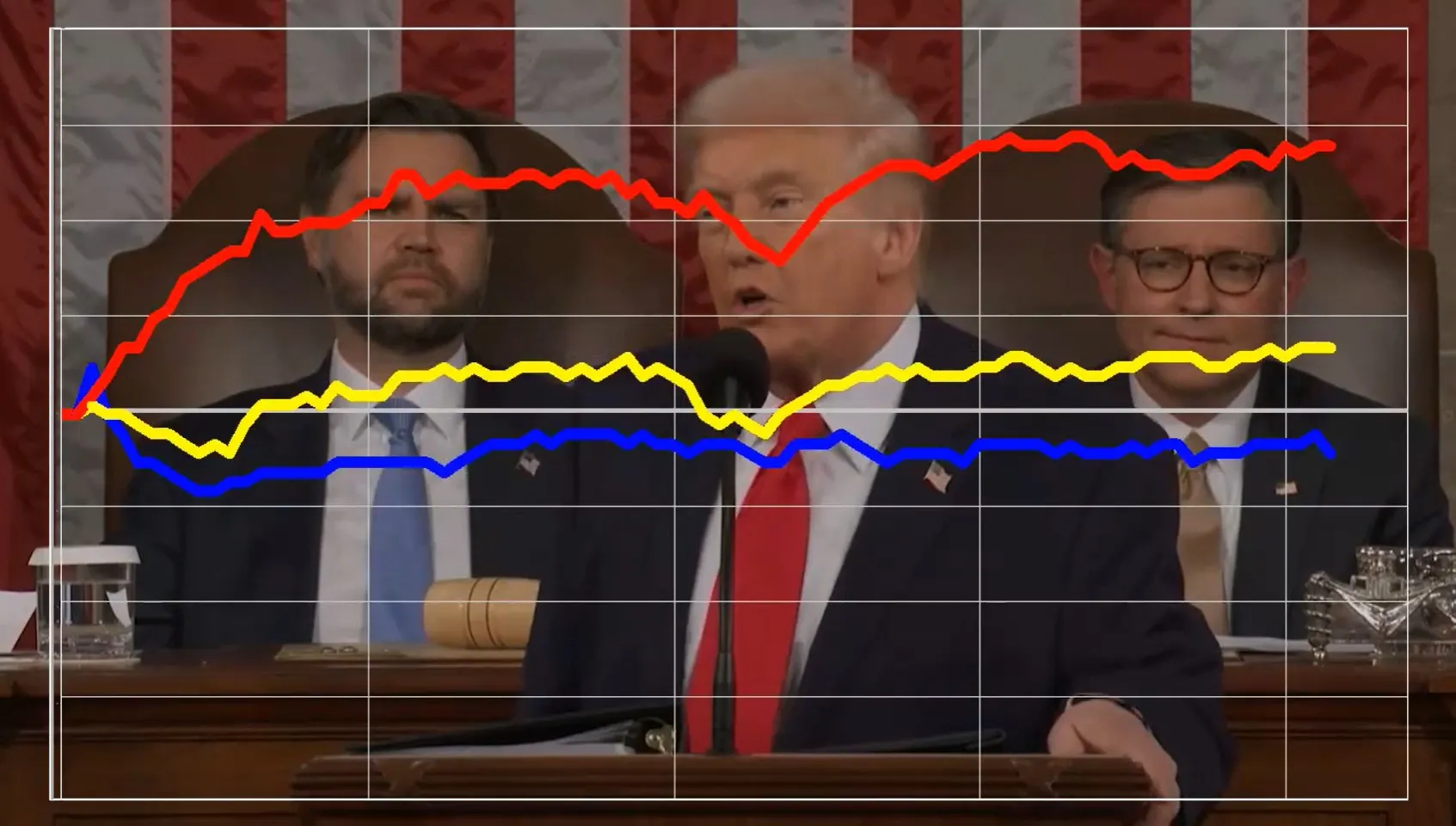
The panel, organized by polling group Maslansky & Partners, tracked real-time reactions from 99 voters—29 Democrats, 30 Independents, and 40 Republicans—during Tuesday’s address. Using a graphical display system, the group visualized voter sentiment with lines representing each political affiliation: blue for Democrats, red for Republicans, and yellow for Independents.
Trump’s economic segment garnered particularly robust support when he cited inflation figures under his administration. “In 12 months, my administration has driven core inflation to the lowest level in more than five years, and in the last three months of 2025 it was down to 1.7%,” Trump stated, drawing applause from lawmakers in the chamber.
This economic messaging proved effective across party lines. While Republican support predictably peaked during these remarks, even Democratic panel members showed moderate interest, with their support hovering just below the 50% threshold during the inflation discussion—a notable achievement in today’s polarized political environment.
The president’s comments on falling gasoline prices sparked the highest levels of Republican enthusiasm during the speech. Trump highlighted that some regions of the country were paying as little as $1.85 per gallon, a point that clearly resonated with his base. Energy prices have long been a politically sensitive economic indicator, with voters often directly connecting pump prices to their evaluation of presidential performance.
Independent voters—a crucial demographic in American elections—maintained strong positive reactions throughout the economic portion of the address. Their support reached its zenith when Trump discussed mortgage rates, stating: “Mortgage rates are the lowest in four years and falling fast. And the annual cost of a typical new mortgage is down almost $5,000 just since I took office. In one year.”
Housing affordability has emerged as a critical kitchen-table issue for many middle-class Americans, particularly as the real estate market has experienced significant volatility in recent years. Trump’s focus on this area suggests a strategic attempt to connect with swing voters concerned about household finances.
Despite these positive reactions to economic messaging, Maslansky & Partners concluded that the speech largely reinforced existing beliefs rather than persuading undecided voters or opponents. “There was almost no evidence of movement. Instead, voters expressed strong affirmation or strong rejection,” the polling group noted in their post-speech analysis.
This finding aligns with broader trends in contemporary American politics, where partisan divisions have hardened and persuasion has become increasingly difficult. The firm’s statement acknowledged this reality: “It did not soften opposition. It did not significantly broaden appeal. But in a turnout-driven environment, reinforcement may be the point.”
Political analysts have noted that in recent election cycles, mobilizing base voters has often proven more effective than attempting to convert opponents. Trump’s economic messaging appears calibrated to this strategy, focusing on concrete metrics like inflation rates, gas prices, and mortgage costs that resonate with his supporters and potential allies.
The State of the Union address, traditionally one of the president’s highest-profile speaking opportunities, comes at a time when economic concerns continue to rank among voters’ top priorities in polling. By emphasizing tangible economic improvements under his leadership, Trump appears to be laying groundwork for messaging that could carry through to future electoral contests.
As campaigns increasingly rely on data-driven approaches to voter outreach, this type of real-time reaction analysis provides valuable insights into which specific policy points and rhetorical approaches generate the strongest responses among different voter demographics.
Fact Checker
Verify the accuracy of this article using The Disinformation Commission analysis and real-time sources.

8 Comments
As an investor in mining and energy, I’ll be closely watching how these economic trends impact commodity prices and the performance of related equities. Transparency and realistic assessments will be crucial for businesses and markets.
The low inflation figures are certainly noteworthy, but I’d be curious to understand how this aligns with other key economic indicators like GDP, employment, and consumer confidence. A more comprehensive analysis would help provide a clearer picture.
The economic achievements outlined in this speech are certainly noteworthy, though I would be curious to see a more objective analysis of the data and trends. Reducing inflation is always a positive, but the impact on different sectors and demographics is worth digging into further.
It’s good to see bipartisan agreement on positive economic trends, but I remain cautiously optimistic until I can dive deeper into the underlying data and projections. As an investor, I’ll be watching closely for how this plays out in the markets.
While the political rhetoric is interesting, I’m more focused on how these economic policies and indicators translate to real-world outcomes for industries like mining, energy, and commodities. The details will be important for assessing the true impact.
The low inflation figures are certainly eye-catching, but the full context around factors like GDP growth, employment, and consumer sentiment would help provide a more holistic view of the economic landscape. Objective data is crucial here.
It’s interesting to see the bipartisan appeal of the economic messaging, even if the Republican support was more predictable. Effective communication of economic progress can definitely resonate across the aisle, if the data supports the claims.
Agreed, the ability to find common ground on economic issues is important for bridging political divides. Fact-based analysis is key to evaluating the true impact.