


Listen to the article
Senate Stalls on Trump-Backed Voter Citizenship Bill Despite Presidential Pressure
Election-year legislation requiring strict proof-of-citizenship for voting remains stalled in the Senate, despite President Donald Trump’s urgent appeal during his State of the Union address for Republicans to pass the bill “before anything else.”
The legislation, known as the Safeguard American Voter Eligibility (SAVE America) Act, has placed Senate Majority Leader John Thune in a difficult position as he navigates pressure from the White House and conservative lawmakers to bypass normal Senate procedures. While Thune has expressed support for the bill, he acknowledges divisions within his caucus on how to move forward.
“Senate Republicans aren’t unified on an approach,” Thune told reporters Wednesday following Trump’s speech.
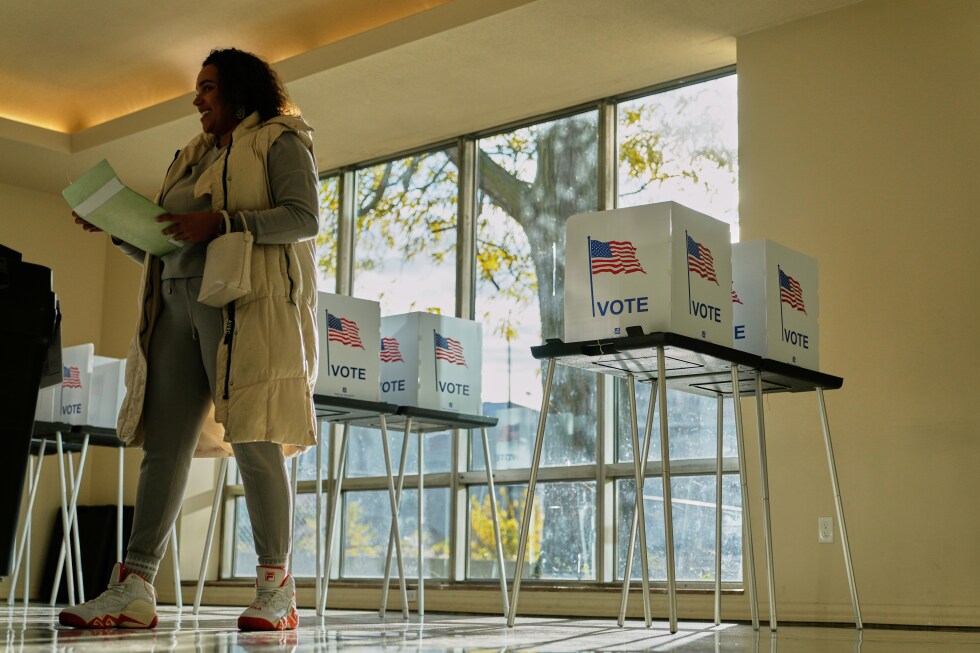
The bill would require Americans to prove citizenship when registering to vote, primarily through a U.S. passport or birth certificate, and mandate photo identification before casting ballots. The House narrowly approved the measure earlier this month on a largely party-line vote of 218-213.
To circumvent Democratic opposition, Trump and his allies have advocated for a “talking filibuster” approach, reminiscent of the classic film “Mr. Smith Goes to Washington,” where senators would be forced to speak continuously to block legislation. Currently, the Senate typically bypasses extended speeches and moves directly to a vote to end debate, which requires 60 votes in the 53-47 Republican-majority chamber.
Utah Senator Mike Lee, a vocal supporter of the maneuver, argued on social media: “We won’t pass the SAVE America Act unless we start by making filibustering senators speak. This will take time and effort, but we’d be crazy not to give it the effort it deserves.”
However, implementing a talking filibuster presents significant procedural challenges. Democrats could employ various tactics to restart the debate clock if sufficient Republicans aren’t present on the floor. This would require nearly all 53 Republican senators to remain near the chamber throughout the filibuster, while Democrats would only need to maintain a single speaker at a time.
Even if Republicans successfully overcame the initial filibuster, Democrats could offer unlimited amendments on any topic, forcing Republicans into politically difficult votes during an election year and potentially attaching Democratic priorities to the bill if they secure some bipartisan support.
“We’d have to have 50 to defeat every amendment,” Thune explained. “And that’s not where we are right now.”
Some moderate Republicans have expressed concerns that pursuing this strategy could lead to further erosion of Senate rules. Senator Thom Tillis of North Carolina stated, “I agree with the SAVE Act, but I’m not going to nuke the filibuster.” Senator John Curtis of Utah similarly warned that “the reason or method doesn’t matter—it’s breaking the filibuster.”
Additional obstacles include potential opposition from Republican Senators Lisa Murkowski of Alaska, who has stated she opposes the SAVE Act, and former GOP Majority Leader Mitch McConnell, who has resisted similar legislation previously.
Even supportive Republicans acknowledge the steep challenges. Missouri Senator Eric Schmitt noted it would require “a deep commitment among almost all of our members,” while Florida Senator Rick Scott characterized the approach as “hard but doable.”
Proponents of the legislation argue it’s necessary to prevent voter fraud, while critics warn it could disenfranchise millions of Americans. Voting experts have cautioned that more than 20 million U.S. citizens of voting age lack readily available proof of citizenship, and almost half of Americans don’t possess a U.S. passport.
Federal law already requires that voters in national elections be U.S. citizens, though current regulations don’t demand documentary proof during registration. Voters affirm their eligibility under oath, risking prosecution for false statements. Election security experts consistently report that voter fraud is extremely rare, with very few non-citizens managing to cast ballots.
The legislation would also mandate that states share voter information with the Department of Homeland Security to verify citizenship, raising privacy concerns among election officials, including some Republicans.
During his State of the Union address, Trump characterized the bill as “country-saving” and claimed Democrats oppose it because “they want to cheat, they have cheated, and their policy is so bad that the only way they can get elected is to cheat”—echoing his false claims about the 2020 election.
Trump has made clear he will hold Democrats and potentially Thune responsible if Republicans lose their congressional majorities in November—despite the fact that Republicans won control of Congress and the White House in 2024 without these proposed requirements in place.
Fact Checker
Verify the accuracy of this article using The Disinformation Commission analysis and real-time sources.

15 Comments
The debate over voter ID requirements touches on fundamental questions of election integrity and voter access. I’m curious to see how the Senate navigates this complex and politically charged issue.
This voter ID bill seems to be a politically contentious issue. I’ll be watching the Senate’s deliberations closely to see how they navigate the competing priorities and concerns around election integrity and voter access.
Voter ID laws are a sensitive topic with valid arguments on both sides. I’ll be interested to see how the Senate approaches this issue and whether they can find a balanced solution that addresses concerns while protecting voting rights.
Agreed, this is a delicate balance that requires careful consideration. Transparency and inclusive policymaking will be key to finding a solution that enjoys broad public support.
The push for stricter voter ID requirements is a hot-button issue, with valid concerns on both sides. It will be crucial for lawmakers to find a solution that protects voting rights while also addressing legitimate security concerns.
Absolutely, this is a delicate balance that requires careful consideration of all perspectives. Transparent and inclusive policymaking will be key.
This voter ID bill seems like a complex and divisive issue. I can understand concerns about election integrity, but there are also valid concerns about voter disenfranchisement. It will be interesting to see how the Senate navigates this tricky political terrain.
Agreed, this is a sensitive topic with valid arguments on both sides. I hope the Senate can find a balanced approach that upholds democratic principles.
This voter ID bill seems to be a politically charged issue, with legitimate concerns on both sides. It will be interesting to see how the Senate handles this sensitive topic and whether they can find a balanced approach.
Absolutely, this is a nuanced issue that requires careful consideration of all perspectives. I hope the Senate can find a solution that upholds democratic principles while also addressing valid security concerns.
The debate over voter ID requirements touches on fundamental questions of election integrity and voter access. I’m interested to see how the Senate balances these competing priorities in their deliberations.
Agreed, this is a delicate balancing act. I hope the Senate can find a solution that enjoys broad bipartisan support and strengthens public trust in the electoral process.
Voter ID laws are a complex and politically charged topic. I’m curious to see how the Senate navigates this, as there are reasonable arguments on both sides that need to be weighed carefully.
You’re right, this is a nuanced issue without easy answers. I hope the Senate can find a compromise that upholds democratic principles while also addressing valid security concerns.
Voter ID laws are a contentious issue, with valid arguments on both sides. I’ll be following the Senate’s deliberations closely to see how they navigate this complex and politically charged topic.