


Listen to the article
Republicans Confront Telecom Companies Over Trump Election Probe Records Access
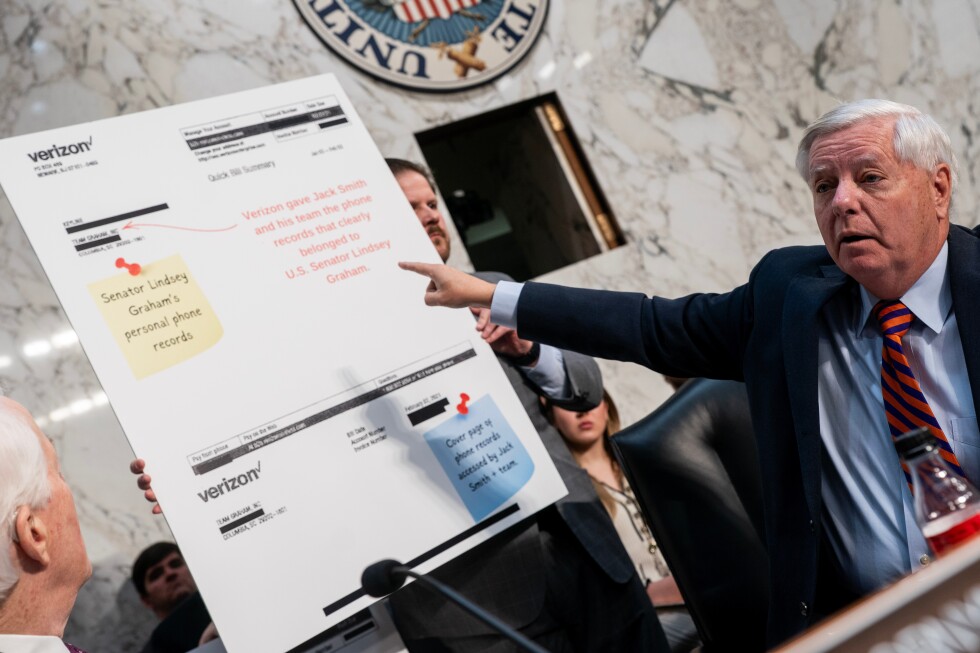
Republican lawmakers expressed outrage Tuesday during a Senate Judiciary subcommittee hearing where they questioned telecommunications companies about providing phone records of sitting members of Congress to prosecutors investigating former President Donald Trump’s efforts to overturn the 2020 election.
“If the shoe were on the other foot, it’d be front-page news all over the world that Republicans went after sitting Democratic senators’ phone records,” said Republican Sen. Lindsey Graham of South Carolina, who was among those whose records were accessed. “I just want to let you know, I don’t think I deserve what happened to me.”
According to Sen. Chuck Grassley, chairman of the Senate Judiciary Committee, special counsel Jack Smith’s team obtained phone records of 20 current or former Republican members of Congress. These records revealed call timing and duration but not the content of conversations between lawmakers and Trump during the crucial period surrounding January 6, 2021.
Representatives from major telecommunications companies defended their actions while acknowledging room for improvement in their protocols. Chris Miller, senior vice president and general counsel of Verizon’s consumer group, emphasized their legal obligation to comply with valid subpoenas but conceded, “Our processes could have been better suited to meet what was a new and unique set of circumstances for us, and for other companies.”
The telecom executives testified that the subpoenas provided minimal context and did not identify the targeted numbers as belonging to members of Congress. Miller stated that Verizon’s subpoenas “did not include any names or any other information identifying these numbers as belonging” to lawmakers, and judicial non-disclosure orders prevented the company from alerting those affected.
David McAtee, senior executive vice president and general counsel at AT&T, detailed a similar experience where subpoenas in January 2023 listed only phone numbers with no indication they belonged to sitting legislators. In another instance, when AT&T’s legal team inquired about how the Constitution’s “speech or debate” clause might apply to a congressional member’s records, “The special counsel’s office never responded to that email — at least not substantively — and ultimately the office abandoned the subpoena and no records were produced,” McAtee said.
The hearing highlighted the tension between routine law enforcement practices and the heightened privacy expectations for elected officials. Democratic lawmakers characterized Republican concerns as misplaced considering the severity of the January 6 Capitol riot.
“Let me start by rejecting the notion that the Department of Justice’s investigation into the attack on the Capitol was worse than the attack on the Capitol,” said Democratic Sen. Sheldon Whitehouse of Rhode Island.
Michael Romano, a former Justice Department prosecutor who helped oversee Capitol riot prosecutions, reinforced this perspective: “When I first learned of this hearing, I was surprised. I was surprised because from my perspective as a long-serving federal prosecutor, there is nothing remotely scandalous or controversial about the collection of toll records.”
Romano acknowledged lawmakers’ discomfort but concluded, “Nobody enjoys having the government collect their information. But apart from that, I’m happy to say you were not harmed.”
Smith himself previously addressed the matter in a December private deposition, stating that “if Donald Trump had chosen to call a number of Democratic senators, we would have gotten toll records for Democratic senators.”
In response to the controversy, telecommunications companies are implementing new safeguards. Verizon announced plans to ensure senior leadership is notified before disclosing information about members of Congress. The company also pledged to notify lawmakers when their information is sought and to challenge non-disclosure orders that prevent such notification.
AT&T said it is developing a process to better identify all phone numbers associated with congressional members, not just their official lines.
The hearing underscores broader questions about the balance between legitimate investigative needs and the privacy of elected officials, particularly in politically sensitive investigations. As the Justice Department continues to pursue cases related to the 2020 election aftermath, these tensions are likely to persist in the legal and political landscape.
Fact Checker
Verify the accuracy of this article using The Disinformation Commission analysis and real-time sources.

13 Comments
This is a delicate balance between the need for transparency and accountability, and the rights and privileges of elected officials. While I can understand the outrage expressed by the Republican lawmakers, the specific justification for the records access should be carefully reviewed.
The concerns raised by the Republican lawmakers about the potential for abuse of power and political targeting are valid. At the same time, the details of the investigation and the legal basis for accessing the phone records should be thoroughly examined to ensure due process was followed.
Well said. Upholding the rule of law and protecting the integrity of democratic institutions should be the top priorities in a case like this.
This issue highlights the ongoing tensions between the legislative and executive branches, and the need for clear guidelines and oversight when it comes to accessing the communications of elected officials. Transparency and accountability are important, but so are the rights and privileges of lawmakers.
This is a sensitive and complex issue that touches on fundamental questions of separation of powers and the rights of elected officials. While investigations must be allowed to proceed, the process and justification for accessing lawmakers’ records needs to be carefully scrutinized.
This is a complex and sensitive issue. I can understand the concerns of both sides – the need for transparency and accountability, but also the potential for abuse of power. It will be important to find the right balance and ensure proper oversight and due process.
Agreed, there are valid arguments on both sides. Striking the right balance between necessary investigations and protecting the rights of lawmakers will be crucial.
The concerns raised by the Republican lawmakers are understandable, as the ability of prosecutors to access the phone records of sitting members of Congress could set a concerning precedent. However, the specific circumstances and legal basis for this action should be thoroughly examined.
Agreed, the details and rationale behind this records access must be made clear to ensure it was not an overreach of executive power.
The ability of prosecutors to access phone records of sitting members of Congress is certainly concerning and raises questions about separation of powers and potential political targeting. However, the details of the investigation and justification for the records access should be carefully examined.
You make a fair point. The specific circumstances and rationale behind the records access need to be thoroughly reviewed to ensure it was warranted and not an abuse of power.
As a supporter of strong institutions and the rule of law, I can see valid arguments on both sides of this debate. It’s crucial that any investigation is conducted with proper safeguards and due process, to ensure it is not politically motivated.
Well said. Upholding the integrity of democratic institutions should be the priority, regardless of partisan affiliations.