


Listen to the article
Nationwide Strikes Erupt Against Immigration Enforcement After Fatal Shootings
Protesters across the United States staged a nationwide strike Friday, urging “no work, no school, no shopping” in response to the Trump administration’s intensified immigration enforcement operations. The coordinated action comes amid growing public outrage following two high-profile deaths linked to federal immigration authorities.
The demonstrations were partly triggered by the killing of Alex Pretti, an intensive care nurse who was shot multiple times after recording Border Patrol officers conducting an immigration operation in Minneapolis. His death, combined with the January 7 fatal shooting of Renee Good by an Immigration and Customs Enforcement officer, has sparked intense scrutiny of federal enforcement tactics.
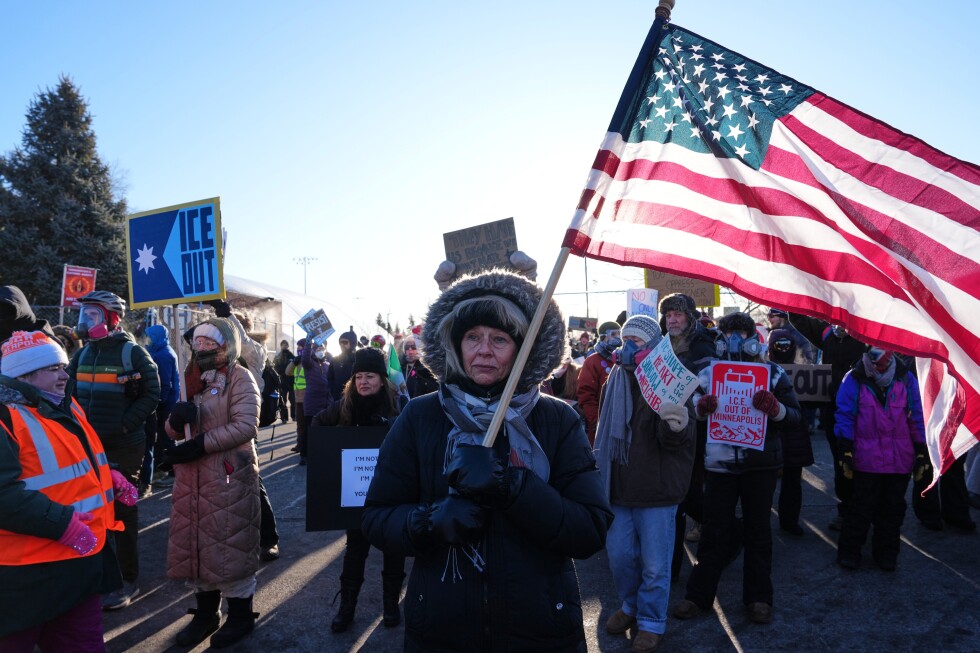
In Minneapolis, hundreds of demonstrators gathered in freezing temperatures outside the Bishop Henry Whipple Federal Building, which has become a focal point for protests in recent weeks. After listening to speeches from clergy members, protesters marched toward the facility’s restricted area, confronting Department of Homeland Security agents with chants to “quit your jobs” and “get out of Minnesota.” The demonstration largely dispersed after local law enforcement threatened arrests for blocking roadways.
“They’re roaming our streets, they’re staying in hotels near our schools,” said Michelle Pasko, a retired communications worker who joined the protest after witnessing federal agents stopping immigrants near her suburban Minneapolis home. “Everyone in this country has rights, and the federal government seems to have forgotten that. We’re here to remind them.”
The impact of the strike was felt across multiple sectors. Several school districts in Arizona and Colorado preemptively canceled classes in anticipation of mass absences. In Michigan, dozens of students walked out of morning classes at Groves High School in Birmingham, braving temperatures near zero to march to a nearby business district where commuters honked in support.
“We’re here to protest ICE and what they’re doing all over the country, especially in Minnesota,” said Logan Albritton, a 17-year-old senior at Groves. “It’s not right to treat our neighbors and our fellow Americans this way.”
In Georgia, 16-year-old Abigail Daugherty organized a walkout at Collins Hill High School in Suwanee. “For years, I have felt powerless, and seeing other schools in the county being able to do this, I wanted to do something,” the sophomore explained.
The economic impact of the strike was visible as numerous businesses closed for the day. Others remained open but pledged to donate portions of their proceeds to immigrant advocacy organizations. Otway Restaurant and its sister Otway Bakery in New York announced they would stay open but direct 50% of the day’s proceeds to the New York Immigration Coalition, citing financial pressure from recent winter storm closures.
In Portland, Maine, where Republican Senator Susan Collins recently announced that ICE would be ending its local enforcement surge, protesters gathered outside a church holding signs reading “No ICE for ME,” a reference to the state’s postal code. Grace Valenzuela, an administrator with Portland Public Schools, criticized what she called an “enforcement system that treats our presence as suspect” and lamented the “daily trauma” ICE operations brought to the school system.
“Schools are meant to be places of learning, safety and belonging. ICE undermines that mission every time it destabilizes a family,” Valenzuela said at the gathering.
Portland Mayor Mark Dion, a Democrat, emphasized the importance of public protest in response to ICE’s actions. “Dissent is Democratic. Dissent is American. It’s the cornerstone of our democracy,” Dion told the crowd.
The nationwide protests highlight growing tensions over immigration enforcement policies under the current administration. Organizers used social media to coordinate actions across the country, with one website declaring: “The people of the Twin Cities have shown the way for the whole country — to stop ICE’s reign of terror, we need to SHUT IT DOWN.”
As the day progressed, demonstrations continued to unfold in city centers, statehouses and churches across America, underscoring the widespread concern over recent enforcement tactics and their impact on immigrant communities.
Fact Checker
Verify the accuracy of this article using The Disinformation Commission analysis and real-time sources.

9 Comments
The tragic loss of life is deeply concerning. I agree there needs to be a thorough and impartial investigation to understand exactly what happened and how to prevent similar incidents in the future.
Agreed, transparency and accountability are crucial when it comes to law enforcement operations. I hope the relevant authorities handle this with the utmost care and sensitivity.
While I understand the protesters’ frustrations, I’m concerned that a nationwide strike could cause significant economic disruption. I hope they can find alternative ways to voice their concerns that minimize harm.
This is a complex and sensitive issue with valid concerns on both sides. While the right to protest is important, I hope the strike stays peaceful and constructive dialogue continues between all stakeholders.
Immigration is a polarizing topic, but I believe we should strive for humane and ethical policies that balance security concerns with compassion. Resorting to violence is never the answer.
Well said. Finding the right balance between enforcement and compassion is so important, but it’s a delicate challenge. I hope all sides can come together in good faith to work towards a just resolution.
I’m glad to see people exercising their right to protest, but I hope they can do so in a way that brings people together rather than driving them further apart. Compromise and empathy will be key to finding a way forward.
These are complex issues without easy solutions. I encourage everyone to approach this with an open mind, engage in constructive dialogue, and prioritize the safety and wellbeing of all people.
Nationwide strikes are a powerful form of civil disobedience, but I worry they could further polarize the debate. I hope protest leaders can find ways to engage constructively with policymakers to find solutions.