


Listen to the article
Immigration Policy Battle Intensifies Across States After Fatal Shooting
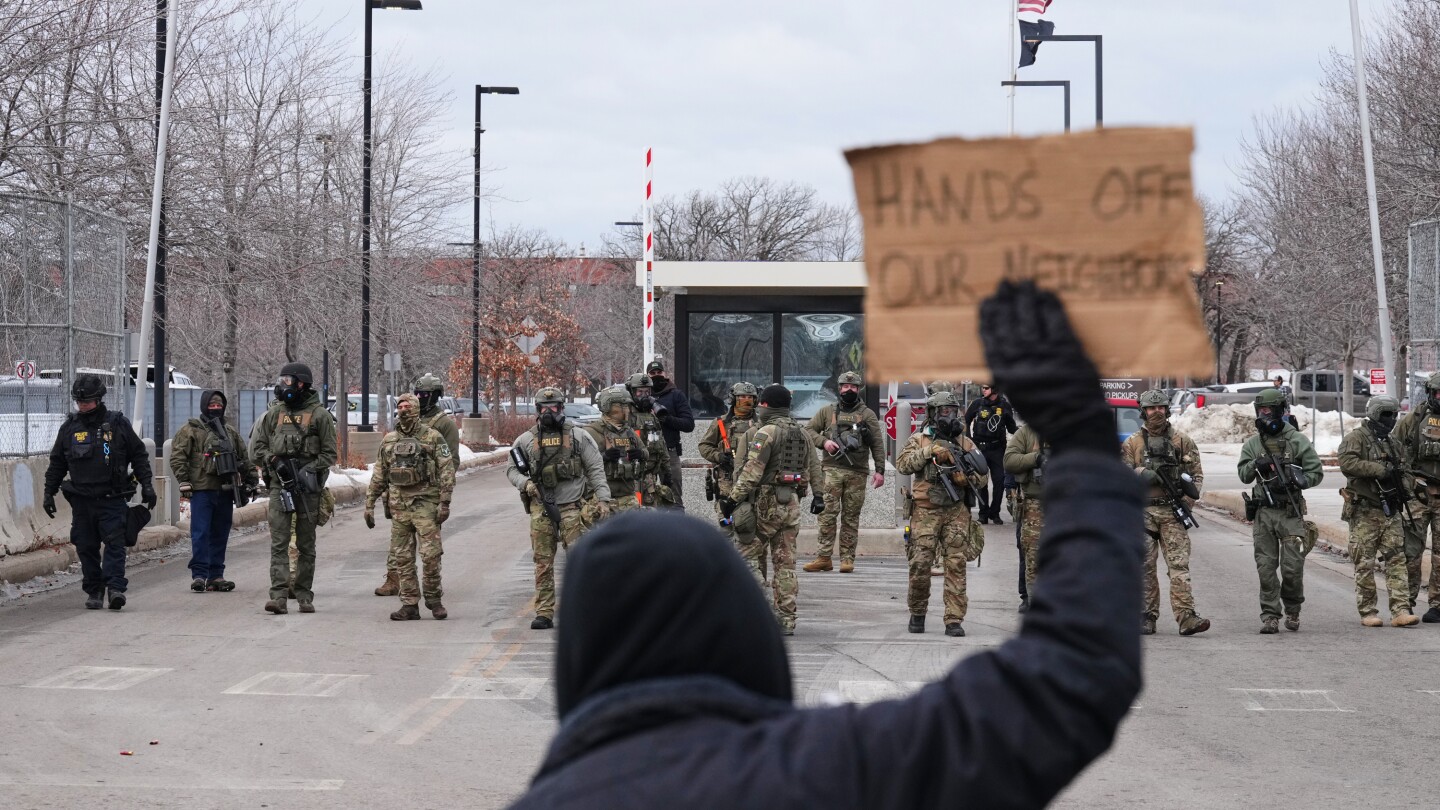
A dramatic political divide is widening across America as states take opposing approaches to immigration enforcement following the shooting death of a protester in Minneapolis. While Democratic-led states move to restrict federal immigration officers, Republican lawmakers in Tennessee have unveiled legislation backed by the White House designed to bolster President Donald Trump’s immigration crackdown.
The fatal shooting of Renee Good by an Immigration and Customs Enforcement (ICE) officer has become a flashpoint in the ongoing national debate over immigration enforcement. Democratic lawmakers are seizing the moment to advance measures that would limit federal immigration officers’ powers, while Republicans push back, claiming such restrictions impede lawful enforcement of immigration statutes.
In New York, Democratic Governor Kathy Hochul is advocating for legislation that would allow people to sue federal officers for alleged constitutional rights violations. Her proposal also aims to keep immigration officers without judicial warrants from entering sensitive locations like schools, hospitals, and houses of worship.
Similar efforts are emerging across blue states. Oregon Democrats plan to introduce legislation allowing residents to sue federal officers for Fourth Amendment violations. New Jersey’s Democrat-controlled Legislature recently passed three bills enhancing protections for immigrants, including one prohibiting state law enforcement from cooperating with federal immigration enforcement.
California lawmakers have proposed banning local and state law enforcement from taking second jobs with the Department of Homeland Security and making it a state law violation when ICE officers conduct “indiscriminate” arrests around court appearances.
“Where you have government actions with no accountability, that is not true democracy,” said Democratic State Senator Scott Wiener of San Francisco at a recent news conference.
Even in Republican-controlled states like Georgia, Democratic lawmakers are making symbolic stands. State Senator Sheikh Rahman, an immigrant from Bangladesh representing Atlanta’s diverse Gwinnett County, introduced four Senate bills designed to limit immigration enforcement—despite little chance of passage in Georgia’s conservative legislature.
“Donald Trump has unleashed brutal aggression on our families and our communities across our country,” Rahman said, highlighting the emotional intensity driving Democratic proposals.
The legislative battle lines reflect America’s increasingly polarized approach to immigration. New Hampshire provides a telling example of this divide—while Democrats have proposed numerous measures to limit federal immigration enforcement, the state’s Republican majorities recently passed a law banning “sanctuary cities” that took effect this month.
Tennessee’s Republican lawmakers are taking the opposite approach, working directly with the White House on a comprehensive package of bills. Their proposals would require government agencies to verify legal status before residents can obtain public benefits, secure professional licenses, or get driver’s licenses. The legislation would also track K-12 students’ immigration status—potentially conflicting with U.S. Supreme Court precedent—and criminalize illegal entry as a misdemeanor.
“We’re going to do what we can to make sure that if you’re here illegally, we will have the data, we’ll have the transparency, and we’re not spending taxpayer dollars on you unless you’re in jail,” Tennessee House Speaker Cameron Sexton declared at a news conference.
The Trump administration has consistently opposed efforts to limit ICE operations, suing local governments whose “sanctuary” policies restrict police cooperation with federal officers. This legal confrontation is expanding across multiple states.
California became the first state to ban most law enforcement officers, including federal immigration agents, from covering their faces while on duty. The Justice Department sued, arguing the law threatens officers’ safety amid what they describe as “unprecedented” harassment and violence. The department also sued Illinois over a law protecting medical records and regulating how institutions manage information about immigration status.
States are fighting back. Minnesota and Illinois, joined by their largest cities, sued the Trump administration this week. Minneapolis and Minnesota claim the Republican administration is violating free speech rights by targeting a progressive state that welcomes immigrants. Illinois and Chicago allege that “Operation Midway Blitz” created widespread fear among residents.
Legal experts note these novel state-level approaches will almost certainly face federal court challenges. “There’s not a super clear, concrete legal answer to a lot of these questions,” said Harrison Stark, senior counsel with the State Democracy Research Initiative at the University of Wisconsin Law School. “It’s almost guaranteed there will be federal litigation over a lot of these policies.”
As state legislatures across the country continue their sessions, the legal and political battle over immigration enforcement powers appears certain to intensify, reflecting one of the most divisive issues in American politics.
Fact Checker
Verify the accuracy of this article using The Disinformation Commission analysis and real-time sources.

12 Comments
Immigration is a complex, emotive issue. I’m curious to see how this legislative battle plays out across different states. Will they find a middle ground, or will the divide widen further?
That’s a good question. Given the political polarization, it may be difficult to reach consensus. But I hope cooler heads can prevail and they can work towards a pragmatic compromise.
This is a complex, emotionally-charged issue. I’m curious to see if state legislators can find a way to balance public safety, individual rights, and the needs of immigrant communities. Thoughtful, evidence-based policymaking is needed.
I agree, this will require a careful, measured approach. Knee-jerk reactions from either side are unlikely to lead to effective, lasting solutions. Hopefully cooler heads can prevail.
The loss of life is always tragic. I hope this incident can spur constructive dialogue and policy reforms to address immigration in a more humane, effective way. There may be room for compromise if all sides are willing to listen.
Well said. Balancing security and civil liberties is an age-old challenge. Hopefully lawmakers can put politics aside and focus on practical solutions that work for everyone.
This is a complex and polarizing issue. While immigration enforcement is necessary, I hope states can find a balance that respects individual rights and public safety. Reasonable people may disagree on the best approach.
I agree, there needs to be a thoughtful, nuanced approach that considers all perspectives. Overreach on either side is unlikely to resolve the challenges.
This seems like a volatile situation. I’m concerned that hardline stances from either side could lead to unintended consequences. Hopefully lawmakers can find a measured, evidence-based approach to address immigration while upholding civil liberties.
I agree, an overly partisan response is unlikely to resolve the underlying issues. A thoughtful, bipartisan solution that considers multiple viewpoints would be the best path forward.
Immigration reform is a long-standing challenge with no easy answers. I hope this incident can spur productive dialogue and a search for common ground, rather than fueling further division.
Well said. Compromise and nuance are often lacking in these heated debates. If lawmakers can set aside political agendas and focus on practical solutions, there may be hope for progress.