


Listen to the article
The federal government has expanded its crackdown on commercial driver’s licenses issued to immigrants, with investigations now revealing problems in eight states amid heightened safety concerns following deadly crashes.
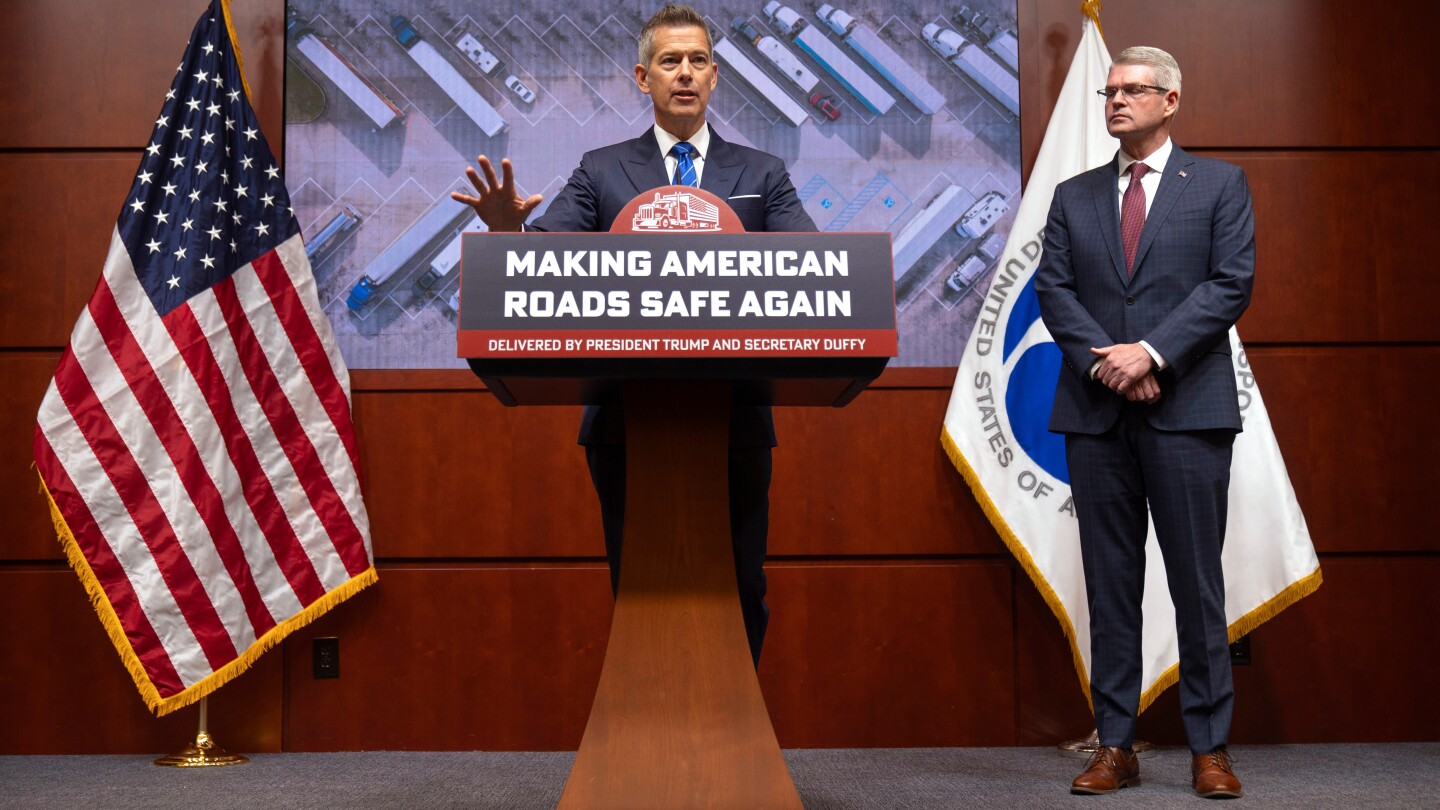
Transportation Secretary Sean Duffy has publicly threatened to withhold millions in federal funding from California, Pennsylvania, Minnesota, and most recently New York after investigations uncovered issues such as licenses remaining valid long after an immigrant’s legal status had expired. Additionally, the department quietly sent similar warning letters to Texas, South Dakota, Colorado, and Washington during the recent government shutdown.
The scrutiny intensified after two fatal crashes involving truck drivers who were in the country illegally. In August, a tractor-trailer driver unauthorized to be in the U.S. made an illegal U-turn in Florida, causing a crash that killed three people. Another fiery accident in California in October, also involving a truck driver in the country illegally, claimed three more lives.
In September, Duffy proposed new restrictions that would severely limit which non-citizens could obtain licenses to drive commercial vehicles, though these new rules have been temporarily halted by court order. Concurrently, the administration has been enforcing existing English language requirements for truckers since summer, with approximately 9,500 drivers nationwide pulled off the road for failing to demonstrate English proficiency during traffic stops or inspections.
California was the first state targeted because the driver in the Florida crash obtained his license there. After initially resisting federal pressure, the state ultimately revoked 21,000 commercial driver’s licenses last month after confirming irregularities. While this action prevented the loss of $160 million in threatened funding, Duffy did revoke a separate $40 million because California reportedly failed to enforce English language requirements for truckers.
In Pennsylvania, federal auditors identified several cases where licenses remained valid after a driver’s legal status ended, or where the state failed to require legitimate proof of legal presence. The Transportation Department has ordered Pennsylvania to halt issuing commercial licenses to immigrants until completing a comprehensive review of its approximately 12,400 non-citizen commercial drivers, with nearly $75 million in federal funding at stake.
Minnesota faces the potential loss of $30.4 million after federal investigators discovered licenses valid beyond work permit expiration dates and instances where immigration status was never verified. State officials acknowledged administrative issues among the 2,117 non-domiciled commercial licenses they’ve issued but indicated many problems had already been identified and corrected internally.
New York became the most recent public target, with Duffy highlighting that more than half of 200 reviewed licenses were improperly issued, many defaulting to eight-year validity regardless of work permit expiration dates. The state reportedly could not prove it had verified immigration status for 32,000 active non-domiciled commercial licenses, and some were issued despite expired work authorizations.
In Texas, investigators found flaws in nearly half of 123 reviewed licenses, putting $182 million in federal funding at risk. Governor Greg Abbott has directed the state’s Department of Public Safety to strictly enforce English proficiency requirements and halt issuing intrastate commercial licenses to drivers who don’t meet standards.
South Dakota’s review revealed licenses valid beyond legal status and improper issuance to Canadian citizens. The state routinely issues temporary paper licenses valid for one year regardless of immigration status, putting $13.25 million in federal funding in jeopardy.
Colorado’s audit found approximately 22% of reviewed licenses violated federal requirements, with a computer system glitch causing some licenses to default to four-year validity when workers performed multiple database searches. The state has paused issuing new licenses while conducting a comprehensive audit expected to conclude in January.
In Washington, where problems appeared in about 10% of reviewed licenses, an internal state review discovered 685 immigrant drivers who received regular commercial licenses instead of the required non-domiciled ones, often due to acceptance of incorrect documentation. This puts $31.35 million in federal funding at risk.
These enforcement actions reflect increasing federal scrutiny of state-level commercial licensing practices amid growing concerns about transportation safety and immigration compliance.
Fact Checker
Verify the accuracy of this article using The Disinformation Commission analysis and real-time sources.

6 Comments
This is a complex issue without easy solutions. On one hand, public safety must be the top priority. But on the other, we need to be cautious about unfairly discriminating against immigrant workers. Thoughtful policy changes are needed.
Stricter regulations around commercial licenses for immigrants make sense given the safety concerns raised by these incidents. However, we should ensure the process remains fair and doesn’t unfairly target law-abiding immigrants.
You make a good point. Finding the right balance between safety and fairness is important. Oversight and transparency in the licensing process will be key.
Tragic accidents like these underscore the importance of strong regulations and oversight around commercial licenses. However, any new policies should be carefully crafted to address the root issues without unduly burdening lawful immigrants.
While I understand the safety concerns, I worry these crackdowns could have unintended consequences for legal immigrants and the economy. Perhaps a more nuanced approach focusing on thorough vetting, rather than blanket restrictions, would be better.
This is a concerning issue that needs to be addressed for public safety. Allowing unauthorized immigrants to obtain commercial licenses poses serious risks. Rigorous checks and enforcement are crucial to ensure only qualified drivers are on the roads.