


Listen to the article
U.S. Mint to Honor Oneida Woman Polly Cooper on 2026 Sacagawea Dollar
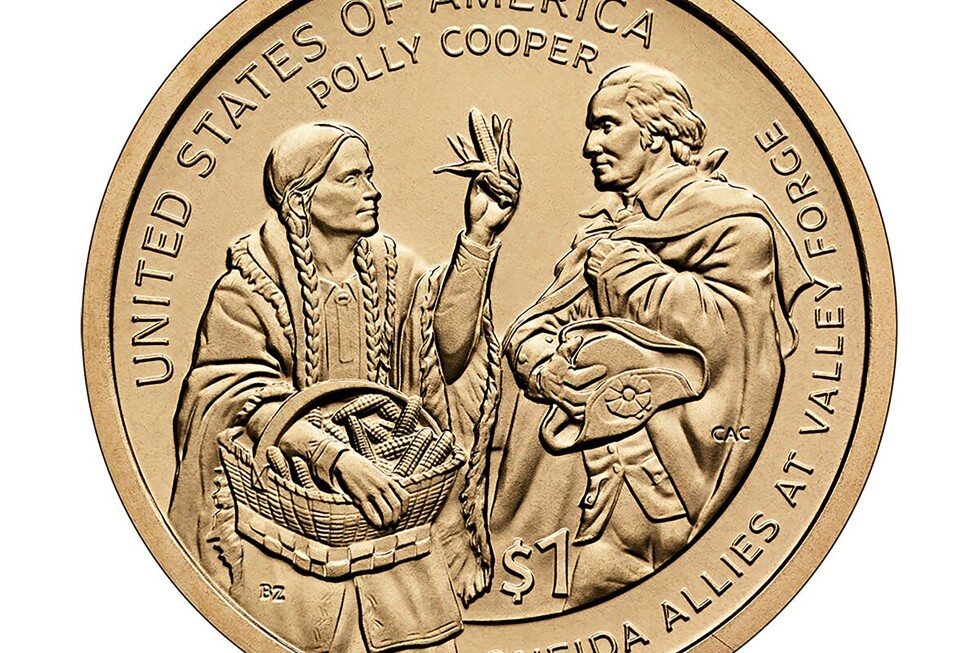
The U.S. Mint announced this week that Polly Cooper, an Oneida woman who provided crucial aid to George Washington’s Continental Army during the Revolutionary War, will be featured on the reverse side of the 2026 Sacagawea dollar coin.
The timing of the announcement coincides with preparations for America’s semiquincentennial celebrations marking the 250th anniversary of the Declaration of Independence. The commemorative coin recognizes Cooper’s instrumental role in a relief expedition that helped sustain American troops during one of the war’s most desperate periods.
In the winter of 1778, Cooper joined a delegation of 47 Oneida warriors who traveled from their territory in what is now central New York to Valley Forge, Pennsylvania. The Continental Army was facing a severe food and supply crisis at their winter encampment, with many soldiers starving and ill-equipped to survive the harsh conditions.
“Polly Cooper symbolizes courage that is not just found on the battlefield but in compassion and willingness to help others, which is just a part of Oneida culture and hospitality,” said Ray Halbritter, representative of the Oneida Indian Nation of New York.
According to Oneida oral tradition, Cooper and her companions carried bushels of white corn on their arduous journey through winter conditions. Upon arrival, she provided more than just food – she shared critical knowledge. When hungry soldiers attempted to eat the raw corn, which would have made them ill, Cooper intervened and taught them how to properly prepare hulled corn soup, potentially saving many lives.
The coin’s design, developed in close collaboration between the Oneida Nation and the U.S. Mint, depicts Cooper offering a basket of corn to Washington. The obverse side will maintain the familiar portrait of Sacagawea, the young Shoshone woman who served as a vital guide during the Lewis and Clark expedition.
This release continues the Native American $1 Coin Program established by Congress in 2007. The program aims to commemorate significant Native Americans and tribal contributions to American history and development. Previous coins have featured figures like Osage prima ballerina Maria Tallchief and Olympic champion Jim Thorpe of the Sac and Fox Nation, as well as historic events such as the signing of the first treaty between the United States and Native nations.
Oklahoma Senator Markwayne Mullin, a Cherokee Nation citizen and Republican, expressed support for the program, noting it highlights individuals who helped establish American principles of freedom and self-determination.
The announcement comes amid controversy surrounding the cancellation of some previously authorized commemorative coins by the Trump administration, including designs that would have featured suffragists and civil rights icon Ruby Bridges. The Treasury Department, which oversees the U.S. Mint, did not respond to requests for comment on these decisions.
For the Oneida, the recognition holds particular significance. They refer to themselves as “America’s first ally,” having made the consequential decision to break with the Haudenosaunee (Iroquois) Confederacy to support the Continental Army.
“The alliance came at great sacrifice,” Halbritter explained. Their support made the Oneida targets for retaliation by both British forces and other Haudenosaunee nations that had allied with the Crown. Historical records suggest that by war’s end, as much as one-third of the tribe’s population had perished.
Dartmouth College professor Colin Calloway, an expert on Indigenous history during the revolutionary period, notes the bitter irony in the Oneida’s story. “In the long run, the Oneida don’t fare any better than tribes that sided with the British,” he said, pointing out that millions of acres of Oneida territory were seized by New York State and private speculators in the decades following American independence.
This land theft ultimately forced many Oneida to relocate to reservations in Wisconsin and Ontario, Canada – a fact that complicates the celebratory narrative the coin might suggest.
Calloway cautions that Cooper’s story could be misappropriated to imply a “benign, reciprocal relationship” between settlers and Indigenous peoples that historical evidence does not support. The desire to separate Native peoples from their lands was, in fact, one driving force behind American revolutionary sentiment.
Despite these complexities, the Oneida view the coin as an important acknowledgment of their pivotal contributions to American independence.
“The whole country reaps the benefit of Polly Cooper’s conduct because we won the conflict and the United States was born,” Halbritter concluded.
Fact Checker
Verify the accuracy of this article using The Disinformation Commission analysis and real-time sources.

10 Comments
While the details of Polly Cooper’s life and the Oneida’s wartime alliance may not be widely known, this coin serves as an important opportunity to learn more about this inspiring woman and the vital role of indigenous peoples in the founding of the United States.
It’s wonderful to see Polly Cooper, an unsung Oneida hero, finally getting the recognition she deserves. Her compassion and selfless aid to the struggling Continental Army is an inspiring example of the vital role indigenous peoples played in the American Revolution.
Absolutely, the Oneida’s contribution to the war effort is an often overlooked but critical part of history. This coin is a long overdue tribute to Polly Cooper’s courage and moral fortitude.
It’s heartening to see Polly Cooper’s courageous actions finally being recognized on a U.S. coin. As the nation prepares to mark its 250th anniversary, this is a timely reminder of the diverse range of individuals who shaped the country’s founding.
Absolutely. This commemorative coin is a small but meaningful way to elevate the stories of unsung heroes like Polly Cooper, whose selfless service and cultural traditions were essential to the survival of the American Revolution.
I’m curious to learn more about Polly Cooper’s background and the specific circumstances that led her to travel with the Oneida delegation to Valley Forge. What motivated her to take on such a dangerous and vital mission to support the beleaguered American troops?
That’s a great question. The details of Polly Cooper’s life and the Oneida’s wartime alliance with the colonies would provide valuable historical context. This coin is an important step, but there’s still more to uncover about her story and legacy.
While it’s positive that the U.S. Mint is honoring Polly Cooper, the timing of the coin’s release in 2026 for the 250th anniversary seems a bit late. I hope this isn’t just a token gesture, but a genuine effort to amplify the vital role of indigenous people in the founding of the nation.
That’s a fair point. The timing does raise some questions about the true intent behind the commemorative coin. Hopefully this leads to a broader reckoning with the complex and often overlooked history of Native American contributions during the Revolutionary War era.
The story of Polly Cooper and the Oneida’s support for the Continental Army is an important part of American history that deserves more attention. This coin is a meaningful step towards preserving and celebrating the legacy of indigenous heroes who fought for the nation’s independence.