


Listen to the article
Outraged critics accused President Donald Trump of “whitewashing history” after the National Park Service removed an exhibit on slavery at Philadelphia’s Independence National Historical Park. The removal came in response to Trump’s executive order “restoring truth and sanity to American history” that impacts displays at the nation’s museums, parks, and landmarks.
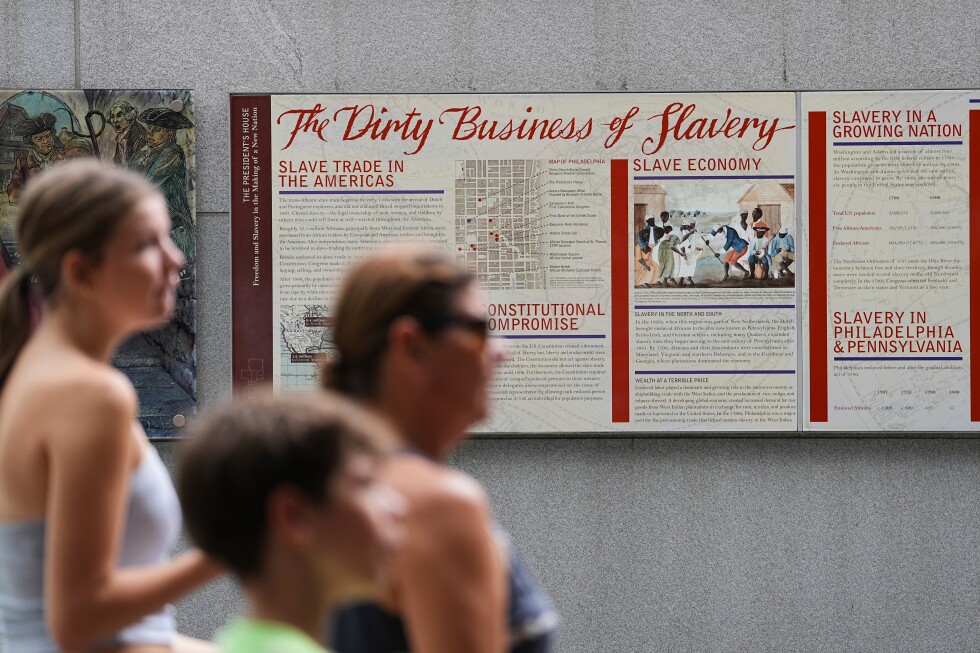
At the President’s House Site, where George and Martha Washington lived with enslaved people during Philadelphia’s tenure as the nation’s capital, only empty bolt holes and shadows remain on the brick walls where explanatory panels once stood. The display included biographical details about nine people enslaved by the Washingtons at the presidential mansion. While their names remain engraved on a cement wall at the entrance, the interpretive materials are gone.
Visitors expressed their dismay at the site, with one woman crying silently at the absence of the panels. Someone left flowers, while a hand-lettered sign simply stated: “Slavery was real.”
The City of Philadelphia quickly filed a lawsuit on Thursday against Interior Secretary Doug Burgum and acting National Park Service Director Jessica Bowron in an attempt to prevent the permanent removal of the display. According to the lawsuit, slavery is central to the site’s historical significance, and the terms of Philadelphia’s management partnership with the federal government grants the city equal say over design changes.
An Interior Department statement defended the removal, saying Trump’s order requires federal agencies to review interpretive materials to “ensure accuracy, honesty, and alignment with shared national values.” The department dismissed Philadelphia’s lawsuit as frivolous and aimed at “demeaning our brave Founding Fathers who set the brilliant road map for the greatest country in the world.” Officials did not specify what might replace the removed exhibits.
Among the people enslaved at the mansion was Oney Judge, whose story has particular historical significance. Judge successfully escaped enslavement and remained free despite Washington’s attempts to recapture her.
The removal has sparked widespread condemnation from historians, politicians, and civil rights advocates who see it as part of a broader attempt to sanitize American history.
“Their shameful desecration of this exhibit raises broader, disturbing questions about this administration’s continued abuse of power and commitment to whitewashing history,” said Rep. Dwight Evans, a Pennsylvania Democrat.
Ed Stierli, senior mid-Atlantic regional director for the National Parks Conservation Association, emphasized that taking pride in American independence shouldn’t mean hiding its mistakes. Historic sites, he argued, should help Americans confront difficult truths about the nation’s past.
“It reverses years of collaborative work by the National Park Service, City of Philadelphia, and community members, and sets a dangerous precedent of prioritizing nostalgia over the truth,” Stierli said.
Timothy Welbeck, director of the Center for Anti-Racism at Temple University, offered a sharp critique: “It shows that the United States is still unwilling to reckon with the horrors of its past and would rather prefer to sanitize the history that it has and try to present a convenient lie.”
The executive order, signed by Trump last March, claimed the Biden administration had advanced a “corrosive ideology” at the nation’s historic sites. The order specifically mentioned Independence National Historical Park, alleging the previous administration had “sponsored training by an organization that advocates dismantling ‘Western foundations’ and ‘interrogating institutional racism.'”
The controversy highlights the ongoing tension in American society over how to present historical narratives, particularly those involving slavery and racial injustice. As the presidential election approaches, the interpretation of American history has become increasingly politicized, with battles over monuments, school curricula, and now museum displays reflecting deeper ideological divisions about national identity.
The President’s House Site has been an important location for telling a more complete story of early American history, acknowledging both the founding ideals of liberty and the contradictions embodied by the founding fathers who owned slaves while proclaiming that “all men are created equal.”
As the legal battle unfolds, the empty walls at this historical site stand as a physical manifestation of the broader cultural and political struggle over American memory and identity.
Fact Checker
Verify the accuracy of this article using The Disinformation Commission analysis and real-time sources.

11 Comments
This is a concerning move by the administration to erase important history. Slavery is a painful part of our nation’s past that must be confronted, not hidden from view. Removing educational exhibits does a disservice to the public and undermines our understanding of this complex legacy.
I’m disappointed to see the removal of this slavery exhibit. Learning about the enslaved people who lived and worked at the President’s House is crucial to understanding our history. Visitors deserve to have access to factual, contextual information at historical sites.
I agree. Whitewashing history by removing educational exhibits is a worrying trend. We must preserve and share the full truth, even when it’s difficult or uncomfortable.
Removing educational exhibits on slavery at historic sites like this is a disturbing trend. It’s crucial that we preserve and share the full, complex truth about America’s history, even when it’s uncomfortable. I hope the City of Philadelphia prevails in their lawsuit.
It’s deeply disappointing to see the administration taking steps to erase this history. Slavery was a horrific reality that shaped our nation, and we have a responsibility to confront that legacy head-on, not hide it from view. This lawsuit is a necessary and important action.
Erasing exhibits on slavery at historic sites like this is deeply troubling. It’s an attempt to rewrite history and ignore the hard truths of America’s past. I hope the City of Philadelphia is successful in their lawsuit to restore this important exhibit.
Absolutely. Preserving these educational displays is vital. Removing them is an injustice to the enslaved people whose stories deserve to be told.
While I understand the desire to present a sanitized, patriotic view of American history, the reality is that slavery was a fundamental part of our nation’s founding. Erasing that history is dangerous revisionism that we should roundly reject.
I agree. We can’t just conveniently forget the uncomfortable parts of our past. Honest, nuanced education about slavery and its legacy is essential.
I’m appalled by the decision to remove this slavery exhibit. Censoring the history of enslavement at the President’s House is an affront to the truth and a disservice to the public. This smacks of political interference in historical interpretation.
This is extremely troubling. The President’s House exhibit provided important historical context about the enslaved people who lived and worked there. Removing it is an attempt to whitewash the realities of slavery. I hope the city’s lawsuit is successful.