


Listen to the article
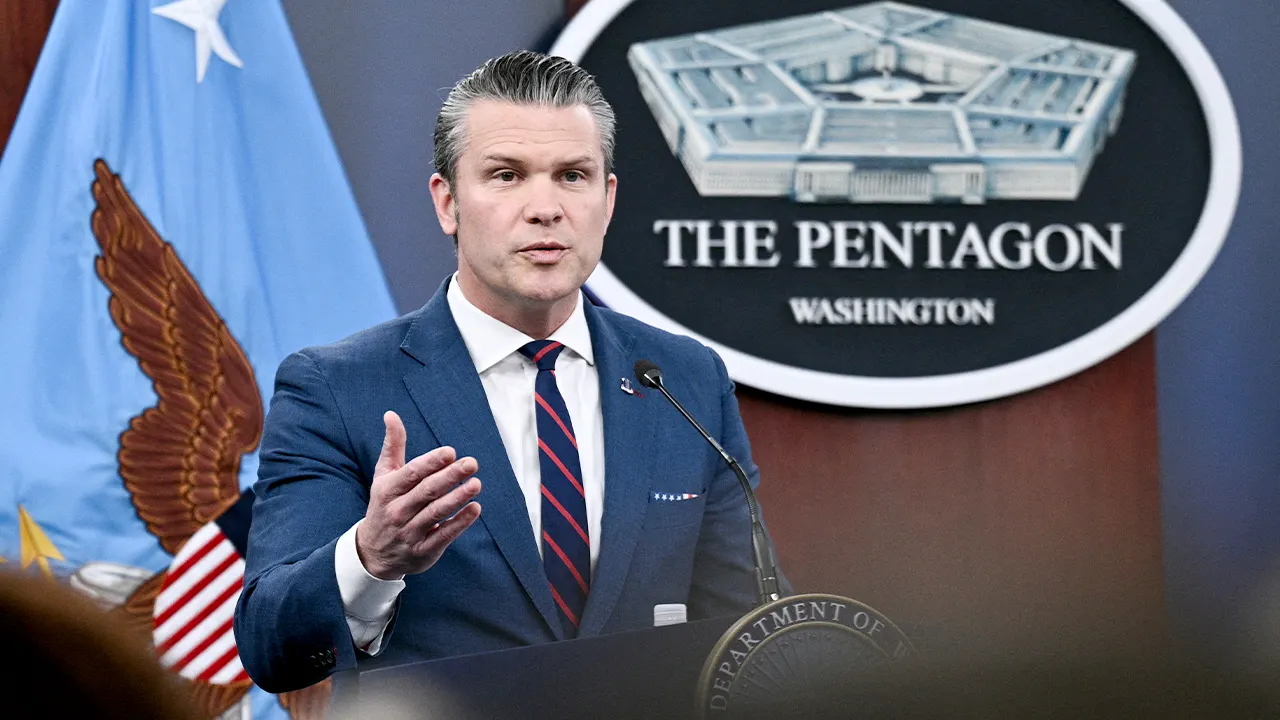
U.S. Defense Secretary Pete Hegseth outlined a focused three-part military mission against Iran on Monday, emphasizing that the operation has specific, achievable objectives rather than open-ended goals that characterized previous Middle Eastern conflicts.
During the first Pentagon briefing since joint U.S.-Israeli strikes began over the weekend, Hegseth detailed the core aims of Operation Epic Fury: destroying Iran’s offensive missile capabilities, crippling its naval forces, and preventing Tehran from acquiring nuclear weapons.
“We set the terms of this war from start to finish. Our ambitions are not utopian. They are realistic, scoped to our interests and the defense of our people and our allies,” Hegseth told reporters gathered at the Pentagon.
The Secretary’s remarks come at a critical juncture as tensions between Iran and the U.S.-Israeli alliance have escalated dramatically in recent days. The weekend’s coordinated strikes targeted key military installations across Iran, marking a significant escalation in the long-simmering conflict between the regional powers.
Military analysts note that Hegseth’s statement represents an attempt to distinguish the current operation from past U.S. military engagements in Iraq and Afghanistan, which evolved into protracted conflicts spanning decades. By explicitly stating that this conflict “is not endless,” the Defense Secretary appears to be addressing domestic concerns about potential military overreach.
The operation’s name, “Epic Fury,” suggests a high-intensity campaign, though Pentagon officials have been careful to frame it as targeted and proportionate. The three-pronged strategy focuses specifically on neutralizing Iran’s offensive capabilities rather than regime change or broader geopolitical objectives that defined previous interventions in the region.
Iran has been developing its missile program for decades, viewing it as a crucial deterrent against regional adversaries. The country possesses one of the largest and most diverse missile arsenals in the Middle East, including both ballistic and cruise missiles with varying ranges and capabilities.
The Iranian navy, while smaller than major global naval powers, has strategic significance in the Persian Gulf and Strait of Hormuz, through which approximately 20% of the world’s oil passes. Iranian naval forces, particularly the Islamic Revolutionary Guard Corps Navy (IRGCN), have previously threatened to close this vital shipping channel during periods of heightened tensions.
The third component of Hegseth’s stated mission—preventing nuclear weapons acquisition—addresses long-standing international concerns about Iran’s nuclear program. Despite the 2015 Joint Comprehensive Plan of Action (JCPOA) that aimed to limit Iran’s nuclear activities in exchange for sanctions relief, tensions have remained high, especially after the U.S. withdrew from the agreement in 2018 under then-President Donald Trump.
Regional experts suggest that by clearly delineating the operation’s objectives, the Pentagon is attempting to manage expectations and potentially limit the scope of the conflict. This approach contrasts sharply with the more expansive goals that characterized the post-9/11 wars, which included ambitious nation-building components alongside military objectives.
The timing of Operation Epic Fury comes amid a complex regional landscape, with ongoing conflicts in Gaza and Lebanon further complicating diplomatic and military calculations. Israel, a key U.S. ally in the region, has been engaged in its own escalating conflict with Iran-backed groups such as Hamas and Hezbollah.
As the operation unfolds in the coming days and weeks, international attention will focus on whether the U.S. and Israel can achieve their stated military objectives without triggering a broader regional conflagration that could draw in other powers and further destabilize the Middle East.
Fact Checker
Verify the accuracy of this article using The Disinformation Commission analysis and real-time sources.

14 Comments
While the Pentagon’s approach seems prudent, the situation with Iran remains highly volatile. Unexpected escalations or miscalculations could quickly derail the limited operation outlined by Secretary Hegseth.
Absolutely, close coordination between military, diplomatic, and intelligence efforts will be critical to mitigate risks of unintended consequences.
Hegseth’s emphasis on realistic, scoped objectives is refreshing. Avoiding the utopian goals that characterized previous Middle Eastern conflicts is a wise move. Let’s hope this operation can be carried out effectively and with minimal collateral damage.
Interesting to see the Pentagon outlining a focused, limited scope for the Iran response. Measured and realistic objectives are crucial to avoid mission creep and unintended consequences.
Agreed, a strategic, targeted approach is wise given the complex dynamics in the region.
I’m curious to see how the U.S.-Israeli alliance will execute this operation and whether they can maintain the limited scope outlined by Secretary Hegseth. Avoiding mission creep will be critical.
Yes, clear communication of objectives and parameters for success will be key to preventing the operation from escalating.
It’s encouraging to see the Pentagon taking a more measured approach this time. Maintaining laser-focus on the stated objectives will be crucial to avoiding mission creep and an escalating conflict.
While the Pentagon’s stated aims seem reasonable, the history of U.S. military interventions in the Middle East raises concerns about unintended consequences. Careful planning and execution will be essential.
Agreed, lessons from past conflicts should inform a cautious, well-considered approach this time around.
Destroying Iran’s offensive missile capabilities and crippling its naval forces seem like prudent initial steps. Preventing Iran from acquiring nuclear weapons is the ultimate goal, but achieving that will require sustained diplomatic efforts as well.
Absolutely, a comprehensive strategy balancing military and diplomatic pressure will be essential.
Crippling Iran’s naval forces and missile capabilities could have significant implications for the global commodities market, especially oil and gas. I’ll be closely watching how this unfolds and what impacts it may have.
Good point. Any disruptions to Iran’s energy exports or regional shipping lanes could roil global energy and commodity prices.