


Listen to the article
Missouri Redistricting Fight Escalates as Opponents Submit 300,000 Petition Signatures
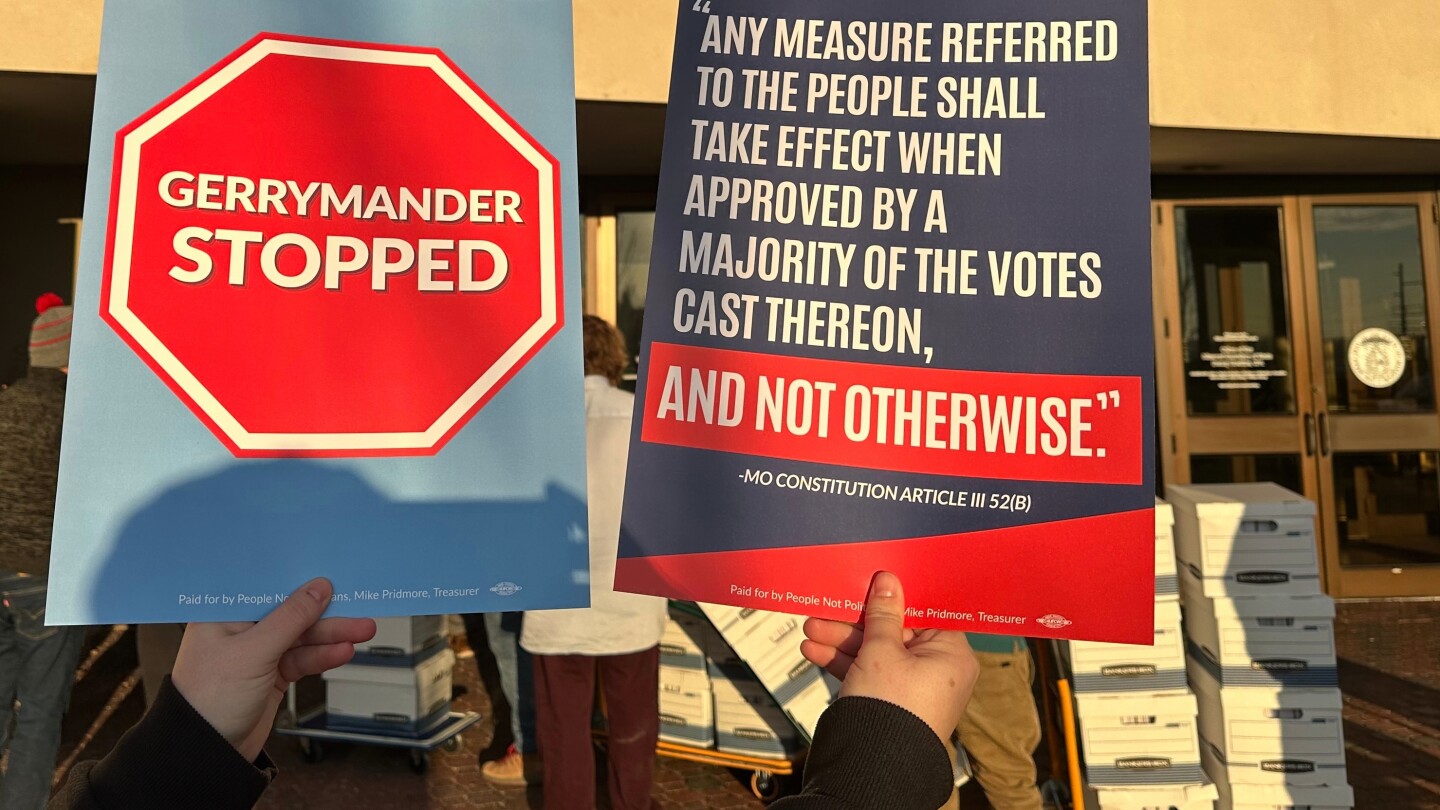
Opponents of Missouri’s new congressional map submitted more than 300,000 petition signatures on Tuesday, potentially triggering a statewide referendum that could derail Republican efforts to maintain control of the U.S. House of Representatives in 2024.
The petition drive, organized by the group People Not Politicians, easily exceeded the approximately 110,000 signatures required to suspend implementation of the newly approved districts until voters can weigh in. If verified, the referendum would likely appear on the November 2024 ballot, unless Missouri legislators schedule an earlier vote during their upcoming session beginning in January.
“At the end of the day, these are going to have to get counted, and people are going to vote on this,” said Richard von Glahn, executive director of People Not Politicians, which spearheaded the referendum effort.
The move represents a significant challenge to President Donald Trump’s nationwide redistricting strategy. Trump has urged Republican-controlled state legislatures to reshape congressional districts to help maintain the GOP’s slim majority in the House, where Democrats need a net gain of just three seats to win control and potentially block key elements of Trump’s second-term agenda.
The dispute has significant electoral implications for Missouri, particularly in the Kansas City area where Republicans hope their redrawn map could help them flip a currently Democratic-held seat. However, if the referendum proceeds, it would create uncertainty about which district boundaries will be used in the 2024 elections. Missouri’s candidate filing period runs from February 24 through March 31, though district lines can still be adjusted after that deadline, as occurred when the legislature last approved districts in 2022.
Republican Secretary of State Denny Hoskins, who must verify the petition signatures, has argued that the referendum itself is unconstitutional. This sets the stage for what could be a protracted legal battle over whether the vote can proceed.
The Missouri conflict is part of an unusual mid-decade redistricting wave sweeping through multiple states. Typically, congressional maps are redrawn only once every ten years following the national census, but the current political climate has triggered an intense battle for electoral advantage.
Texas led the way by passing a new congressional map that could help Republicans win five additional seats, a move the U.S. Supreme Court recently allowed to stand for the 2026 elections. Republicans could also gain seats under new maps in North Carolina and Ohio, while Indiana is considering changes that might deliver two more Republican-leaning districts.
Democrats have scored redistricting victories of their own. California voters approved a new Democratic-drawn map in November that could help the party win five additional seats, and a judge-imposed redistricting plan in Utah could net Democrats one more seat. However, Republicans are challenging both outcomes in court, and Utah lawmakers are currently meeting to consider delaying candidate filing deadlines during the legal fight.
In Missouri, the redistricting battle has become especially contentious. People Not Politicians has raised approximately $5 million, primarily from out-of-state organizations opposed to the new map. National Republican groups have responded by pouring more than $2 million into a committee supporting the redrawn districts.
The fight has taken several unusual turns. According to a lawsuit filed by a signature-gathering company hired by People Not Politicians, organizations supporting the Republican redistricting plan allegedly attempted to pay petition circulators up to $30,000 to stop collecting signatures.
Additionally, Secretary Hoskins contends he cannot legally count roughly 100,000 petition signatures gathered between the legislative approval of the redistricting bill and his formal approval of the referendum petition format. He has also written a controversial ballot summary stating the new map “repeals Missouri’s existing gerrymandered congressional plan … and better reflects statewide voting patterns” – language that referendum supporters are challenging in court as misleading.
Meanwhile, Republican Attorney General Catherine Hanaway filed a federal lawsuit asserting that congressional redistricting legislation cannot be subject to a referendum at all. Although a federal judge dismissed that suit on Monday, the ruling noted that Hoskins still has “the power to declare the petition unconstitutional himself,” which would likely trigger new litigation.
The last time Missouri held a referendum on congressional redistricting was over a century ago. In 1922, voters rejected U.S. House districts approved by the Republican-led legislature, with nearly 62% voting against the plan.
Fact Checker
Verify the accuracy of this article using The Disinformation Commission analysis and real-time sources.

10 Comments
The petition drive to force a public vote on Missouri’s new congressional map is an important development. Redistricting can have major implications, so it’s crucial that the process is transparent and that voters have a direct say. I’m curious to see how this plays out.
Absolutely. Partisan gerrymandering erodes public trust in the democratic process, so it’s encouraging to see citizens mobilizing to challenge these efforts. A referendum gives voters a chance to have their voices heard on this critical issue.
Interesting to see this redistricting fight in Missouri. It’s important that the public has a say in how districts are drawn, even if it goes against party interests. I’m curious to see how this plays out and whether the referendum will make it to the ballot.
This is a complex issue with high stakes for both parties. I appreciate that the opponents of the Trump-backed redistricting plan in Missouri are trying to give the public a direct say through a referendum. Transparent and fair redistricting processes are crucial for democracy.
Agreed, it’s good to see citizens exercising their right to challenge redistricting plans through the democratic process. Even if it may go against the interests of a particular party, giving voters a voice on these important issues is essential.
The Trump-backed redistricting plan in Missouri is facing strong pushback from opponents. I appreciate that they’ve gathered over 300,000 signatures to trigger a potential referendum. It’s good to see democratic processes being used to challenge partisan gerrymandering efforts.
This is a high-stakes political battle over redistricting in Missouri. The petition drive to force a public vote is an interesting tactic, but it remains to be seen if it will be successful. Curious to hear more perspectives on the potential implications of this referendum.
The petition drive to force a public vote on Missouri’s new congressional map is a significant development. I’m glad to see citizens taking action to challenge redistricting efforts that may be seen as unfairly partisan. It will be interesting to see how this plays out.
Kudos to the opponents of the Trump-backed redistricting plan in Missouri for mobilizing such a large petition effort. Giving voters a direct say on how districts are drawn is important for democracy, even if it goes against the interests of a particular party.
This petition drive to force a public vote on the new congressional map is a significant development. It will be important to see if the signatures are verified and the referendum makes it to the ballot. Redistricting can have major implications, so giving voters a direct say is crucial.