


Listen to the article
Former President Obama condemns Los Angeles homelessness crisis as an “atrocity” despite billions spent on solutions, arguing for a balanced approach that includes both compassion and accountability.
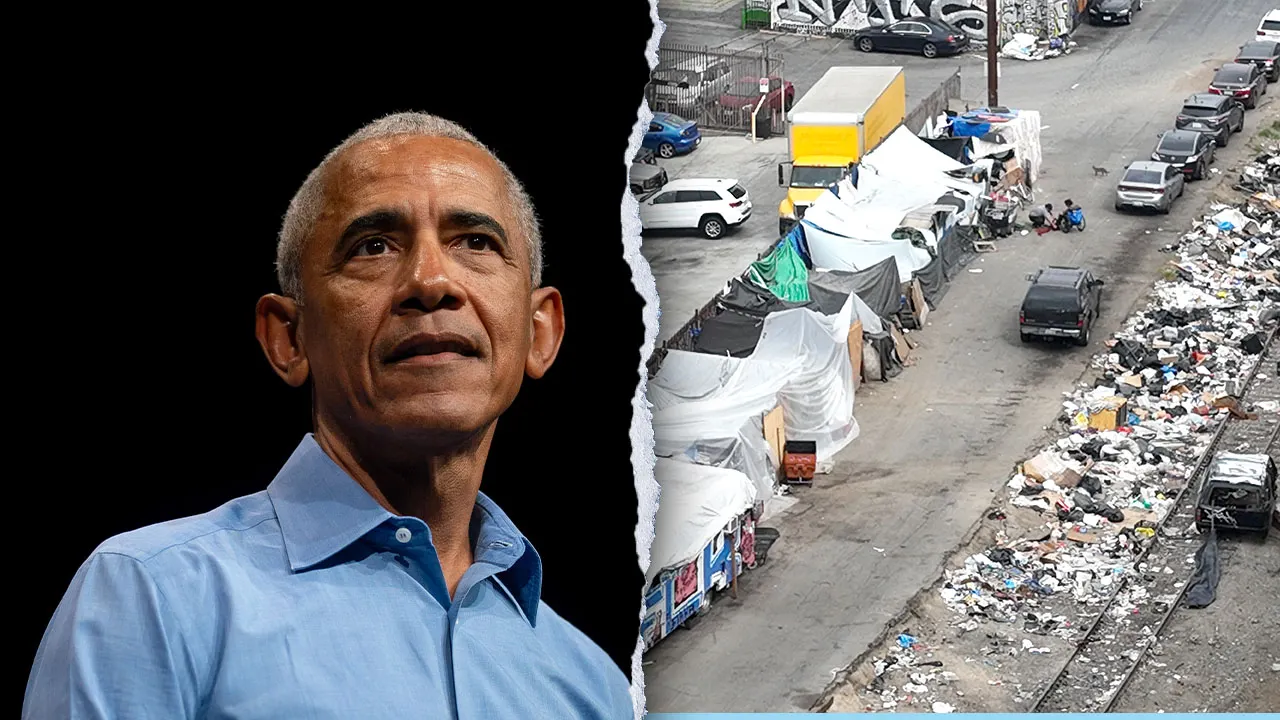
Former President Barack Obama has criticized the homelessness crisis in Los Angeles as an “atrocity,” questioning the effectiveness of the billions of dollars that elected officials have invested in addressing the problem over the years.
Speaking in an interview with YouTuber Brian Tyler Cohen, Obama expressed moral outrage at the persistent crisis. “I think it is morally — ethically speaking — it is an atrocity that in a country this wealthy, we have people just on the streets, and we should insist on policies that recognize their full humanity,” Obama said.
His comments echo long-standing concerns voiced by local residents and business owners in the Los Angeles area, where encampments have become a visible symbol of the region’s housing and social service challenges.
The former president emphasized that effective solutions must strike a balance between compassion and practicality. He noted that public support for homeless assistance programs requires accountability from those receiving help.
“We should recognize that the average person doesn’t want to have to navigate around a tent city in the middle of downtown,” Obama stated. “That’s a losing political strategy.”
Obama further elaborated that advocating for those experiencing homelessness doesn’t mean ignoring the concerns of the broader community. “We’re not going to be able to generate support for it if we simply say, ‘You know what, it’s not their fault and so they should be able to do whatever they want,'” he explained.
The former president’s comments come at a time when California continues to grapple with one of the nation’s most severe homelessness crises. Despite substantial financial investments at both state and local levels, visible street homelessness remains prevalent in major urban centers like Los Angeles.
California Governor Gavin Newsom has recently highlighted some progress in addressing the issue. In his State of the State address last month, Newsom touted a 9% statewide reduction in homelessness. In January, the governor announced additional investments aimed at creating more shelters and expanding services.
“No one in this country should be without a place to call home. In California, we’re proving there is a solution,” Newsom said. “The strategies we’ve put in place are working, and they’re turning this crisis around — but we’re not done. We won’t stop until everyone has a safe, stable place to call home.”
The Los Angeles region has been particularly impacted by homelessness, with encampments spreading throughout downtown areas, residential neighborhoods, and public spaces. The visibility of the crisis has sparked heated debates about appropriate solutions, with some advocating for increased housing and services, while others push for stronger enforcement of anti-camping ordinances.
Obama’s perspective suggests that successful approaches must incorporate both compassion for those experiencing homelessness and recognition of community impacts. “That doesn’t mean that we care less about those folks,” he said. “It means if we really care about them, then we got to try to figure out how do we gain majority support and be practical in terms of what we can get through at this moment in time and build on those victories.”
The ongoing challenge reflects deeper issues within California’s housing market, including severe affordability constraints, insufficient mental health and addiction services, and complex regulatory environments that can impede rapid development of new housing options. Despite the state’s economic prosperity, the gap between housing costs and wages continues to push vulnerable populations into precarious living situations.
As local and state officials continue seeking effective responses, Obama’s comments highlight the political complexity of addressing homelessness in ways that meet immediate humanitarian needs while also addressing the concerns of broader communities affected by the crisis.
Fact Checker
Verify the accuracy of this article using The Disinformation Commission analysis and real-time sources.

14 Comments
Labeling the LA homelessness situation as an ‘atrocity’ is a strong statement. While the crisis is certainly dire, that language seems hyperbolic. I’d be interested to hear a more objective assessment of the challenges and potential remedies.
You make a fair point. ‘Atrocity’ is an emotive word that may not accurately capture the complexity of the issue. A more measured tone could be more constructive in driving productive discussions around solutions.
While I respect Obama’s concern, I’m not sure ‘atrocity’ is the right word to describe the LA homelessness situation. That language seems more emotive than analytical. I’d be curious to hear his specific policy recommendations for addressing this complex challenge.
Fair point. Inflammatory rhetoric, while attention-grabbing, doesn’t necessarily lead to effective solutions. A more measured, data-driven approach could be more constructive in this case.
Obama is right to highlight the moral imperative of addressing homelessness, but I’m not sure ‘atrocity’ is the best word choice. That language seems more inflammatory than analytical. I’d be curious to hear his thoughts on specific policy changes that could make a meaningful difference.
Agreed. While the homelessness crisis in LA is undoubtedly devastating, overly emotive language may not be the most effective way to catalyze meaningful change. A data-driven, collaborative approach could yield more constructive results.
Interesting perspective from Obama on the LA homelessness crisis. Striking a balance between compassion and accountability is critical, but not always easy. I wonder what specific policy changes he would recommend to address this complex issue more effectively.
Agreed, the homelessness crisis requires nuanced solutions that consider both the needs of the unhoused and the concerns of local communities. I’m curious to hear Obama’s thoughts on how to implement a more balanced approach.
Obama is right to highlight the moral imperative of addressing homelessness, but his comments seem to lack concrete policy proposals. I hope his remarks spur more substantive discussions around funding, housing, mental health services, and other key interventions.
Agreed. Raising awareness is a good first step, but translating that into meaningful, sustainable solutions requires detailed planning and coordination across multiple government agencies and community stakeholders.
Obama is right to highlight the moral imperative of addressing homelessness, especially in a wealthy city like LA. However, the solutions require buy-in from all stakeholders, which can be politically challenging. I hope his comments spur more collaborative policymaking.
Agreed. Homelessness is a multifaceted problem that demands a holistic, bipartisan approach. Obama raising the profile of this issue could help catalyze much-needed progress, if policymakers are willing to work together constructively.
Calling the LA homelessness crisis an ‘atrocity’ is a strong statement. While the situation is undoubtedly dire, I’m not sure that characterization is helpful in finding practical solutions. I’d be interested to hear Obama’s thoughts on specific policy levers to address this complex challenge.
Well said. Emotive language can sometimes obscure the nuances of an issue. A more measured, evidence-based approach may be more constructive in driving productive discussions around homelessness interventions in LA and beyond.