


Listen to the article
In the quest to harness the power of the stars, scientists are making notable progress toward turning nuclear fusion into a viable energy source, though significant challenges remain before it can power our electrical grid.
Nuclear fusion, the same process that powers our sun and other stars, occurs when immense pressure and high temperatures force atomic nuclei to combine, releasing enormous energy. This natural phenomenon prevents stars from collapsing under the force of gravity while radiating heat and light across the cosmos.
“The fusion here on Earth has a lot of corollaries to how we understand how stars work in astrophysics,” explains Bob Mumgaard, CEO of Commonwealth Fusion Systems. “They both rely on studying plasma, the fourth state of matter. They both have the same types of reactions, and we use some of what we learn in how the stars work to inform how to build better fusion machines on Earth.”
Scientists have pursued fusion power since the 1950s when they first designed experimental machines. More than seven decades later, the goal of generating commercially viable electricity from fusion remains elusive, though recent breakthroughs have renewed optimism in the field.
“The biggest misconception is thinking that fusion is right around the corner. Or that people think, on the other hand, that it’s a total failure. And it’s neither. It’s real progress combined with real uncertainty,” says Adam Stein, director of nuclear energy innovation at the Breakthrough Institute.
The technical challenges are formidable. Creating fusion on Earth requires generating plasmas at temperatures hotter than the sun, developing materials that can withstand extreme heat, and maintaining plasma stability. Until recently, fusion experiments consumed substantially more energy than they produced.
A significant milestone occurred in 2022 when the National Ignition Facility at Lawrence Livermore National Laboratory demonstrated that fusion could generate more energy than it directly consumed in the reaction itself. However, the breakthrough was modest – producing enough power to keep a small LED light bulb illuminated for about 20 hours. Critics note that powering the entire facility required roughly 100 times more energy than what was produced in the experiment.
“NIF put in enough energy to power roughly a thousand homes and got enough out to power an LED. Because the overall system has inefficiency,” Stein explained.
Despite these challenges, investment in fusion technology has accelerated. The industry raised $2.6 billion in private and public funding in the 12 months leading to July 2025. While impressive, this represents only a fraction of investment in established energy sources – the nuclear sector received an estimated $70 billion in 2025, while solar energy investment reached approximately $450 billion.
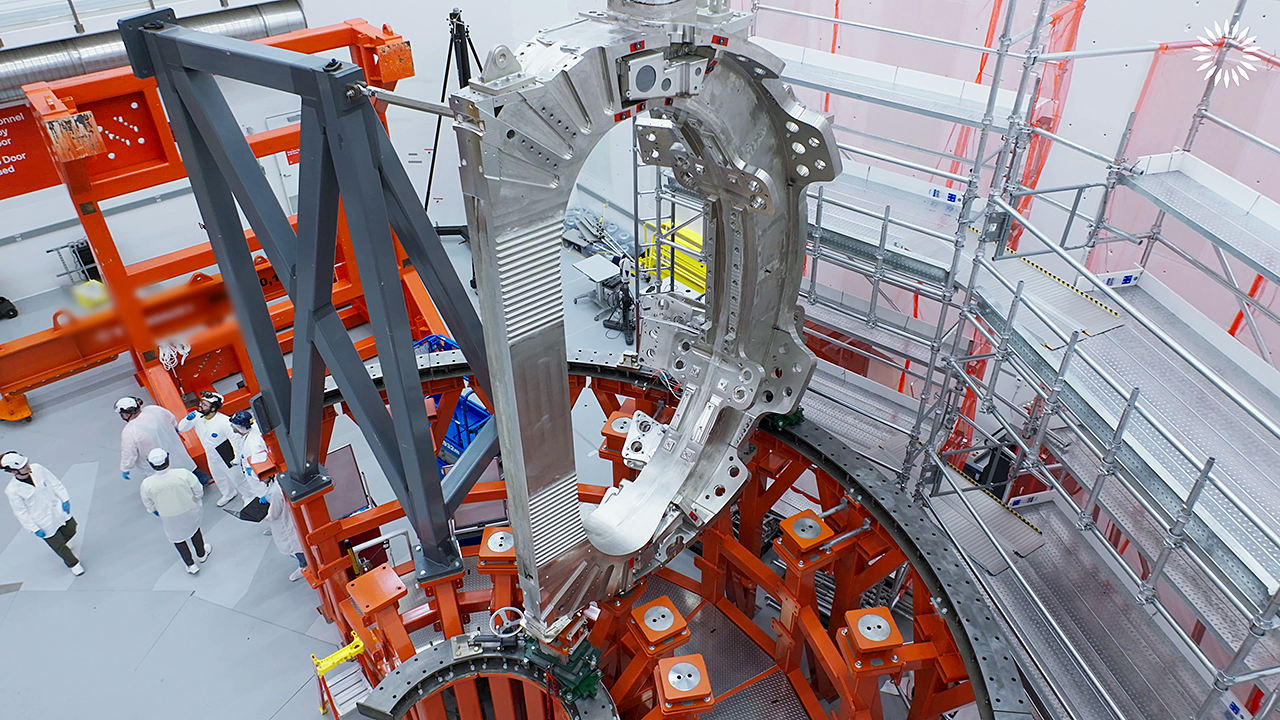
Commonwealth Fusion Systems is among the companies working to shorten the timeline for commercial fusion. Mumgaard believes his company could have a viable reactor by the early 2030s, saying, “We’ve learned a lot about what it takes to make these machines. The scientific advance has happened. And we’re now at the stage where we have confidence in that science, that fusion is turning more to an engineering problem.”
Artificial intelligence is accelerating progress across the energy sector, including fusion research. Commonwealth Fusion Systems uses NVIDIA software to monitor and map fusion plants in real time, while Google’s DeepMind technology helps better control plasma behavior.
“Whether that’s to make the computer simulations run faster or to make the control systems for the plasma able to react faster, gain insights in how to build the machines. And so you see that in our company but in fusion labs around the world that A.I. is having an accelerating factor in this whole field,” Mumgaard said.
Not everyone shares the optimism. Elon Musk has dismissed fusion as a “pet science project” and advocated for greater investment in solar energy instead. However, support for fusion research crosses political lines, with Energy Secretary Chris Wright stating at Semafor’s World Economy Summit in April 2025: “Definitely in the next several years, we’re gonna see at scale much more energy come out than goes in in fusion devices. It’s a little bit of time after that to make it commercial and machines and all that, but it’s coming.”
As global energy demands continue to rise, fusion proponents believe the technology could eventually help alleviate strain on power grids. Calvin Butler, CEO of Exelon, notes, “We need every electron on this system. And if and when fusion becomes commercially viable, it should also be in that equation because it’s that important.”
Stein offers a balanced perspective on fusion’s place in our energy future: “Fusion isn’t a near-term energy solution. It’s not science fiction either, but it’s a long-horizon, high-risk, high-reward option with unavoidable uncertainty. The near-term solution is fission and other energy sources that we already know how to build. But that does not mean that we shouldn’t pursue fusion for mid to long-term energy needs.”
Fact Checker
Verify the accuracy of this article using The Disinformation Commission analysis and real-time sources.

13 Comments
While the fusion breakthroughs are exciting, the article is right to emphasize the lingering challenges around integrating this technology into the existing power grid. Significant infrastructure upgrades will likely be required.
Nuclear fusion is one of the holy grails of clean energy. The scientific progress is encouraging, but the article highlights the daunting technical obstacles that still must be overcome.
While the fusion breakthroughs are exciting, the article rightly notes that major hurdles remain around integrating this technology into the existing power grid. Curious to see how scientists address those challenges.
Yes, the grid integration issue is a critical one that will likely require significant infrastructure upgrades and new transmission capabilities. But the potential payoff makes it a worthwhile problem to solve.
Powering the electrical grid with fusion would be a game-changer, but the article rightly highlights the significant integration challenges that remain. Patience and persistence will be key.
Good point. Transitioning such a fundamental part of our energy infrastructure won’t be easy, but the potential rewards are enormous if they can overcome the technical obstacles.
I’m glad to see the field of nuclear fusion making steady progress, even if full commercialization is still elusive. Cautious optimism seems warranted given the scale of the challenge.
Nuclear fusion has long held the promise of abundant, safe, and environmentally-friendly energy. While the technical hurdles are immense, the potential benefits make it a worthy pursuit.
Agreed. Even if it takes decades more to achieve commercial viability, the scientific advances along the way could have valuable applications in other fields.
Fascinating to see how the insights from stellar astrophysics are informing the development of fusion reactors on Earth. The parallels between these processes are really quite remarkable.
Absolutely. The cross-pollination of knowledge between these fields is a great example of how scientific disciplines can synergistically advance each other’s understanding.
Exciting to see the progress on nuclear fusion technology, even if challenges remain. Harnessing the power of the stars for clean, sustainable energy would be a huge breakthrough.
Absolutely. The parallels between fusion and stellar astrophysics are fascinating. I’m curious to learn more about how that cross-pollination of knowledge is advancing the technology.