


Listen to the article
The Trump administration has issued a sweeping new order that could lead to the arrest of tens of thousands of refugees who are lawfully in the United States but have not yet obtained permanent residency status. The directive, outlined in a Department of Homeland Security memo filed Wednesday ahead of a federal court hearing in Minnesota, overturns years of established legal protections for refugees.
According to the memo, refugees applying for green cards must return to federal custody one year after their admission to the U.S. for a review of their applications. The document states that DHS “may maintain custody for the duration of the inspection and examination process,” potentially subjecting refugees to indefinite detention.
Refugee advocacy and resettlement organizations have strongly condemned the order, which will likely face significant legal challenges. The directive has created widespread concern among the nearly 200,000 refugees who entered the United States during the Biden administration, many of whom could be affected by this policy shift.
This order represents the latest in a series of immigration restrictions implemented by the Trump administration, which has fundamentally altered longstanding U.S. refugee policies. Previous measures have included dramatically reducing the number of refugees admitted to the country and suspending green card approvals for those who arrived during the Biden years, as revealed in a memo obtained by The Associated Press late last year.
While the administration has cited national security and economic concerns as justification for these policy changes, experts emphasize that refugees admitted to the U.S. already undergo comprehensive vetting procedures before arrival.
The timing of the order is particularly significant, as it came just hours before U.S. District Judge John Tunheim heard arguments on whether to extend a temporary order protecting Minnesota refugees from arrest and deportation. Though Tunheim’s order currently applies only in Minnesota, the implications of the new national policy dominated Thursday’s court proceedings.
During the hearing, Justice Department attorney Brantley Mayers argued that the government should have the authority to arrest refugees one year after their entry into the U.S., though he suggested such arrests would be discretionary. “That’s a discretion call for DHS to make,” Mayers stated, a comment that was met with skepticism from attorneys representing Minnesota refugees.
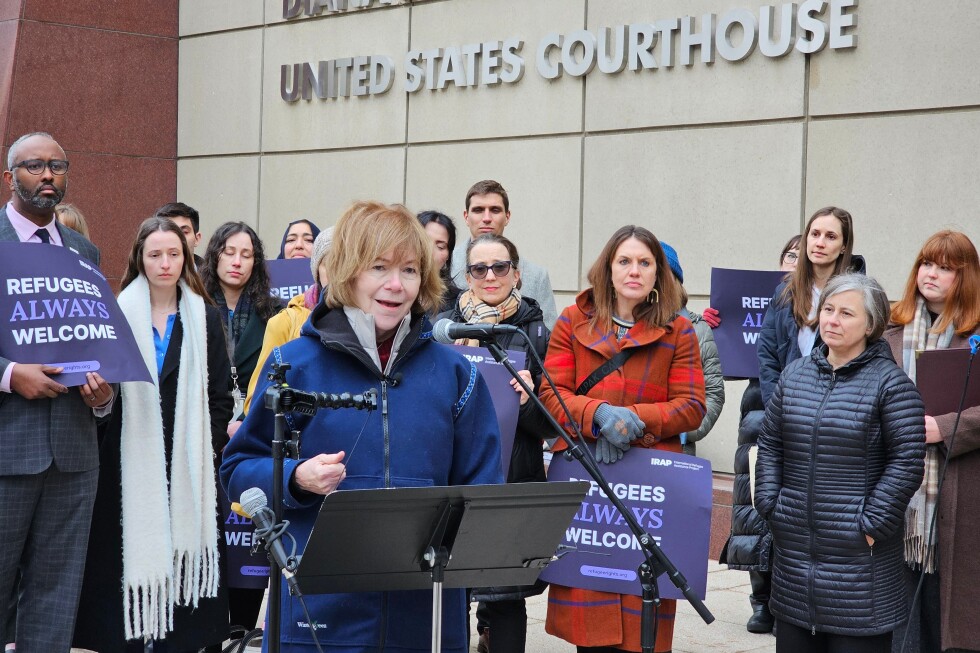
Judge Tunheim did not issue an immediate ruling, indicating he would provide a written decision on extending the temporary order. Following the hearing, Democratic U.S. Senator Tina Smith of Minnesota criticized the government’s position, stating they “failed to offer any coherent argument for their policy in either law or fact.”
HIAS, an international Jewish nonprofit serving refugees and asylum-seekers, described the new policy as “a transparent effort to detain and potentially deport thousands of people who are legally present in this country, people the U.S. government itself welcomed.”
“They were promised safety and the chance to rebuild their lives. Instead, DHS is now threatening them with arrest and indefinite detention,” said Beth Oppenheim, the group’s CEO.
Last month, Judge Tunheim blocked the government from targeting Minnesota refugees, stating that the plaintiffs would likely prevail in their claims “that their arrest and detention, and the policy that purports to justify them, are unlawful.” His temporary restraining order, issued January 28, expires February 25 unless he grants a more permanent preliminary injunction.
Tunheim previously rejected the government’s assertion that it had legal authority to arrest and detain refugees without green cards after one year of U.S. residency. He called this interpretation “nonsensical” since refugees cannot even apply for green cards until they’ve been in the country for a year.
The legal challenge began in January after the government launched Operation PARRIS (Post-Admission Refugee Reverification and Integrity Strengthening), described as a “sweeping initiative” to reexamine cases of 5,600 Minnesota refugees who had not yet received permanent resident status. Federal authorities cited fraud in public programs as justification.
Operation PARRIS was part of a broader immigration enforcement operation in Minnesota that the Department of Homeland Security characterized as the largest in U.S. history. The operation sparked widespread protests, particularly after federal agents shot and killed two U.S. citizens. While White House border czar Tom Homan announced last week that the surge was ending, a smaller federal presence will remain.
In his earlier order, Judge Tunheim emphasized that refugees are extensively vetted by multiple agencies before resettlement in the U.S. He noted that none of those arrested under Operation PARRIS had been deemed dangerous to the community or flight risks, nor had any been charged with deportable offenses.
“They are not committing crimes on our streets, nor did they illegally cross the border,” Tunheim wrote. “Refugees have a legal right to be in the United States, a right to work, a right to live peacefully.”
Fact Checker
Verify the accuracy of this article using The Disinformation Commission analysis and real-time sources.

7 Comments
While immigration policy is complex, this order appears to undermine the rule of law and basic human rights. Subjecting refugees to indefinite detention is extremely troubling and counterproductive.
I share your concerns. Refugee protection should be a priority, not a target for punitive policies. This order seems to erode hard-won legal safeguards.
Subjecting refugees to prolonged detention after being lawfully admitted is extremely concerning. This appears to undermine established protections and could have devastating impacts on refugee families and communities.
I agree, this is a very worrying development. The administration should focus on processing refugee applications efficiently and humanely, not arbitrarily detaining people.
This new order seems troubling. Detaining legal refugees indefinitely raises serious humanitarian and legal concerns. I hope the administration reconsiders this policy and works to protect the rights of vulnerable refugees.
Detaining lawful refugees is cruel and unjust. This policy seems to go against the fundamental principles of refugee protection. I hope refugee advocates are able to successfully challenge this order in court.
This is a disturbing shift in policy that could traumatize thousands of refugees who have already faced tremendous hardship. I hope the courts swiftly intervene to block this directive and uphold the rights of these vulnerable individuals.