


Listen to the article
New Mexico Launches Investigation into Forced Sterilization of Native American Women
New Mexico has approved a historic investigation into the forced sterilization of Native American women that occurred throughout the 1970s, confronting a dark chapter in U.S. healthcare history that has long gone unaddressed by the federal government.
The state legislature recently passed a measure directing the New Mexico Indian Affairs Department and the Commission on the Status of Women to examine the history, scope, and lasting impact of coerced sterilizations performed by the Indian Health Service (IHS) and other providers. The investigation will focus particularly on women of color who were sterilized without their full and informed consent.
“It’s important for New Mexico to understand the atrocities that took place within the borders of our state,” said state Senator Linda Lopez, who co-sponsored the legislation. The findings are expected to be delivered to the governor by the end of 2027.
New Mexico joins a growing number of states confronting similar historical injustices. Vermont launched a truth and reconciliation commission in 2023 to study forced sterilization of marginalized groups, while California began issuing reparations in 2024 to individuals sterilized without consent in state-run facilities.
The scale of these sterilizations first came to light in the mid-1970s when Dr. Connie Redbird Uri, a physician of Choctaw and Cherokee descent, reviewed IHS records. She alleged that the federal agency had sterilized as many as 25% of its female patients of childbearing age. Some women interviewed by Uri were unaware they had been sterilized, while others reported being pressured into consenting or misled about the procedure’s permanence.
Uri’s allegations prompted a Government Accountability Office (GAO) audit, which found the Indian Health Service had sterilized 3,406 women across just four of the agency’s twelve service areas between 1973 and 1976, including in Albuquerque. Many patients had signed consent forms that failed to comply with federal regulations designed to ensure informed consent, and some were under 21 years of age.
However, advocates believe the full extent remains unknown since the GAO never interviewed affected women, citing methodological concerns. The IHS and the Department of Health and Human Services did not respond to requests for comment on New Mexico’s investigation.
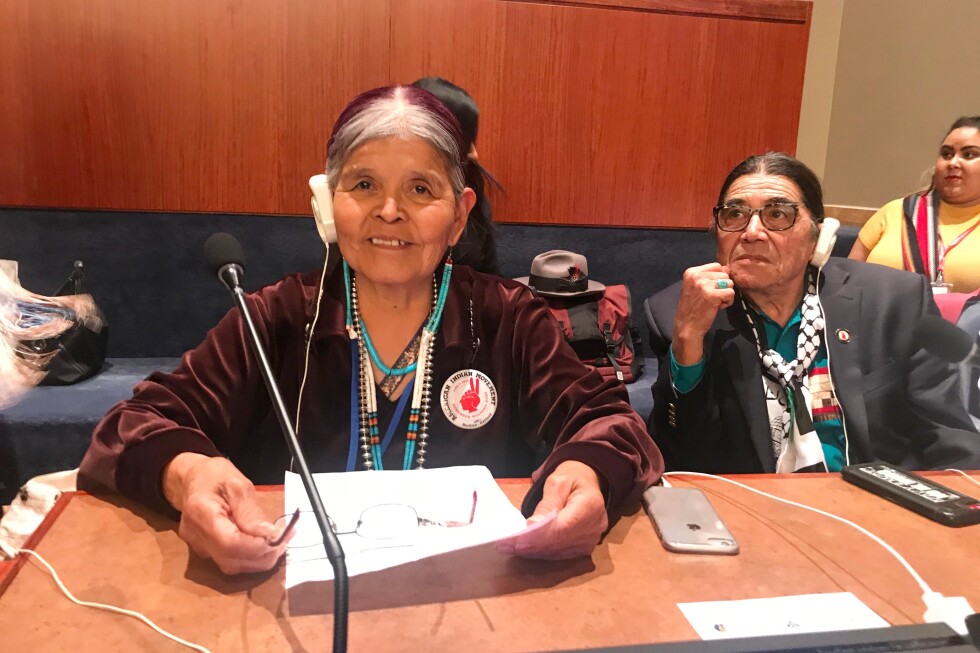
Jean Whitehorse, a Navajo Nation citizen, represents one of countless stories behind these statistics. In 1972, at age 22 and a new mother, she was rushed into emergency surgery for a ruptured appendix at an IHS hospital in Gallup, New Mexico. Amid “extreme pain” and confusion, she signed forms thrust before her.
“The nurse held the pen in my hand. I just signed on the line,” Whitehorse recalled. Years later, when struggling to conceive again, she discovered she had undergone a tubal ligation. The revelation devastated her, contributed to the breakdown of her relationship, and led to struggles with alcoholism.
Whitehorse kept her experience private for nearly 40 years before gradually sharing her story, first with family and eventually as an advocate for other victims. In 2025, she testified before the United Nations Permanent Forum on Indigenous Issues, calling for a formal U.S. government apology.
“Each time I tell my story, it relieves the shame, the guilt,” Whitehorse said. “Now I think, why should I be ashamed? It’s the government that should be ashamed of what they did to us.”
The impact of these practices extends across generations. Dr. Donald Clark, a retired IHS physician, testified in a recent New Mexico legislative hearing that he has seen patients in their 20s and 30s “seeking contraception but not trusting that they will not be irreversibly sterilized” because of stories passed down by their grandmothers, mothers, and aunts.
These sterilizations occurred within a broader historical context. A 1927 U.S. Supreme Court decision in Buck v. Bell had upheld states’ rights to sterilize those considered “unfit” to reproduce, enabling similar practices against immigrants, people of color, and disabled individuals throughout much of the 20th century.
Advocates like Rachael Lorenzo, executive director of Indigenous Women Rising, place these sterilizations within a pattern of federal policies meant to disrupt Native people’s reproductive autonomy, from the removal of Indigenous children to boarding schools to the 1976 Hyde Amendment restricting abortion access at tribal facilities.
While New Mexico’s investigation represents a significant step toward accountability, its effectiveness may depend on federal cooperation. Sarah Deer, a professor at the University of Kansas School of Law who studies this issue, notes that without access to federal records, the commission’s fact-finding abilities will be limited.
As the investigation proceeds, advocates emphasize the need for trauma-informed approaches. “It’s such a taboo topic. There’s a lot of support that needs to happen when we tell these traumatic stories,” Lorenzo cautioned, highlighting the delicate balance between seeking truth and avoiding re-traumatization of survivors.
Fact Checker
Verify the accuracy of this article using The Disinformation Commission analysis and real-time sources.

7 Comments
It’s critical that the full truth about the forced sterilization of Native American women be uncovered and addressed. This is a shameful episode in US history that has had profound and lasting consequences. I commend New Mexico for taking this important step toward accountability and healing.
The forced sterilization of Native American women is a horrific abuse of power that deserves to be thoroughly investigated and condemned. I hope this inquiry can provide a measure of justice and closure for the survivors and their communities. This is a difficult but necessary reckoning with a painful part of our history.
This is a deeply disturbing chapter in US history that deserves a thorough investigation. The forced sterilization of Native American women is a horrific violation of human rights that has had devastating intergenerational impacts. I’m glad to see New Mexico taking this issue seriously and working to uncover the full truth.
It’s heartbreaking to learn about the forced sterilization of Native American women by the US government. This is a clear example of systemic racism and a shocking abuse of medical authority. I hope the investigation can shed light on the scale of this injustice and lead to meaningful accountability and reparations for the survivors.
Forced sterilization is a grave violation of reproductive rights and bodily autonomy. I’m glad to see New Mexico taking steps to investigate this dark history and confront the lasting trauma inflicted on Native American communities. This type of state-sanctioned medical abuse should never be tolerated.
Forced sterilization is a horrific violation of human rights, and I’m glad to see New Mexico taking action to confront this dark chapter in US history. The impact on Native American communities has been devastating, and I hope this investigation can shed light on the full scale of the abuse and lead to meaningful justice and reparations.
The forced sterilization of Native American women is an appalling injustice that deserves thorough investigation and redress. I hope the findings of this inquiry can provide a measure of truth and healing for the survivors and their families. This is an important step toward accountability and reconciliation.