


Listen to the article
Nevada’s “Fake Electors” Case Resumes in Clark County Amid Legal Challenges
The criminal case against six Nevada Republicans accused of falsely claiming to be presidential electors in 2020 continued Monday in Clark County after the Nevada Supreme Court ruled the jurisdiction appropriate for the proceedings. The case highlights ongoing legal battles surrounding contested election results in multiple states.
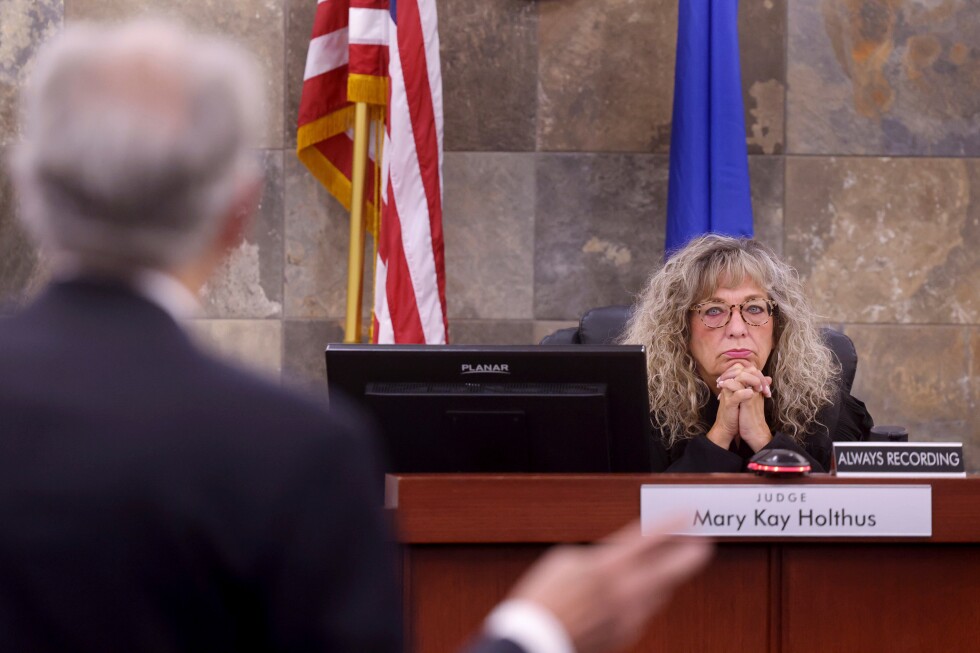
During Monday’s hearing, defense attorneys challenged the two criminal charges their clients face: offering a false instrument for filing and uttering a forged instrument. Judge Mary Kay Holthus expressed skepticism about the second charge, which requires prosecutors to prove an “intent to defraud.”
“They’re not really thinking that they’re going to pull one over, that… ‘we’re going to sign this document and make everybody think that Trump was elected when he wasn’t elected,'” Holthus remarked during the proceeding. “It’s almost nonsensical to me that they would have done that, prepared it and filed it with the intent to fraud. I don’t know how it would ever get there.”
The judge requested prosecutors submit a brief by early March detailing evidence of the defendants’ alleged intent to defraud, with the next hearing scheduled for April 10.
The case stems from events in December 2020, when six Republican electors held an unofficial ceremony in Carson City where they signed documents purporting to award Nevada’s electoral votes to then-President Donald Trump and Vice President Mike Pence. This occurred despite Joe Biden winning the state’s popular vote, and the legitimate Biden electors holding their own lawful ceremony as required by state law.
The defendants include prominent Republican Party officials: Nevada GOP Chairman Michael McDonald, Nevada GOP Vice Chair Jim Hindle, Republican National Committeeman Jim DeGraffenreid, then-Clark County GOP Chairman Jesse Law, along with Shawn Meehan and Eileen Rice.
The legal proceedings have followed a winding path. Judge Holthus initially dismissed the case in 2024, ruling Clark County was not the proper venue. However, the Nevada Supreme Court overturned that decision in November, allowing the prosecution to proceed in Clark County—a jurisdiction likely less favorable to the defendants than the state’s more conservative rural areas.
As a contingency against an unfavorable Supreme Court ruling, prosecutors had also filed a narrower case in Carson City. Nevada law permits parallel prosecutions until a jury is impaneled.
Monday’s hearing addressed unresolved issues from before the initial dismissal. Defense attorneys argued prosecutors provided incomplete evidence to the grand jury that indicted their clients in 2023. They also contended the documents in question weren’t false instruments but rather “genuine documents that contain false information.”
“There’s no evidence that defendants were doing anything other than exercising their First Amendment rights to preserve their future First Amendment rights to petition the government and challenge the results of that election,” argued Maggie McLetchie, who represents Jesse Law.
The defense position hinges on the claim that the signing ceremony was merely preparatory—positioning the alternate slate of electors in case legal challenges to Nevada’s election results succeeded. Although the Nevada Supreme Court had rejected election challenges before the ceremony, appeals to the U.S. Supreme Court remained theoretically possible, though none materialized.
Prosecutors countered that the documents were inherently false because they contained knowingly false information. “They wanted those documents to be considered, because those documents themselves were forged documents,” state prosecutor Alissa Engler argued.
The case represents one of several ongoing prosecutions against Republican electors who participated in similar ceremonies across multiple battleground states after the 2020 election. Prosecutors in Arizona and Wisconsin are pursuing similar cases, though these efforts have encountered various legal obstacles, including case dismissals.
The Nevada case highlights the complex legal questions surrounding post-election activities in 2020 and the ongoing effort to determine whether these actions constituted legitimate political expression or criminal conduct. The outcome could have significant implications for how electoral challenges are handled in future contested elections.
Fact Checker
Verify the accuracy of this article using The Disinformation Commission analysis and real-time sources.

8 Comments
The judge’s skepticism about the ‘intent to defraud’ charge is noteworthy. It suggests the prosecutors may have a high bar to clear in proving the defendants acted with malicious intent rather than political zeal.
Agreed, the intent element could be tricky for the prosecution to establish conclusively. This case seems to raise complex legal and evidentiary issues.
I’m curious to see what additional evidence the prosecutors submit in their brief to bolster the ‘intent to defraud’ charge. The judge’s remarks indicate they may need to make a strong case on that point.
This case underscores the ongoing disputes over the integrity of the 2020 election results. Regardless of one’s political leanings, it’s important the legal process plays out objectively and transparently.
This case highlights the ongoing legal battles surrounding the 2020 election results. It will be interesting to see how the court evaluates the intent behind the actions of the ‘fake electors’ and whether the charges hold up.
This is a complex and politically charged case. I hope the courts can cut through the noise and render a fair and impartial judgment based on the facts and the law.
The judge’s skepticism about the ‘intent to defraud’ charge is noteworthy. It will be important to see how the prosecutors respond and what evidence they are able to present on that point.
The actions of the ‘fake electors’ seem misguided at best and potentially criminal at worst. But the judge is right to scrutinize the intent element – that could be crucial in how this case is ultimately resolved.