


Listen to the article
Navy Chief Advocates for Smaller, Flexible Ships in Global Deployments
The U.S. Navy’s top uniformed officer is pushing for a strategic shift away from the military’s heavy reliance on massive aircraft carriers, advocating instead for more tailored deployments of smaller vessels better suited to specific missions.
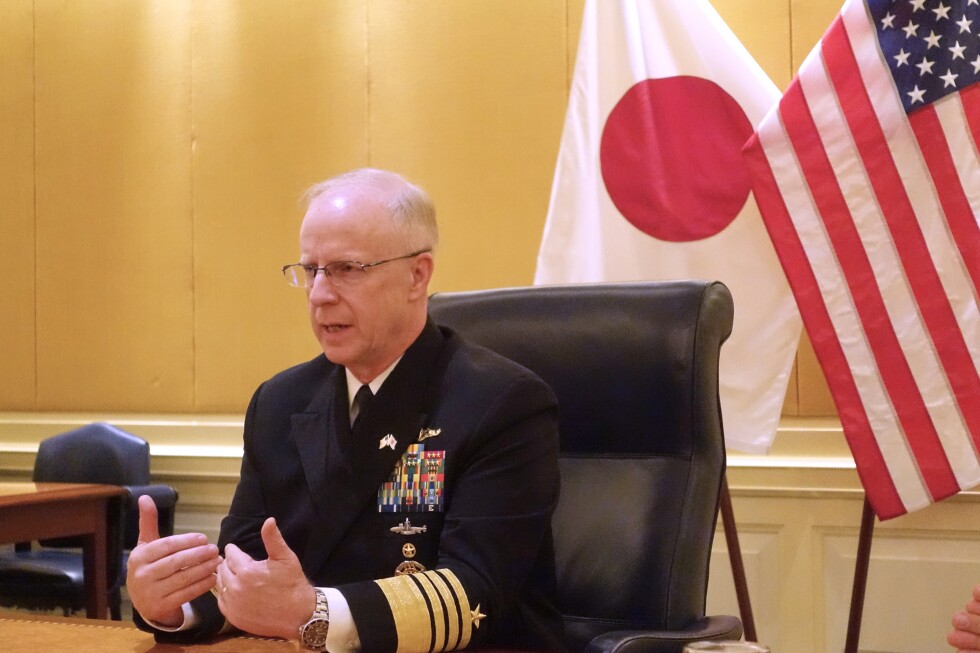
Admiral Daryl Caudle’s vision, outlined in what he calls his “Fighting Instructions,” aims to give the Navy greater flexibility in responding to global crises while addressing mounting concerns about the strain on larger vessels facing increasing maintenance challenges.
“I don’t want a lot of destroyers there driving around just to actually operate the radar to get awareness on motor vessels and other tankers coming out of port,” Caudle told The Associated Press in a recent interview. “It’s really not a well-suited match for that mission.”
The admiral’s push comes amid a series of high-profile deployments that have disrupted standard Navy operations. In late 2023, the USS Gerald R. Ford, the world’s largest aircraft carrier, was redirected from the Mediterranean Sea to the Caribbean as part of operations related to then-Venezuelan President Nicolás Maduro. More recently, the USS Abraham Lincoln was pulled from the South China Sea to the Middle East as tensions with Iran escalated.
These redirections highlight the very issue Caudle seeks to address. The Navy currently has an unprecedented 11 ships, including the Ford and several amphibious assault ships carrying thousands of Marines, operating in South American waters. This represents a dramatic increase for a region that historically sees only one or two smaller Navy vessels.
For areas like the Caribbean, Caudle envisions a leaner presence focused primarily on interdiction operations and monitoring merchant shipping. The U.S. military has already seized multiple suspicious and falsely flagged tankers connected to Venezuela that were part of a global shadow fleet helping governments evade sanctions.
“That doesn’t really require a carrier strike group to do that,” Caudle noted, suggesting the mission could be accomplished with smaller littoral combat ships, Navy helicopters, and close coordination with the Coast Guard.
The admiral is also advocating for greater use of drones and other robotic systems to provide military commanders with similar capabilities while requiring less investment from Navy ships. He acknowledges this will require an education campaign to help commanders understand how to effectively integrate these new technologies.
“Even if a commander knows about a new capability, the staff may not know how to ask for that, integrate it, and know how to employ it in an effective way to bring this new niche capability to bear,” Caudle explained.
His vision represents a potential clash with President Donald Trump’s preference for large, powerful naval displays. Trump has frequently referred to aircraft carriers and their accompanying destroyers as “armadas” and “flotillas.” The president has also revived the historic battleship title for a planned vessel type that would feature advanced weapons systems including hypersonic missiles, nuclear cruise missiles, rail guns, and high-powered lasers.
The proposed “Trump-class battleship” would be larger than World War II-era Iowa-class battleships, despite the Navy’s ongoing struggles to field some of the technologies Trump envisions and its challenges in building even smaller, less sophisticated ships on time and within budget.
Caudle’s approach would mean compensating differently when major assets like aircraft carriers are redirected. Using the Lincoln’s recent redeployment to the Middle East as an example, he suggested talking with the Indo-Pacific commander about alternatives: “So, as Abraham Lincoln comes out, I’ve got a three ship (group) that’s going to compensate for that.”
According to Caudle, his strategy is already working in Europe and North America “for the last four or five years.” He believes it could soon apply to the strategically important Bering Strait, which separates Russia and Alaska, noting that “the importance of the Arctic continues to get more and more prevalent” as China, Russia, and the U.S. prioritize the region.
This Arctic focus aligns with Trump’s previous interest in the area, including his controversial proposal to acquire Greenland from Denmark, which he justified by citing threats from China and Russia.
As global tensions continue to evolve across multiple regions, Caudle maintains that his “tailored force packages” would provide military commanders with more solutions and greater flexibility to respond to emerging threats with appropriately sized forces rather than automatically deploying the Navy’s largest assets.
Fact Checker
Verify the accuracy of this article using The Disinformation Commission analysis and real-time sources.

14 Comments
The Navy’s reliance on aircraft carriers has been under scrutiny for a while now. Shifting to a more diverse fleet of tailored vessels could enhance adaptability, though the logistics and costs will need careful consideration.
You raise a good point. Transitioning away from the carrier-centric model will require significant planning and investment. But if executed well, it could pay dividends in terms of operational flexibility.
Interesting perspective from the Navy leader. Smaller, more flexible ships could allow for quicker deployment and better mission-specific operations. Curious to see how this strategic shift plays out.
I agree, the focus on agility and responsiveness over massive carriers seems prudent given modern challenges. It will be important to strike the right balance though.
The Navy leader’s vision of a more flexible, tailored fleet is an interesting concept. Reducing the reliance on massive aircraft carriers could increase operational agility, but the long-term implications for force projection and deterrence will require thorough analysis.
Agreed. This strategic shift is a complex issue with pros and cons that will need to be carefully weighed. The Navy will have to strike the right balance to ensure it can effectively fulfill its mission.
I’m curious to see how this plays out in practice. Smaller, more agile ships could enhance the Navy’s responsiveness, but the loss of some aircraft carrier-based power projection will be a significant trade-off. Balancing those factors will be challenging.
You raise a fair point. The shift away from carriers needs to be well-planned and implemented to ensure the Navy retains the necessary capabilities to meet its global responsibilities.
The Navy leader’s emphasis on agility and tailored deployments is an intriguing concept. Reducing the reliance on aircraft carriers could improve responsiveness, but the long-term implications for the Navy’s strategic positioning will require thorough evaluation.
Absolutely. This shift represents a significant strategic decision that will need to be analyzed from multiple angles to ensure the Navy can effectively fulfill its global responsibilities.
This shift toward smaller, more specialized vessels is an ambitious move. It could enhance the Navy’s ability to respond quickly to crises, but the tradeoffs in terms of overall firepower and force projection will be crucial considerations.
You make a fair point. The Navy will have to carefully assess the trade-offs and ensure it maintains the necessary capabilities to deter potential adversaries and project power globally.
This strategic shift away from aircraft carriers is an intriguing idea. It could allow the Navy to react more nimbly to evolving global threats. However, the tradeoffs in terms of force projection and deterrence capabilities will need to be weighed carefully.
Absolutely. Maintaining the right mix of capabilities – both large platforms and more specialized vessels – will be crucial. The Navy will have to thread that needle carefully.