


Listen to the article
NASA Shifts Strategy to Permanent Moon Base in Race Against China
NASA is pivoting toward establishing a permanent human presence on the moon, abandoning previous plans for a lunar-orbiting space station in favor of building infrastructure directly on the lunar surface. The Trump administration has proposed allocating approximately $20 billion for this ambitious project, signaling a fundamental shift in America’s space exploration strategy.
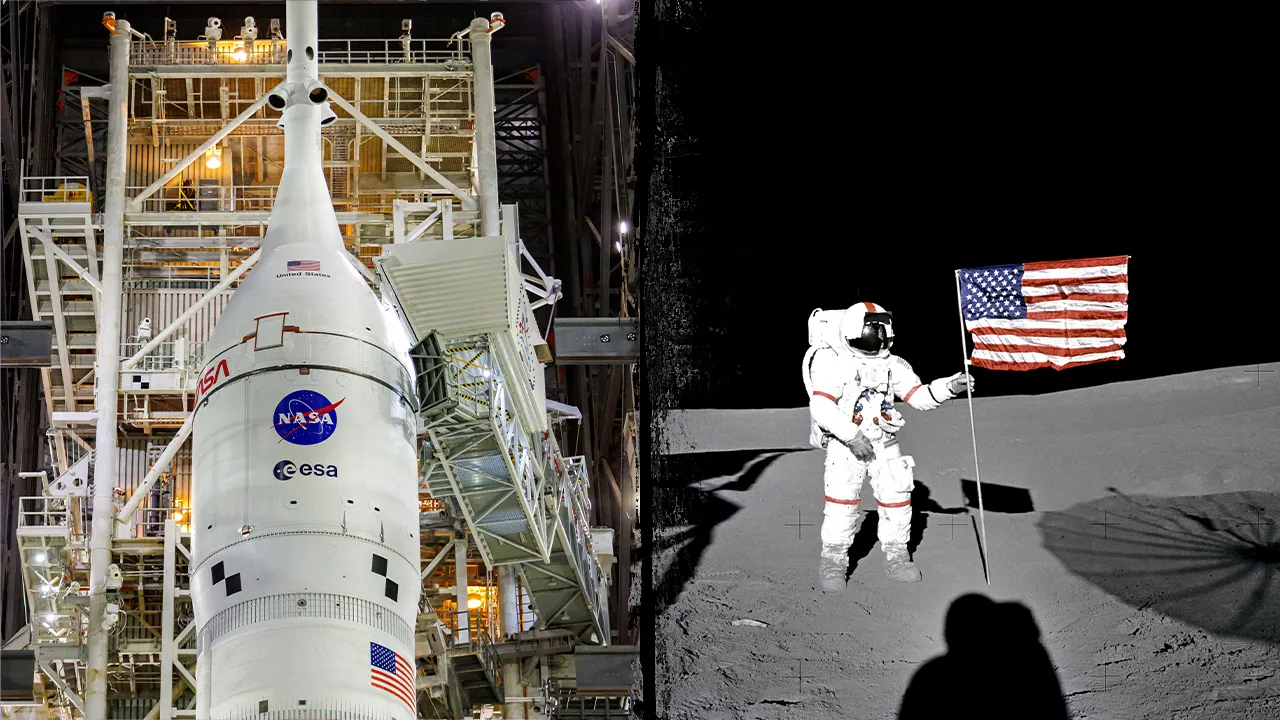
“This time, the goal is not flags and footprints,” NASA Administrator Jared Isaacman stated while unveiling the plan. “This time, the goal is to stay.”
The strategic redirection comes amid intensifying competition with China, which has made rapid advances in its own lunar exploration program and aims to land astronauts on the moon around 2030.
Casey Dreier, chief of space policy at The Planetary Society, explained the rationale behind the shift: “The reason you want to have a lunar base is that it acts as a focal point of our ongoing efforts to not just be around the Earth, but go into deep space. It’s like the reason that we have our base stations in Antarctica.”
A permanent lunar installation would enable the United States to store supplies, develop infrastructure, and gradually expand capabilities in ways that wouldn’t be possible with the previously planned Gateway program—a space station intended to orbit the moon that has faced delays, funding uncertainties, and questions about its necessity.
The Gateway was originally conceived as a staging area for astronauts traveling to and from the lunar surface, serving as both a communications hub and transfer point in orbit. Resources previously allocated for this project will now be redirected toward establishing infrastructure directly on the moon.
While the new approach provides clearer focus, experts caution that both the timeline and budget remain highly ambitious. When asked whether $20 billion would suffice for building and sustaining a lunar base, Dreier responded, “Probably not. It’s an ambitious level.” He suggested that the approximately seven-year implementation timeline is aggressive given the technical challenges of lunar operations, and that the effort may begin with a limited presence that would expand over time.
The strategic shift comes in direct response to China’s rapid advancement in space exploration. The Chinese space program has achieved significant milestones in recent years, including landing spacecraft on the far side of the moon and conducting successful robotic sample return missions—technically challenging feats that demonstrate their growing capabilities.
“They have gone from launching one or two satellites or space science satellites to launching dozens,” Dreier noted. “They have landed huge amounts of mass now on the moon, on the far side of the moon.”
These achievements have given China certain advantages in lunar exploration. “At the Moon, China actually has the advantage right now,” Dreier acknowledged.
China is collaborating with international partners, notably Russia, on plans for establishing a long-term presence near the lunar south pole—an area believed to contain water ice and other valuable resources critical for sustainable operations.
The geopolitical dimensions of this new space race are explicit in NASA’s communications. “We find ourselves with a real geopolitical rival, challenging American leadership in the high ground of space,” Isaacman stated.
Beyond the immediate goal of establishing a lunar presence, policy experts suggest that developing sustained operations on the moon could strengthen broader U.S. capabilities in space, particularly as Earth orbit becomes increasingly contested by multiple nations.
“The moon is the ultimate high ground,” Dreier emphasized. “If we have to have space contested, let’s make it a race to the moon… rather than something far more direct and destructive in Earth orbit.”
This pivot represents NASA’s most significant strategic reorientation in decades, prioritizing permanent infrastructure over temporary missions and directly addressing the challenge posed by China’s rapidly advancing space program.
Fact Checker
Verify the accuracy of this article using The Disinformation Commission analysis and real-time sources.

9 Comments
The $20 billion investment shows how serious the US is about getting back to the moon and staying there. It will be fascinating to see how China responds to this accelerated timeline.
Absolutely. The lunar base could serve as a critical staging point for future deep space exploration as well. The geopolitical implications are huge.
While the race to the moon is exciting, I hope the focus remains on the scientific and exploratory objectives rather than just geopolitical one-upmanship. The more we can learn about the lunar environment, the better.
Establishing a permanent human presence on the moon is an incredibly ambitious goal. I’m curious to see how the technical and logistical challenges are overcome. The scale of this undertaking is mind-boggling.
This is an exciting development in the space race between the US and China. Having a permanent lunar base would be a major strategic and technological advantage for whichever country achieves it first.
The strategic rationale for a lunar base makes sense, but I hope the process is transparent and the benefits are shared broadly, not just among a few powerful nations. Equitable access to space exploration is important.
Curious to see if this renewed focus on the moon will spur greater international cooperation, or if it will intensify the rivalry between the US and China. Either way, the scientific and technological advancements could be transformative.
A permanent lunar base would open up all sorts of possibilities, from resource extraction to scientific research. I wonder what kind of infrastructure and technologies will be required to sustain a long-term human presence on the moon.
Good point. Advancements in life support systems, power generation, and in-situ resource utilization will be critical. This could drive a lot of innovation in those areas.