


Listen to the article
Mike Lindell, the founder of MyPillow and a vocal supporter of former President Donald Trump, officially announced his candidacy for Minnesota governor on Thursday, positioning himself to challenge Democratic Governor Tim Walz in the 2026 election.
Making his announcement at his MyPillow factory in Shakopee, a Minneapolis suburb, Lindell used the manufacturing floor as his backdrop while workers continued packaging products behind him. The scene underscored his business credentials as machinery banged and hissed throughout his speech.
“Well, it didn’t work. I’m still standing. MyPillow is still standing,” Lindell declared, referring to what he described as attempts to shut down his business due to his political views. “And now I want you to know that I will stand for you as governor of the state of Minnesota.”
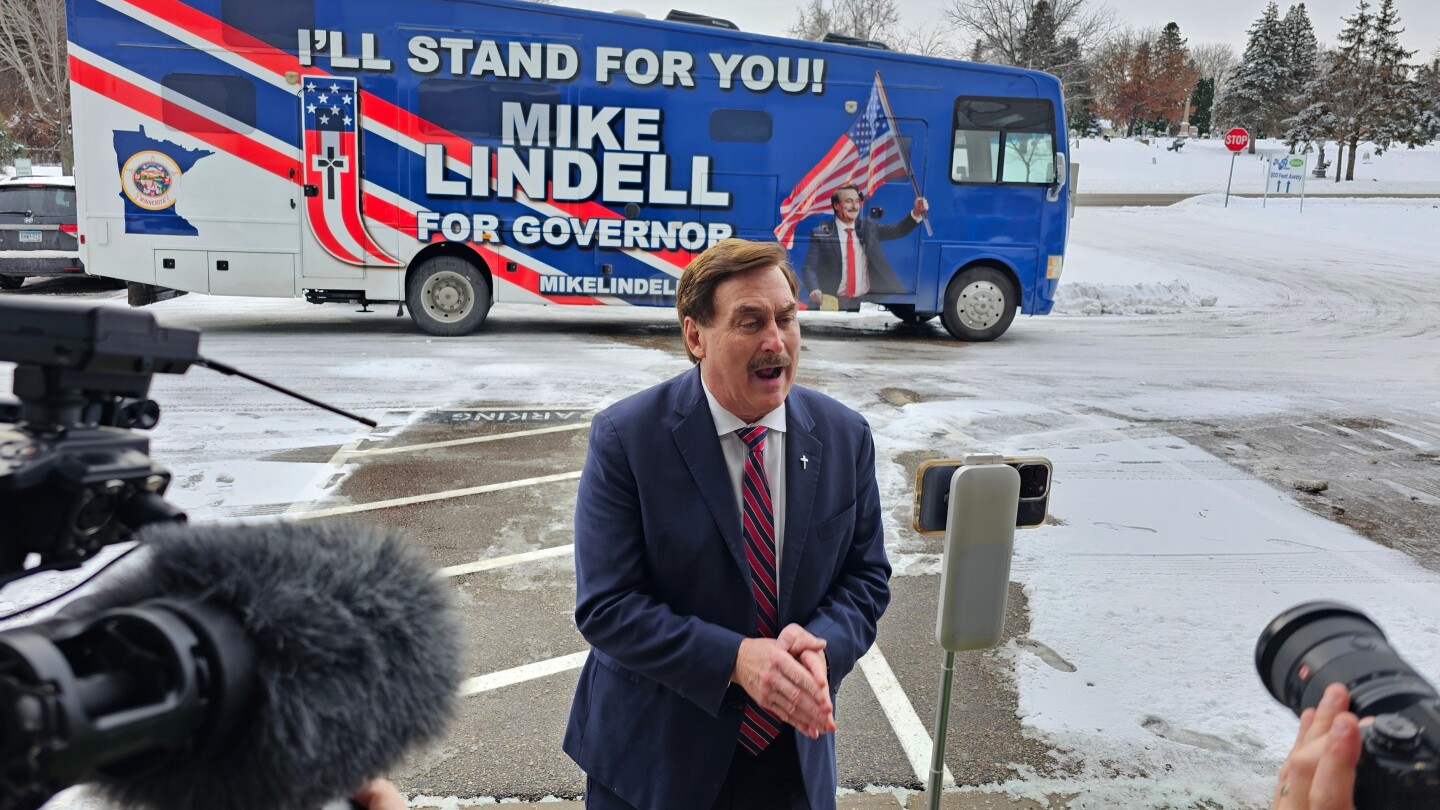
Immediately after his announcement, Lindell conducted a live interview with Steve Bannon, a fellow Trump ally, on Bannon’s “War Room” podcast. The energetic businessman then unveiled a red-white-and-blue campaign bus, pledging to visit every town in Minnesota during his gubernatorial run.
In conversations with reporters, Lindell revealed he had informed Trump about his political ambitions back in August but stopped short of predicting whether the former president would endorse him. Such an endorsement could significantly influence grassroots Republicans ahead of next year’s state party convention. Lindell also acknowledged receiving political advice from Rudy Giuliani, Trump’s former personal lawyer, who hosts a show on Lindell’s media platform.
The 64-year-old entrepreneur founded MyPillow in 2009 and transformed it into a nationally recognized brand through his ubiquitous late-night television infomercials. However, his company faced considerable financial and legal challenges after he became one of the most prominent promoters of false claims that the 2020 presidential election was stolen from Trump.
“Not only have I built businesses, you look at problem solution,” Lindell told The Associated Press. “I was able to make it through the biggest attack on a company, and a person, probably other than Donald Trump, in the history of our media… lawfare and everything.”
Lindell’s entry into the race prompted immediate criticism from Governor Walz’s campaign, which characterized him as “a snake oil salesman caught up in multiple legal fights who wants to bring Trump extremism to Minnesota.” Walz, who served as Kamala Harris’s running mate in the 2024 presidential election, announced in September that he would seek a third term as governor.
While no Republican has won statewide office in Minnesota since 2006, the state has occasionally embraced unconventional candidates. In 1998, voters elected former professional wrestler Jesse Ventura as governor, and in 1978, they sent TV pitchman and home improvement company owner Rudy Boschwitz to the U.S. Senate.
Lindell’s path to political prominence began in 2016 when he met Trump during his first presidential campaign. He subsequently became a fixture at Trump rallies and co-chaired Trump’s Minnesota campaign. His outspoken support for Trump’s election fraud claims, however, triggered significant backlash for his business.
Major retailers discontinued MyPillow products, revenue declined, and lines of credit disappeared, costing Lindell millions by his own account. Several vendors sued MyPillow over billing disputes, Fox News stopped airing his commercials, and lawyers withdrew from representing him.
Legal problems continue to mount for the potential Republican candidate. In September, a federal judge in Minnesota ruled that Lindell defamed Smartmatic with 51 false statements about the voting machine company. Smartmatic is seeking “nine-figure damages.” In June, a Colorado jury found that Lindell defamed a former Dominion Voting Systems executive and awarded $2.3 million in damages.
Lindell did secure a legal victory in July when a federal appeals court overturned a $5 million arbitration award to a software engineer who challenged Lindell’s claims about Chinese interference in the 2020 election.
While his crusade against electronic voting machines will be part of his platform, Lindell told the AP that his campaign would focus on broader issues as well. He faces competition for the Republican nomination from several candidates, including Minnesota House Speaker Lisa Demuth, former state senator Dr. Scott Jensen, and former federal prosecutor Chris Madel.
“These guys haven’t lived what I live,” Lindell said of his Republican rivals.
Though unwilling to commit to abiding by the Minnesota GOP endorsement process if he loses, Lindell expressed confidence in securing the party’s backing. He acknowledged financial constraints, saying he’ll rely on supporter donations rather than his own resources to fund his campaign.
“I don’t have the money,” he admitted, before adding optimistically, “I’ve had thousands upon thousands of people text and call, saying from all around the country… ‘Hey, I’ll donate.'”
Fact Checker
Verify the accuracy of this article using The Disinformation Commission analysis and real-time sources.

12 Comments
Lindell’s gubernatorial bid is sure to be a closely watched race, given his high-profile status as a Trump supporter and his history of making unsubstantiated claims. His campaign will undoubtedly add to the ongoing debates around the role of Trump-aligned figures in the Republican party.
It will be interesting to see how Lindell’s campaign resonates with Minnesota voters and whether his controversial political views prove to be an obstacle or an asset.
While Lindell’s business success is undeniable, his extreme political views and ties to Trump could make it difficult for him to appeal to a broad swath of Minnesota voters. A gubernatorial run could be an uphill battle for the MyPillow founder.
Lindell’s decision to run for governor is a bold move, but it remains to be seen whether his controversial brand of politics will resonate with Minnesotans.
Lindell’s decision to run for governor is a testament to the enduring influence of Trump-aligned figures in the Republican party. While his business success may resonate with some voters, his embrace of conspiracy theories and divisive rhetoric could be a significant liability.
As the 2026 election approaches, it will be important to closely follow Lindell’s campaign and how it shapes the political discourse in Minnesota.
Lindell’s announcement highlights the continued influence of Trump supporters in Republican politics. His anti-establishment platform and embrace of Trump’s election fraud claims could resonate with some voters, but may also alienate moderates.
Given Lindell’s history of making unsubstantiated claims, his gubernatorial bid will likely face intense scrutiny from the media and his political opponents.
Lindell’s run for Minnesota governor is sure to spark a lot of debate and controversy. While his business success and loyalty to Trump may appeal to some, his divisive political views will likely be a major point of contention.
It will be interesting to see how Lindell’s campaign positions itself and how voters in Minnesota respond.
Lindell’s announcement is sure to shake up the 2026 Minnesota governor’s race. His staunch support for Trump and promotion of election fraud claims could galvanize his base, but may also motivate strong opposition from Democrats and moderate Republicans.
It will be crucial to see how Lindell’s campaign navigates the complex political landscape in Minnesota and whether he can broaden his appeal beyond his core supporters.