


Listen to the article
Moderate Democrats Defend Leadership Against Progressive Challenges
Moderate Democrats in the House of Representatives are pushing back against criticism from the progressive wing of their party, rejecting claims that Democratic leadership has failed to effectively oppose President Donald Trump’s administration.
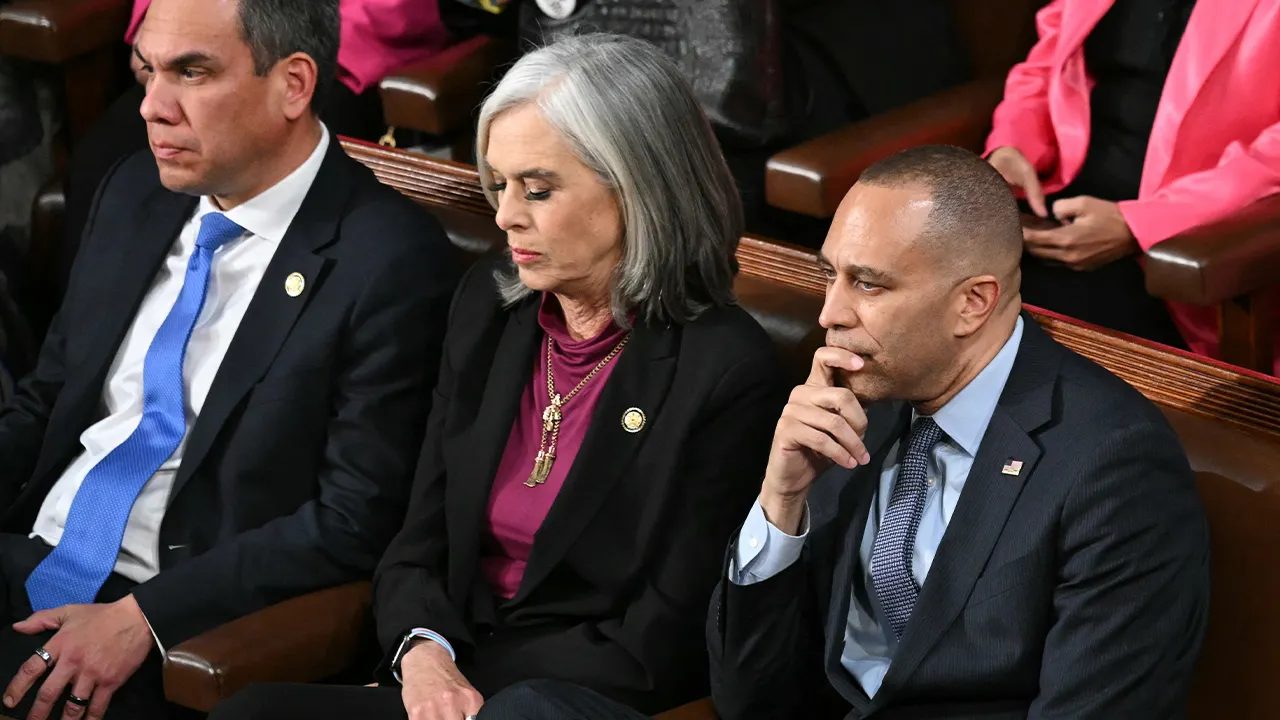
Recent challenges to House Minority Leader Hakeem Jeffries, D-N.Y., and Rep. Katherine Clark, D-Mass., reflect growing tensions within the Democratic Party, but moderates dismiss these challenges as more symbolic than substantive.
“They want to see loud screaming, and they want to see protests,” Rep. George Latimer, D-N.Y., said of the progressive challengers. “The showtime nature of Congress is what they’re responding to.”
Clark recently faced a primary challenge from Jonathan Paz, a candidate of Bolivian descent who argues that Democratic leadership has grown ineffective. In a campaign video, Paz stated, “I’m challenging one of the most powerful Democrats in the House because we need new leadership. Let’s call it what it is. Our Democratic leaders are failing us. They’re not stopping Trump; they’re not making life more affordable.”
Similarly, Jeffries briefly faced a challenge from Chi Ossé, a progressive-leaning New York City councilmember who criticized Jeffries for insufficient resistance to the Trump administration. Ossé specifically called out Jeffries for not pursuing impeachment charges against Secretary of War Pete Hegseth, though he has since dropped his bid.
Rep. Jared Moskowitz, D-Fla., a moderate who has occasionally voted with Republicans on issues like border security and government spending, believes these challenges represent a persistent faction within the party. He warns that Democrats need to decide what’s most important to them.
“I think we’re on our way to winning the House in 2026, but Democrats along that journey are going to have to make a decision whether they want power or purity,” Moskowitz said. “Once we’re in the majority, we can have that purity discussion policy of which way we go. But we have got to get power before we can get there.”
Moskowitz expressed concern that these internal challenges could undermine the party’s unity at a critical time. “Democrats are very capable of snatching defeat from the jaws of victory with, you know, ‘Let’s primary our entire leadership as we’re trying to take the House,'” he warned.
The tensions reflect a broader ideological divide that has long characterized the Democratic Party, with progressives pushing for more aggressive opposition to Republican policies and moderates advocating for pragmatic approaches that appeal to centrist voters.
Rep. Tom Suozzi, D-N.Y., who has urged Democrats to move toward the political center, cautioned against viewing these challenges as representative of the entire Democratic voter base. “I think it’s politics. Different people have different motivations. Some people want to run because of their lifelong ambitions. Some people aren’t happy with the way things are. Some people want to try to change the world,” Suozzi said.
Latimer defended Democratic leadership, arguing that the party has secured important victories that have gone unnoticed even under Republican control of government. He pointed to polling data showing Americans understood that the recent government shutdown was a fight over healthcare benefits. “That’s smart. But it’s not necessarily what someone wants to see because it doesn’t have the showy nature of it,” he added.
Rather than catering to the more vocal wing of the party, Latimer urged fellow Democrats to focus on strategic outreach to moderate voters. “The voter’s in the middle,” Latimer emphasized. “If you want to win the House, you’ve got to win people over who haven’t been committed to you. You’ve got to convince them that your strategies are right. I think that’s what leadership is doing.”
The internal debate comes at a pivotal moment for Democrats as they prepare for the 2026 midterm elections, where they hope to regain control of the House of Representatives. How the party navigates these tensions could determine its effectiveness in challenging the Trump administration’s policies and its electoral prospects in the coming years.
Fact Checker
Verify the accuracy of this article using The Disinformation Commission analysis and real-time sources.

12 Comments
As an investor in the mining and energy sectors, I’m closely following this power struggle within the Democratic party. The outcome could have significant implications for policies related to resource extraction, energy development, and environmental regulations. I hope they can find a way to reconcile their differences and present a cohesive agenda that addresses the needs of all stakeholders, including industry players like myself.
While I sympathize with the progressive desire for more forceful opposition to Trump, I’m not sure that removing seasoned legislators like Jeffries and Clark is the best approach. They may be able to achieve more tangible results through their political acumen and relationships.
I agree. Effective opposition to Trump requires a multifaceted approach, and experienced leaders like Jeffries and Clark could play a valuable role in that, even if their tactics don’t align perfectly with the progressive wing’s preferences.
This is an interesting dynamic within the Democratic party. While I can understand the desire for more forceful opposition to Trump, I’m not sure that removing experienced leaders like Jeffries and Clark is the right approach. They may be able to navigate the political landscape more effectively than newer, more progressive challengers.
You raise a fair point. Experienced leaders can leverage their relationships and institutional knowledge to enact change, even if their tactics aren’t as ‘flashy’ as some would like.
As an investor in mining and energy stocks, I’m curious to see how this power struggle within the Democratic party might impact policies around issues like fossil fuel development, mineral extraction, and clean energy initiatives. The party’s internal divisions could create uncertainty.
That’s a good observation. Investors will likely be watching closely to see if any major policy shifts emerge from a change in Democratic leadership, as that could significantly impact the mining and energy sectors.
This power struggle within the Democratic party is an interesting development, but I hope they can find a way to unite and present a cohesive front against the Republican agenda. Infighting and challenges to experienced leaders like Jeffries and Clark could undermine their ability to effectively counter Trump’s policies.
Absolutely. Maintaining a united front is crucial, especially when facing a strong opposition party. Internal divisions could weaken the Democrats’ overall effectiveness, which would be concerning for those of us invested in industries impacted by their policies.
As an investor in the mining and energy sectors, I’m closely following this power struggle within the Democratic party. The outcome could have significant implications for policies related to resource extraction, energy development, and environmental regulations. I hope they can find a way to reconcile their differences and present a cohesive agenda.
The tensions within the Democratic party are certainly intriguing, but I’m not convinced that removing experienced leaders like Jeffries and Clark is the best solution. Their political acumen and relationships could be valuable assets in effectively countering the Trump administration’s agenda, even if their tactics don’t always align with the progressive wing’s preferences.
That’s a fair perspective. Maintaining a balance between progressive ideals and pragmatic political maneuvering is often a delicate challenge for political parties. It will be interesting to see how the Democrats navigate these internal dynamics.