


Listen to the article
Mexico transfers 37 cartel members to US in latest anti-drug trafficking operation
Mexico transferred 37 high-profile cartel members to the United States on Tuesday, marking a significant escalation in cross-border security cooperation as the Trump administration intensifies pressure on foreign governments to dismantle drug trafficking networks.
Mexican Security Minister Omar García Harfuch described the detainees as “high-impact criminals” who posed “a real threat to the country’s security.” With this latest transfer, Mexico has now extradited 92 cartel figures to the U.S., according to Mexican authorities.
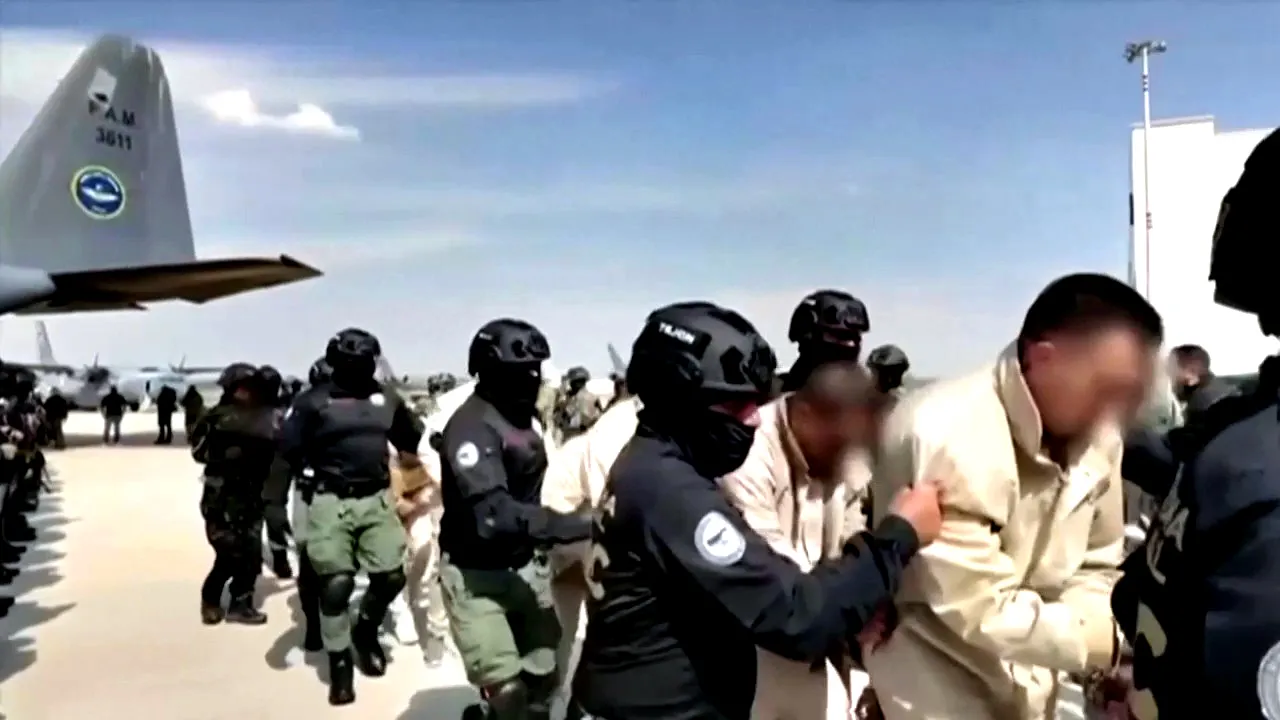
Video footage released by Mexican officials showed handcuffed prisoners surrounded by heavily armed, masked officers as they were loaded onto a military jet near Mexico City. The prisoners were members of several major criminal organizations, including the Sinaloa Cartel, Jalisco New Generation Cartel, Beltrán-Leyva Cartel, the Northeast Cartel, and remnants of the Zetas based in Tamaulipas along the Texas border.
Among those transferred was María del Rosario Navarro Sánchez, notable as the first Mexican national charged in the U.S. with providing material support to a terrorist organization after allegedly conspiring with a cartel, highlighting the increasing intersection between drug trafficking and terrorism concerns.
“This is Mexico resorting to extraordinary measures as pressure from the White House increases,” said David Mora, a Mexico analyst with the International Crisis Group, in a statement to The Associated Press.
The extraditions come at a politically sensitive time in U.S.-Mexico relations. President Donald Trump has recently sharpened his rhetoric against drug cartels, even suggesting the possibility of U.S. military action against them, particularly following the recent U.S. operation in Venezuela that removed former President Nicolás Maduro from power.
“We’ve knocked out 97% of the drugs coming in by water, and we are going to start now hitting land with regard to the cartels,” Trump told Fox News earlier this month. “The cartels are running Mexico—it’s very, very sad to watch, and see what’s happened to that country.”
These comments have raised concerns in Mexico about potential violations of sovereignty. Mexican President Claudia Sheinbaum reportedly spoke with Trump last week, emphasizing that U.S. military intervention in Mexico was “not necessary” while stressing continued bilateral cooperation on security matters.
This marks the third major transfer of cartel members from Mexico to the U.S. in less than a year. The first occurred in February when Mexico sent 29 cartel figures to the U.S., including notorious drug lord Rafael Caro Quintero, wanted for the 1985 killing of a U.S. DEA agent. A second transfer in August included 26 additional cartel members from multiple organizations.
García Harfuch defended the transfers as being motivated by practical security concerns rather than just diplomatic pressure. He argued that cartel leaders were continuing to run their criminal operations from inside Mexican prisons, making their extradition a matter of public safety for both countries.
The transfers reflect the complex dynamics of U.S.-Mexico security cooperation in combating transnational criminal organizations. While Mexico has historically been sensitive about sovereignty issues, the growing power of cartels and their devastating impact on public safety has necessitated increased bilateral cooperation.
Drug trafficking organizations have evolved significantly over the past decade, diversifying their operations beyond narcotics to include human trafficking, extortion, kidnapping, and other criminal enterprises. Their violence has contributed to Mexico’s security crisis, with more than 30,000 homicides recorded annually in recent years.
The Biden administration has sought to balance security cooperation with Mexico while avoiding the more confrontational rhetoric of its predecessor, focusing instead on addressing root causes of migration and drug trafficking. However, with Trump set to return to the White House, Mexico appears to be proactively demonstrating its commitment to combating cartels as a strategic move to manage bilateral tensions.
Fact Checker
Verify the accuracy of this article using The Disinformation Commission analysis and real-time sources.

12 Comments
It’s encouraging to see Mexico taking decisive action against the cartels by extraditing these high-profile members to the US. However, the drug trade remains a persistent and complex problem. Sustained pressure, intelligence-sharing, and a focus on dismantling the cartels’ financial networks will be crucial to making lasting progress.
Agreed. This extradition operation is a significant development, but the cartels have proven to be highly adaptable. Continued cooperation and a multi-faceted approach targeting their operations, finances, and power structures will be necessary to truly weaken their grip on Mexico and the region.
Transferring 37 cartel members to the US is a significant move, but the drug trade remains a huge challenge for Mexico. The cartels have entrenched power and resources, so it will take sustained pressure and coordination to weaken their grip. This is a step in the right direction, but more needs to be done.
I agree. The cartels have proven to be resilient and adaptable, so this is just one battle in a long-running war. Dismantling their networks will require a multi-pronged approach of law enforcement, economic development, and addressing the root causes of the drug trade. It’s good to see progress, but the fight is far from over.
Extraditing cartel leaders to the US is a risky but necessary step. The cartels pose a major threat to security in Mexico and the region. I hope this leads to more effective prosecution and dismantling of their criminal networks on both sides of the border.
Yes, this is an important development. The cartels have become increasingly powerful and violent, so decisive action is required. Let’s hope this is the start of more robust cooperation between Mexico and the US to combat the drug trade.
The extradition of these 37 cartel members to the US is an important step in the fight against drug trafficking, but the challenge remains daunting. The cartels have diversified their criminal activities and have deep roots in Mexican society. Sustained pressure and a comprehensive strategy targeting their networks, finances, and corruption will be crucial to making lasting progress.
Well said. This extradition is a positive development, but the drug trade remains a persistent and complex problem. Dismantling the cartels’ power will require a long-term, multi-pronged approach that goes beyond just law enforcement. Addressing the underlying social and economic factors that fuel the drug trade will also be essential.
This is a significant escalation in the fight against drug cartels. Extraditing high-profile cartel members to the US is a bold move that could disrupt their operations. It will be interesting to see how the cartels respond and whether this leads to more cooperation between Mexico and the US on security issues.
Agreed. The Trump administration has been putting a lot of pressure on Mexico to crack down on the cartels. This transfer of 37 cartel members is a tangible result of that pressure, and could potentially weaken the cartels’ grip on power in Mexico.
The extradition of these cartel members is an important development, but the drug trade remains a major security challenge for Mexico. The cartels have diversified their criminal activities and gained significant political and economic influence. Sustained cooperation between Mexico and the US will be crucial to making real progress against these powerful criminal organizations.
Absolutely. The cartels have become entrenched in Mexico, so dismantling their power structures will require a long-term, comprehensive strategy. This extradition is a positive step, but tackling the root causes of the drug trade, such as poverty and corruption, will also be essential.