


Listen to the article
Federal Masked Officers Spark National Debate Amid Immigration Crackdown
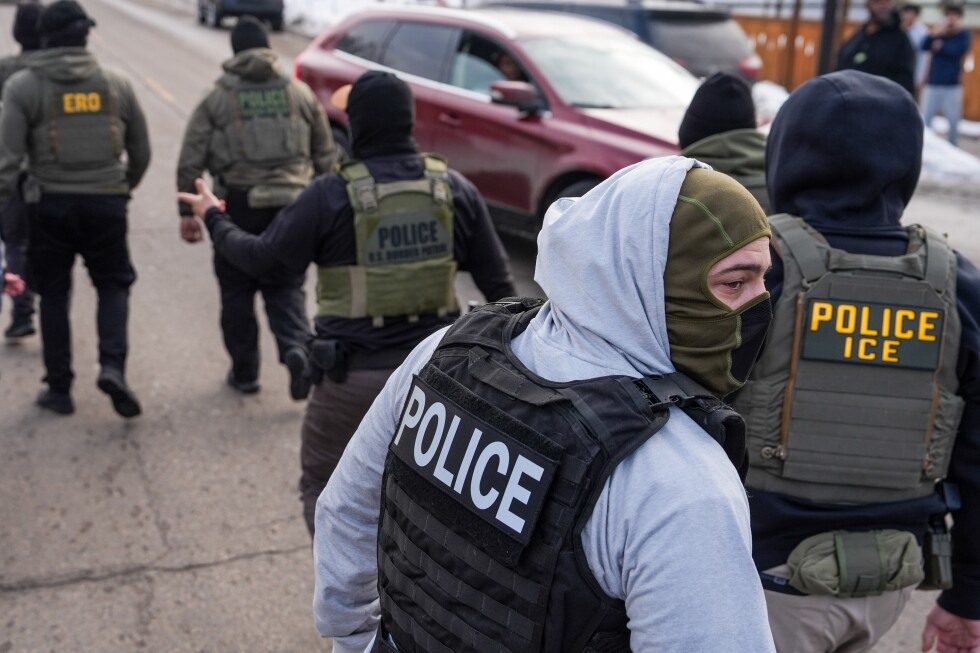
Beyond smashed car windows, people tackled on city streets, or even a child in a bunny-ears snowcap being detained, the presence of masked federal officers has become a flashpoint in the Trump administration’s immigration enforcement operations.
Not in recent memory has an American law enforcement operation so consistently masked thousands of officers from public view. The Department of Homeland Security defends the practice as necessary to protect employees from online harassment. However, experts warn that masking serves another purpose – creating fear in communities while eroding accountability and trust between law enforcement and citizens.
Whether to ban these masks has emerged as a central question in the congressional debate over Homeland Security funding ahead of Friday’s midnight deadline, which could trigger a partial agency shutdown if unresolved.
“Humans read each others’ faces — that’s how we communicate,” explained Justin Smith, executive director and CEO of the National Sheriffs’ Association and former Colorado sheriff. “When federal agents can’t be identified and you can’t see their faces, it makes people uncomfortable. That’s bringing up questions.”
Masks have been a consistent feature throughout the first year of President Donald Trump’s mass deportation initiative. The issue first gained national attention last spring when plain-clothed officers pulling up their masks surrounded and detained a Tufts University doctoral student near her Massachusetts home. Similar scenes have since played out in cities like Los Angeles and Chicago.
The situation escalated dramatically after the shooting deaths of two American citizens by federal immigration officers during demonstrations against ICE raids in Minneapolis, sparking widespread protests and prompting legislative response.
“Cameras on, masks off” has become a rallying cry among Democrats, who insist officers should wear body cameras to ensure greater accountability. House Democratic Leader Hakeem Jeffries has called unmasking federal agents a “hard red line” in ongoing negotiations.
Immigration and Customs Enforcement defends its masking policy on its website, stating that “officers wear masks to prevent doxing, which can (and has) placed them and their families at risk.” The agency maintains that all officers carry badges and credentials and will identify themselves when required for public safety or legal reasons.
Bolstered by approximately $170 billion in funding from Trump’s tax cuts bill, ICE has grown to become one of the nation’s largest law enforcement operations. Last year, the agency announced it had more than doubled its workforce to 22,000 through rapid hiring campaigns that included $50,000 signing bonuses.
Most Republicans support the continued use of masks. Senator Thom Tillis (R-N.C.) expressed concern about officer safety, saying, “There’s a lot of vicious people out there, and they’ll take a picture of your face, and the next thing you know, your children or your spouse are being threatened at home. That’s just the reality of the world we’re in.”
Notably, no other American policing agency regularly uses masking on such a widespread basis. Typically, masks are reserved for special operations like undercover work, large-scale crowd control, or when weather or individual health concerns warrant them.
“It is without precedent in modern American history,” said Naureen Shah of the American Civil Liberties Union. She suggested the practice is deliberately intimidating: “I think it’s calculated to terrify people. I don’t think anybody viscerally feels like this is something we want to become a permanent fixture in our streets.”
This isn’t the first attempt to address federal agent identification. During the previous Trump administration, Congress included provisions requiring federal agents to clearly identify themselves after masked officers were deployed to quell protests in Portland and other cities in 2020.
Last year, California became the first state to ban most law enforcement officers, including federal immigration agents, from covering their faces. The Trump administration’s Justice Department sued, claiming the state’s policies “create risk” for agents.
Smith from the sheriffs’ association suggested a possible compromise – allowing officers to wear masks while requiring badge numbers or other identification to be prominently displayed.
Advocacy groups stress that while unmasking is important, other restraints on immigration enforcement may be even more crucial. They’re pushing Congress to require judicial warrants for ICE operations, particularly home entries, rather than administrative warrants. There’s also an effort to end “roving patrols” where officers can question someone’s legal status based on race, language, or job location – practices sometimes called “Kavanaugh stops” after Supreme Court Justice Brett Kavanaugh’s concurring opinion in a recent case.
“That’s why policy reforms are so important right now to bring the agency in check,” said Greg Chen, senior director of government affairs at the American Immigration Lawyers Association.
Representative Ayanna Pressley (D-Mass.), who recently visited Minnesota, described the impact: “It’s a very heavy presence of surveillance and intimidation. No one is exempt.”
Fact Checker
Verify the accuracy of this article using The Disinformation Commission analysis and real-time sources.

5 Comments
The use of masked federal officers during immigration enforcement operations is certainly concerning. Accountability and trust between law enforcement and the public should be paramount. I hope a reasonable policy can be reached.
As an American, I’m troubled by the idea of federal agents operating in a masked, anonymous way. It seems to erode the principles of open, accountable government. I hope lawmakers can find a sensible solution here.
This debate over masked federal officers speaks to the broader tensions around immigration policy and enforcement in the US. It’s a complex and contentious issue without easy answers. Curious to see how this plays out in Congress.
Interesting how the masks have become such a divisive issue. I can see both sides – protecting officers vs eroding public trust. Wonder if there are any workable compromises, like having IDs visible but not full facial exposure?
You raise a good point. Balancing officer safety and public transparency is tricky. Hopefully Congress can find a solution that addresses both concerns.