


Listen to the article
Longtime DC Delegate Eleanor Holmes Norton Ends Reelection Campaign
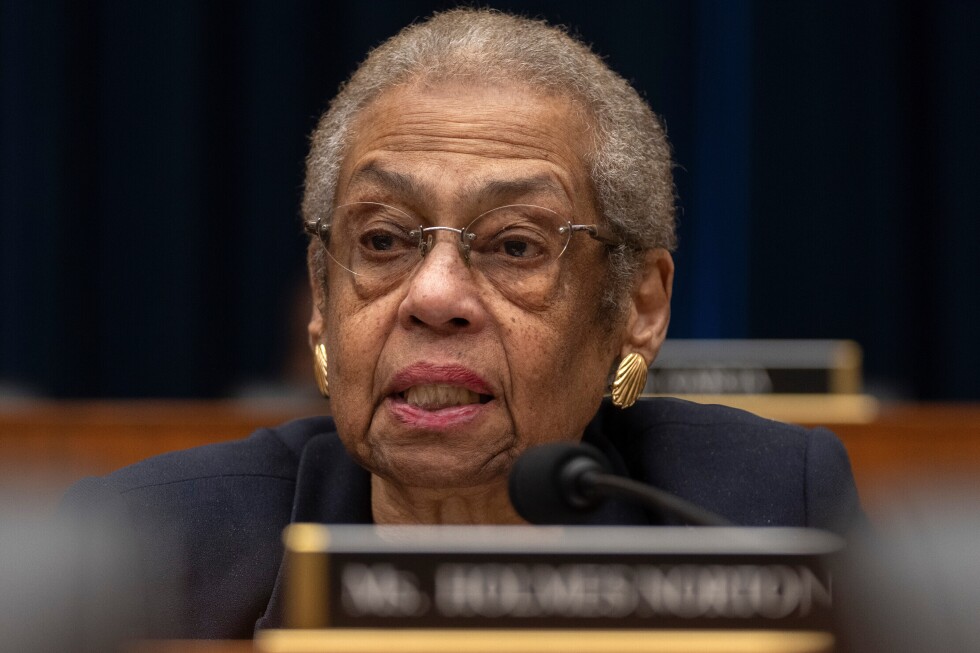
Eleanor Holmes Norton, who has served as the District of Columbia’s sole representative in Congress for more than three decades, has filed paperwork to end her reelection campaign, signaling the conclusion of her remarkable political career that began during the Civil Rights Movement.
The 88-year-old Norton, who has represented Washington, D.C. in Congress since 1991, submitted a termination report to the Federal Election Commission on Sunday. Though her office has not released an official statement regarding her intentions, the filing effectively ends her bid for a 19th term in Congress.
“For 35 years, Congresswoman Norton has been our Warrior on the Hill,” D.C. Mayor Muriel Bowser wrote on social media, praising Norton’s legacy. “Her work embodies the unwavering resolve of a city that refuses to yield in its fight for equal representation.”
Norton’s decision comes amid increasing scrutiny about her effectiveness as an advocate for the district, particularly following the Trump administration’s aggressive intervention in Washington over the past year. The federal government federalized the city’s police force, deployed National Guard troops from multiple states across the capital, and sent Department of Homeland Security agents into D.C. neighborhoods – actions that sparked protests from residents and a lawsuit from the district’s attorney general.
As the district’s congressional delegate, Norton lacks voting power in the full House of Representatives – a limitation she has fought to overcome throughout her tenure. Despite this constraint, she became known for finding alternative ways to advance her constituents’ interests, earning her the nickname “Warrior on the Hill” among supporters for her relentless advocacy for D.C. statehood and federal workers’ rights.
Norton secured several significant bipartisan victories for district residents. She championed legislation allowing D.C. students to attend any public college or university nationwide at in-state tuition rates or receive grants of up to $2,500 for private universities. During the 1990s financial crisis, she brokered a crucial agreement transferring billions in unfunded pension liabilities to the federal government in exchange for budget reforms. She also played a pivotal role in twice securing House passage of D.C. statehood bills.
Born and raised in Washington, Norton’s life reflects the district’s evolution through both challenging and triumphant periods. She attended Dunbar High School as part of its final segregated class. “Growing up black in Washington gave a special advantage. This whole community of blacks was very race conscious, very civil rights conscious,” she said in her 2003 biography, “Fire in My Soul.”
After graduating from Antioch College in Ohio, Norton divided her time between Yale Law School and Mississippi, where she worked as an organizer during the 1963 Freedom Summer. On a fateful day that summer, civil rights leader Medgar Evers picked her up at the airport; he was assassinated that same night.
Norton also helped organize and attended the historic 1963 March on Washington, which she later described to the Associated Press as “the single most extraordinary experience of my lifetime.” Before entering politics, she became the first woman to chair the Equal Employment Opportunity Commission.
Her retirement adds to an unprecedented exodus from Congress this election cycle, with more than 10% of House members declining to seek reelection. Norton’s decision opens the door to what will likely be a competitive Democratic primary in the heavily blue district, where several local lawmakers had already announced their candidacies before her withdrawal.
As she concludes her decades of service, Norton leaves behind a legacy as a steadfast champion for both civil rights and the democratic representation of Washington, D.C.’s residents – a cause she has advanced from the front lines of American history to the halls of Congress.
Fact Checker
Verify the accuracy of this article using The Disinformation Commission analysis and real-time sources.

14 Comments
It’s understandable that an 88-year-old would want to step back after such a long and distinguished career in public service. Norton has been a trailblazer and a fierce defender of D.C. residents’ interests in Congress.
Her departure will leave a big void, but hopefully a new generation of leaders will step up to carry on her work for D.C. statehood and representation.
Congresswoman Norton has been a true champion for D.C. residents. Her departure is a loss, but the fight for equal representation in Congress must continue. I’m curious to see who will emerge as the next leader on this critical issue.
Eleanor Holmes Norton’s decision to end her reelection campaign is a significant moment in D.C. politics. She has been a tireless advocate for the District’s residents, and her departure will leave a void that needs to be filled by new leaders committed to the cause.
Norton’s retirement is certainly noteworthy, given her long tenure and central role in the statehood movement. It will be interesting to see how the political landscape in D.C. shifts with new leadership stepping up to continue the fight.
The challenge will be ensuring the momentum for D.C. statehood is maintained. Norton’s departure is a significant transition, but the cause remains as important as ever.
Eleanor Holmes Norton’s decision to end her reelection campaign is a bittersweet milestone. She has been a stalwart champion for D.C. statehood and voting rights, and her departure will leave a void that needs to be filled.
The next generation of leaders in D.C. will have big shoes to fill, but the fight for full representation in Congress must continue. Norton’s legacy provides a strong foundation to build upon.
Eleanor Holmes Norton’s decision to retire is the end of an era, but her legacy as a tireless advocate for D.C. statehood and voting rights will endure. The city’s residents owe her a debt of gratitude for her decades of service.
Congresswoman Norton’s retirement marks the end of an era, but the work for D.C. statehood and representation must go on. Her dedication and perseverance have been inspiring, and I hope her successor will carry on that important mission.
Congresswoman Norton has been a tireless advocate for D.C. for over 30 years, and her retirement is a significant moment. The city’s residents owe her a great deal of gratitude for her dedication and persistence on this critical issue.
While it’s the end of an era, Congresswoman Norton’s retirement opens the door for new leaders to take up the mantle of D.C. statehood and representation. This is an opportunity to reinvigorate the movement and push it forward.
While Norton’s retirement is bittersweet, it’s a natural transition. The District needs to keep up the momentum for full voting rights and statehood, building on the foundation she has laid over the past three decades.
Eleanor Holmes Norton has been a tireless advocate for D.C. statehood and representation for over 30 years. While her retirement signals the end of an era, her legacy will live on in the continued fight for full voting rights for the District.