


Listen to the article
Nevada Governor’s Campaign Fundraising Relies Heavily on “Bundling” to Skirt Contribution Limits
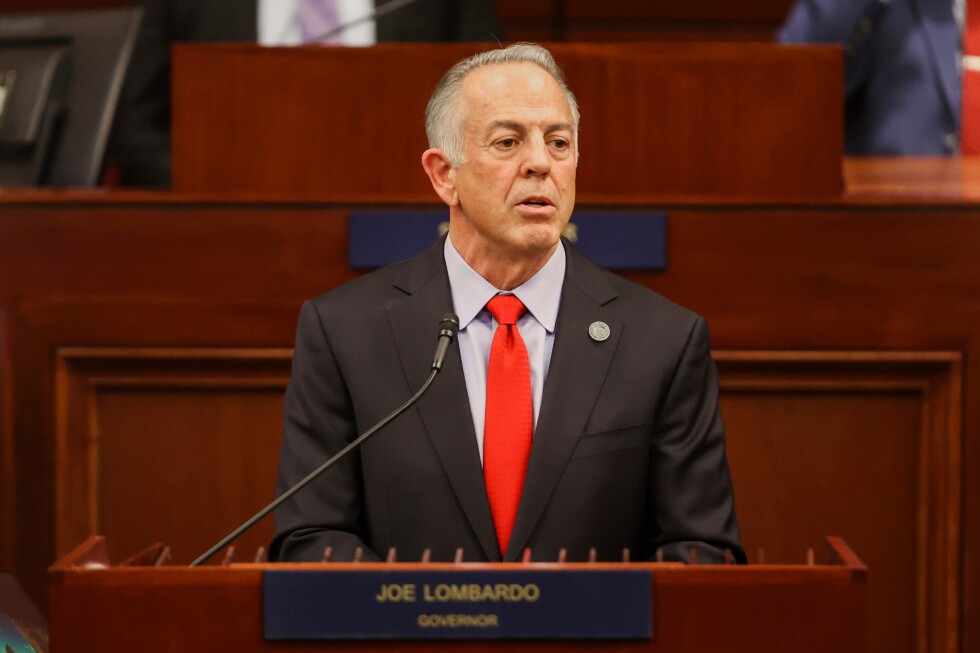
Nearly half of Gov. Joe Lombardo’s impressive $4.3 million campaign fundraising in 2025 came through legal “bundling” arrangements that effectively circumvent Nevada’s contribution limits, an analysis by The Nevada Independent has revealed.
The investigation found that approximately $1.9 million – about 44 percent of Lombardo’s fundraising total – came from entities with known connections or shared addresses that collectively donated more than the single-cycle contribution limit. By contrast, Democratic Attorney General Aaron Ford’s gubernatorial campaign received just $50,000 through similar bundling methods, representing only 2 percent of his haul, while Democratic candidate and Washoe County Commissioner Alexis Hill’s campaign showed minimal reliance on bundled donations.
“Campaign finance systems like these render individual contribution limits moot,” said Ken Miller, a UNLV political science professor, pointing to the legal practice that exists because Nevada, unlike the federal government and about one-third of states, allows corporations to contribute directly to political candidates.
The investigation into Lombardo’s fundraising revealed gaming and real estate companies as dominant contributors. Las Vegas hotel mogul Robert Bigelow contributed $220,000 through 22 companies all tied to a single address, while Las Vegas gambler and developer Billy Walters – who was convicted of insider trading charges in 2017 – donated $200,000 through 20 different entities.
Perhaps most significant were contributions from the Fertitta family and their Station Casinos empire, who collectively donated $3 million to Lombardo’s campaign and associated PACs – accounting for approximately one-third of the $9 million total raised by these entities.
In response to questions about bundling reliance, Lombardo’s campaign stated “there is nothing unusual or improper about the makeup of the Governor’s donor base,” noting that governors from both parties have long received such donations. The campaign highlighted that 84 percent of its contributions came from Nevada addresses, compared to just 42 percent of Ford’s.
Ford’s campaign countered by emphasizing grassroots support, stating that more than half of his individual donors are from Nevada, with contributions from all 17 counties received within a month of his campaign launch. His campaign reported receiving 10,000 donations – claimed as a record for a gubernatorial campaign – with about 90 percent under $125.
The gaming industry emerged as Lombardo’s largest supporter sector. Beyond the Fertittas’ contributions, South Point Hotel and Casino gave $200,000 to Lombardo’s PAC, Boyd Gaming entities contributed $158,000 (plus $40,000 from Boyd employees), The Venetian donated $100,000, and MGM Resorts gave $50,000 through multiple entities.
Real estate and development interests contributed approximately $1.6 million to Lombardo’s campaign. The Washington D.C.-based Leading Builders of America gave $300,000 to Lombardo’s PAC, while commercial real estate developer Brett Torino’s companies contributed $120,000 through 12 entities.
The substantial real estate industry support comes after a legislative session where housing was one of Lombardo’s priorities. The governor helped secure a $133 million allocation for “attainable housing” development and approved $21 million for rental assistance programs. However, he faced criticism from Democrats for vetoing bills that would have capped rent increases for seniors and reformed the state’s eviction process.
“It should be unsurprising that the candidate who becomes governor is not going to be especially supportive of policies that are going to be unfriendly to real estate,” Miller noted, though he described the relationship between donations and policy as a “chicken and egg problem,” questioning whether donations drive policy or like-minded businesses simply support candidates who share their views.
Campaign finance reform experts suggest Nevada’s bundling practices are unlikely to change without a major scandal or clear political advantage for the party controlling state government. Aaron McKean, senior legal counsel at the Campaign Legal Center, suggested public financing of campaigns as an alternative, where governments provide matching funds for small-dollar donations to increase their impact.
“It’s always going to raise that question for regular folks — what is this person buying? What is that interest? Why are they spending so much on elections?” McKean said, noting that large contributions can “undermine the confidence that the public has in our elected officials,” even without direct evidence of quid pro quo arrangements.
Fact Checker
Verify the accuracy of this article using The Disinformation Commission analysis and real-time sources.

5 Comments
Interesting to see the role of bundled donations in Nevada campaign financing. While legal, it does seem to undermine the intent of contribution limits. I’d be curious to learn more about the potential impacts on political representation and accountability.
This legal loophole highlights the complex nature of campaign finance. While the letter of the law may be followed, the spirit of fair and equal political participation could be undermined. Thoughtful policy reforms may be warranted to address such issues.
Campaign finance is a thorny issue with no easy solutions. Bundling allows donors to effectively sidestep limits, but banning it entirely may raise free speech concerns. Finding the right balance is challenging but important for maintaining public trust in the political process.
The reliance on bundled donations raises questions about the influence of moneyed interests in politics. While legal, it seems to create an uneven playing field. I wonder what measures could be taken to promote more equitable political participation.
This report highlights the need for greater transparency and accountability in campaign financing. While the legal technicalities may be followed, the spirit of democratic representation seems compromised. Meaningful reform is clearly an ongoing challenge.