


Listen to the article
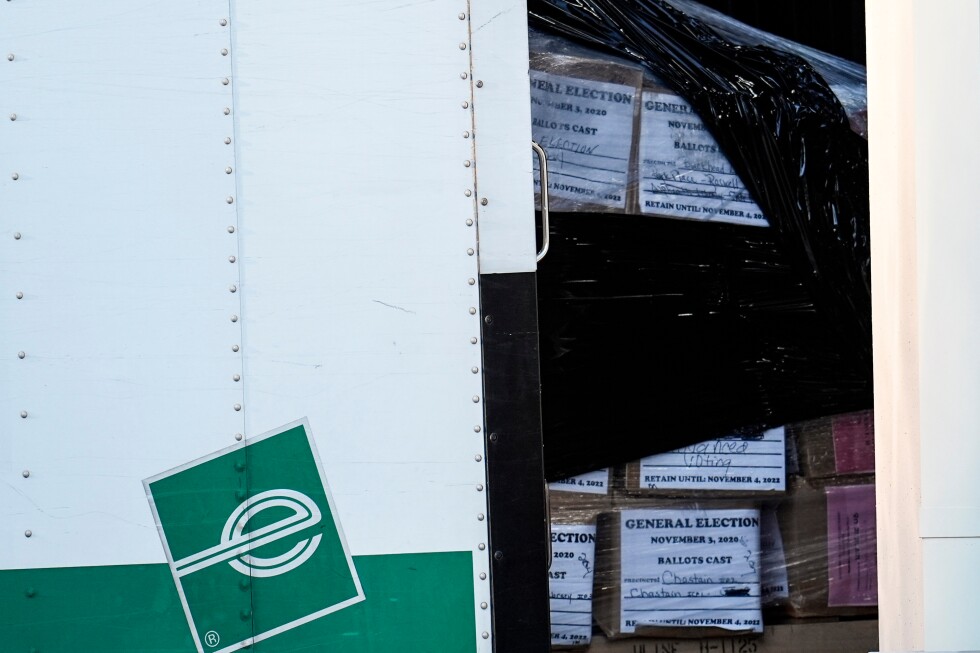
Fulton County officials have asked a federal court to order the FBI to return ballots and other documents from the 2020 election that were seized last week, intensifying a voting battle as President Donald Trump declares his intention to “take over” elections from Democratic-run areas ahead of the November midterms.
The FBI searched a warehouse near Atlanta where election records were stored, a move that followed Trump’s persistent demands for retribution over his unsubstantiated claims that fraud cost him victory in Georgia. Trump reiterated his position about federal intervention in elections during an interview with a conservative podcaster on Monday and again in Oval Office remarks the following day.
“This case is not only about Fulton County,” said county chairman Robb Pitts. “This is about elections across Georgia and across the nation.”
The legal action comes amid growing anxiety over Trump’s plans for the fall elections that will determine control of Congress. U.S. Senator Mark Warner, D-Va., expressed concern this week, saying the possibility that Trump “will ask his loyalists to do something inappropriate, beyond the Constitution, scares the heck out of me.”
While the White House has dismissed such fears, pointing out that Trump did not intervene in the 2025 off-year elections despite Democratic predictions, Trump has already signaled his approach to the midterms. In an NBC News interview aired Wednesday, the president said he will trust Republican losses in the midterms “if the results are honest,” employing his recurring strategy of suggesting that any loss would be attributable to fraud.
Democratic state election officials have begun planning for various scenarios this fall in response to Trump’s statements, the Georgia records seizure, and the deployment of federal officers in Democratic-leaning cities. These contingency plans include how to respond if Immigration and Customs Enforcement officers appear at polling places.
Officials have also voiced concerns about Department of Justice lawsuits targeting primarily Democratic states that request detailed voter information, including birth dates and partial Social Security numbers. Secretaries of state worry the administration may be creating a database to potentially disenfranchise voters in future elections.
Fulton County, Georgia’s most populous county, has been a particular focus for Trump since he narrowly lost the state to Joe Biden in 2020. In the aftermath of that election, Trump famously called Georgia’s Republican Secretary of State Brad Raffensperger, urging him to “find” the 11,780 votes needed to flip the state’s result and suggesting criminal consequences for non-compliance.
“The president himself and his allies, they refuse to accept the fact that they lost,” Pitts said. “And even if he had won Georgia, he would still have lost the presidency.” Pitts defended the county’s election practices, noting that Fulton has conducted 17 elections since 2020 without issues.
According to a warrant cover sheet provided to the county, FBI agents were seeking all materials related to the 2020 general election: ballots, tabulator tapes, electronic ballot images, and voter rolls. The FBI removed hundreds of boxes of ballots and other documents, though county officials say they were not informed of the federal government’s purpose in seizing the materials.
The county is also requesting that the court unseal the sworn statement from the law enforcement agent that was presented to the judge who approved the search warrant. The Justice Department has declined to comment on the county’s motion.
Notably, Tulsi Gabbard, Trump’s director of national intelligence, was present during the Fulton County search last week. This has prompted Democrats in Congress to question the appropriateness of her involvement in what was a law enforcement action rather than an intelligence operation. In a letter to House and Senate Intelligence committee leaders, Gabbard stated that Trump asked her to be there “under my broad statutory authority to coordinate, integrate, and analyze intelligence related to election security.”
Trump claimed during his NBC News interview that he was unaware of why Gabbard was in Fulton County but suggested without evidence that “a lot of the cheating, it’s international cheating.”
The Constitution grants states the authority to administer elections, while Congress can add rules for federal races. One of Trump’s earliest second-term actions was an executive order attempting to rewrite nationwide voting rules, which judges have largely blocked as unconstitutional. Nevertheless, Trump has argued that states are “agents of the federal government to count the votes. If they can’t count the votes legally and honestly, then somebody else should take over.”
While White House spokeswoman Karoline Leavitt claimed Trump’s “take over” comments referred to the SAVE Act legislation that would strengthen proof of citizenship requirements, Trump’s actual remarks did not mention this proposal. Instead, he focused on alleged “horrible corruption on elections” in Democratic-controlled areas like Atlanta.
Even Republican Senator Thom Tillis of North Carolina, while supporting the SAVE Act, distanced himself from Trump’s federal takeover remarks, stating that “nationalizing elections and picking 15 states seems a little off strategy.”
Fact Checker
Verify the accuracy of this article using The Disinformation Commission analysis and real-time sources.

7 Comments
The potential for federal intervention in state elections is a complex and sensitive issue. I hope all parties involved can find a resolution that upholds democratic principles and protects the integrity of the electoral system.
While I understand the desire for election integrity, any attempts to ‘take over’ state electoral processes raise serious red flags. Robust checks and balances are essential to maintain public trust in our democratic institutions.
I’m curious to see how this legal battle plays out. It’s important that all sides respect the rule of law and the will of the voters, regardless of political affiliation.
I agree. The public deserves transparency and accountability when it comes to election processes and records.
This is a concerning trend that bears close watching. Voters should be able to trust that their votes will be counted fairly and accurately, regardless of which party is in power.
Absolutely. Safeguarding the democratic process should be a non-partisan priority for all elected officials and government agencies.
This is a concerning development, as the integrity of elections is crucial for a healthy democracy. Any attempt to undermine the democratic process should be taken seriously and addressed through proper legal channels.