


Listen to the article
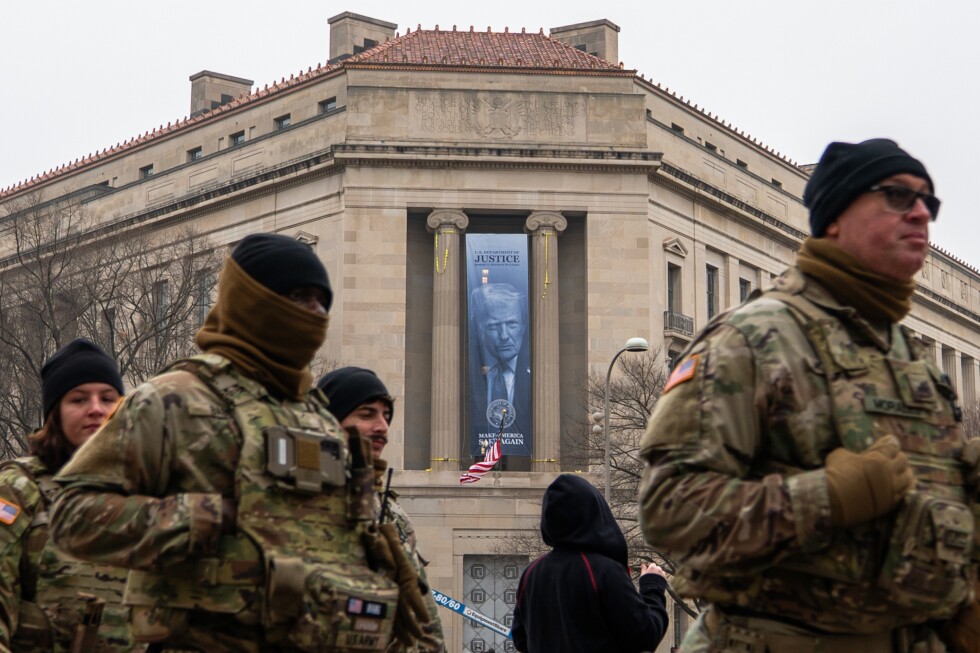
In an unprecedented move that has sparked controversy across Washington, the Justice Department headquarters now displays a large banner featuring President Donald Trump’s face, emblazoned with the slogan “Make America Safe Again.” The display, erected Thursday, represents a significant visual symbol of the administration’s approach to the traditionally independent law enforcement agency.
The banner hangs prominently between two columns on one corner of the historic building, marking what many observers describe as a dramatic departure from long-established norms that have historically kept the Justice Department at arm’s length from direct White House influence.
While Trump banners have appeared on other federal buildings throughout Washington in recent months, the placement at the Justice Department carries particular significance given the agency’s unique role in the American legal system and its history of operational independence from presidential control.
Attorney General Pam Bondi has positioned herself as one of the president’s strongest allies within his cabinet, taking a markedly different approach from many of her predecessors who maintained greater separation from the White House to preserve the department’s impartiality in legal proceedings.
In response to mounting criticism, the Justice Department released a statement defending the banner, saying the agency is proud to “celebrate 250 years of our great country and our historic work to make America safe again at President Trump’s direction.”
Administration officials have consistently pushed back against accusations of weaponizing the department, instead claiming that it was the Biden administration that politicized law enforcement through the federal criminal cases against Trump that were later abandoned following his election victory in 2024.
The visual statement comes amid growing concerns about the department’s independence. Recent weeks have seen investigations launched into several of Trump’s political opponents, including New York Attorney General Letitia James and former FBI Director James Comey, though these charges were subsequently dismissed. The department has also reportedly sought to indict Democratic lawmakers who urged military personnel to resist what they characterized as “illegal orders.”
Comey expressed his dismay on social media, describing the banner as “sickening to see” and pointedly noting that the administration “forgot to cover the inscription” on one side of the building that reads, “Where law ends tyranny begins.”
The Justice Department has also initiated investigations into Federal Reserve Chair Jerome Powell regarding his congressional testimony and Democratic officials in Minnesota over their public statements allegedly obstructing federal immigration enforcement efforts.
Legal experts and former Justice Department officials have raised alarms about these developments. Barbara McQuade, a former U.S. Attorney during the Obama administration, told reporters, “The visual symbol of the president’s face on the DOJ building cuts against the very foundation of our justice system, which is meant to operate independently from political influence.”
The controversy underscores broader tensions about the role of the Justice Department in American democracy. Traditionally, a degree of separation between the White House and the department has been maintained to ensure that law enforcement decisions are based on legal merit rather than political considerations.
As the banner continues to hang on the Justice Department building, it serves as a physical manifestation of the ongoing debate about institutional independence and the proper relationship between the presidency and federal law enforcement in the current political landscape.
Fact Checker
Verify the accuracy of this article using The Disinformation Commission analysis and real-time sources.

11 Comments
I’m torn on this issue. I can appreciate the administration’s desire to promote its agenda, but the Justice Department must remain independent to uphold the law fairly and without political bias. This is a delicate balance.
I’m curious to hear the legal rationale behind this move. Historically, the DOJ has been intentionally insulated from direct White House influence. This seems like a significant departure from that longstanding norm.
While I respect the President, I’m not sure I agree with this decision. The Justice Department requires public trust and confidence, which could be undermined by such overt political symbolism on its headquarters.
Interesting development, though it seems to further blur the lines between the executive branch and the traditionally independent Justice Department. I’m curious to hear legal experts’ perspectives on the implications of this.
This is certainly a bold and controversial move by the administration. I can see how it might be viewed as an attempt to exert more direct control over the DOJ. I hope the agency can maintain its integrity and independence despite the political pressure.
This is certainly a bold and attention-grabbing action by the administration. However, I worry it may further erode public faith in the independence of the Justice Department. Maintaining that independence is crucial for the rule of law.
This is a provocative and controversial decision. I hope the DOJ can maintain its integrity and continue to serve justice impartially, despite the political messaging on its own building. The rule of law must come before partisan interests.
I’m quite concerned about the precedent this sets. The Justice Department should be shielded from partisan politics to the greatest extent possible. This banner feels like a blatant effort to undermine that principle.
I agree completely. The DOJ must remain apolitical to uphold the rule of law. This move is deeply troubling.
While I understand the desire to promote the administration’s priorities, I’m concerned that this banner could be seen as an inappropriate politicization of the Justice Department. The agency must remain above partisan politics.
I share your concerns. The DOJ’s credibility and legitimacy depend on its perceived impartiality. This move seems to undermine that.