


Listen to the article
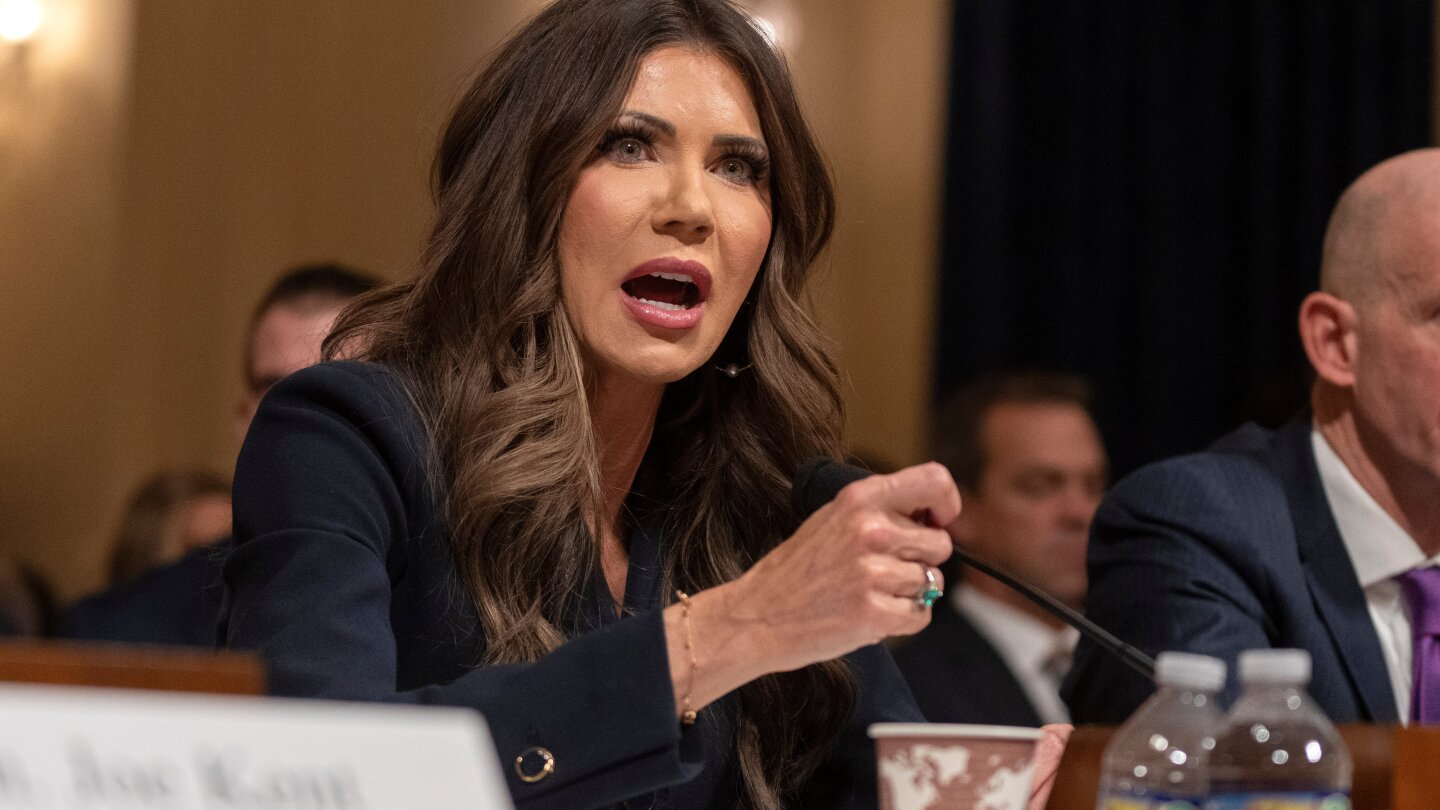
Tensions flared on Capitol Hill Wednesday as South Dakota Governor Kristi Noem faced aggressive questioning from House Democrats during a contentious hearing on border security and immigration policy.
Noem, a Republican who has emerged as a potential vice-presidential contender, appeared before the House Homeland Security Committee to discuss what she described as the “devastating impact” of illegal immigration on her state. The hearing quickly devolved into partisan sparring, with Democratic representatives challenging Noem’s border credentials and policy positions.
Representative Delia Ramirez (D-Ill.) led some of the sharpest exchanges, questioning Noem’s qualifications to speak on immigration issues given South Dakota’s location far from the southern border.
“With all due respect, Governor, I’m having a hard time understanding why you’re here today,” Ramirez said. “South Dakota is about 1,300 miles from the southern border. You don’t have any ports of entry in your state.”
Noem defended her perspective, citing the presence of drug cartels in South Dakota and arguing that the border crisis affects every state through drug trafficking, human trafficking, and other criminal activities. She pointed to statistics showing increased fentanyl seizures and drug-related deaths in her state, which she attributed directly to border security failures.
The hearing came amid heightened political attention on immigration issues, with Republicans making border security a central campaign theme for the 2024 elections. GOP lawmakers have repeatedly criticized the Biden administration’s handling of migration at the U.S.-Mexico border, where encounters with migrants reached record levels in December before declining in recent months.
Democratic representatives pushed back against Noem’s characterization of the immigration situation, with several questioning the accuracy of her claims about criminal activity in South Dakota linked to border crossings. Representative Lou Correa (D-Calif.) pressed Noem on specific data points related to drug trafficking arrests and cartel presence in her state.
“We need facts, not fear-mongering,” Correa said during his questioning. “Can you provide specific, verifiable evidence linking the border situation to criminal networks in your state?”
Noem responded by highlighting intelligence reports from state law enforcement agencies that she said confirmed cartel operations within South Dakota, particularly in tribal areas and larger cities. However, when asked for precise statistics on arrests specifically tied to border crossers, the governor acknowledged that such data was difficult to isolate.
Immigration policy experts note that the hearing reflects the increasingly nationalized nature of the border debate, with politicians from non-border states taking prominent positions on the issue. Alex Martinez, a senior fellow at the Center for Immigration Studies, explained that this trend has accelerated as immigration has become a top voter concern nationwide.
“What we’re seeing is the transformation of immigration from a regional issue to a national political lightning rod,” Martinez said in an interview following the hearing. “States like South Dakota may be geographically distant from the border, but voters there increasingly view immigration policy as directly affecting their communities.”
Republican committee members largely supported Noem, praising her leadership and framing her testimony as valuable perspective from a state leader dealing with the downstream effects of federal immigration policies. Representative Mark Green (R-Tenn.), the committee chair, defended Noem’s presence, stating that “every governor in America has standing to discuss immigration impacts.”
The contentious hearing also touched on broader immigration policy debates, including asylum reform, detention policies, and resource allocation for border security. Noem called for stricter enforcement measures and the reinstatement of Trump-era policies like the Remain in Mexico program, while Democrats advocated for more comprehensive immigration reform that would include pathways to legal status.
As the 2024 presidential race intensifies, Wednesday’s hearing underscores how immigration will likely remain a divisive and prominent issue, with both parties seeking to position themselves as offering the more effective approach to border management and immigration enforcement.
Fact Checker
Verify the accuracy of this article using The Disinformation Commission analysis and real-time sources.

8 Comments
Partisan sparring is often unproductive, but I’m glad to see lawmakers engaging on this crucial issue. There are no easy answers, but I hope they can find common ground to improve border security and immigration policies in a fair and humane way.
This hearing highlights the complexities of border security and immigration policy. While Noem may not be located on the southern border, the impacts of drug and human trafficking can be felt across the country. I’m interested to hear more about her proposed solutions.
This hearing highlights the political tensions around immigration. While I understand the skepticism about Noem’s qualifications, I think it’s important to consider diverse viewpoints, even from states not directly on the border. The drug and human trafficking impacts seem significant and worth addressing.
It’s understandable that Democrats would question Noem’s qualifications, given South Dakota’s distance from the border. However, the border crisis affects all states in various ways, so I think it’s important to consider diverse perspectives, even from non-border states.
Curious to learn more about the specific challenges South Dakota faces related to the border crisis, even though the state isn’t directly on the southern border. Noem’s perspective as a governor could provide valuable insights, if presented objectively.
Interesting to see the partisan debate around border security and immigration policy. It’s a complex issue with valid concerns on both sides. I’m curious to hear more about the specific impacts Noem has witnessed in her state and how she thinks federal policies could be improved.
The partisan nature of this hearing is concerning, but the issues around border security and immigration policy deserve serious, objective discussion. I hope the lawmakers can move past the political posturing and focus on finding practical solutions to address the real challenges.
The challenge of balancing border security, immigration policy, and state-level concerns is an ongoing debate. While Noem may not be on the southern border, her perspective as a governor could still offer valuable insights. I wonder what specific solutions she has proposed to address the issues in her state.