


Listen to the article
A federal judge in Washington, D.C., has declined to block the Trump administration’s new policy requiring members of Congress to provide a week’s notice before visiting immigration detention facilities.
U.S. District Judge Jia Cobb ruled Monday that the Department of Homeland Security did not violate a previous court order when it reimposed the seven-day notification requirement for congressional oversight visits to Immigration and Customs Enforcement (ICE) facilities.
Judge Cobb emphasized that her ruling was procedural rather than a judgment on the policy’s legality. She determined that the plaintiffs, several Democratic members of Congress represented by the Democracy Forward legal advocacy group, had used an improper “procedural vehicle” to challenge the January 8 policy, which she classified as a new agency action not subject to her prior order.
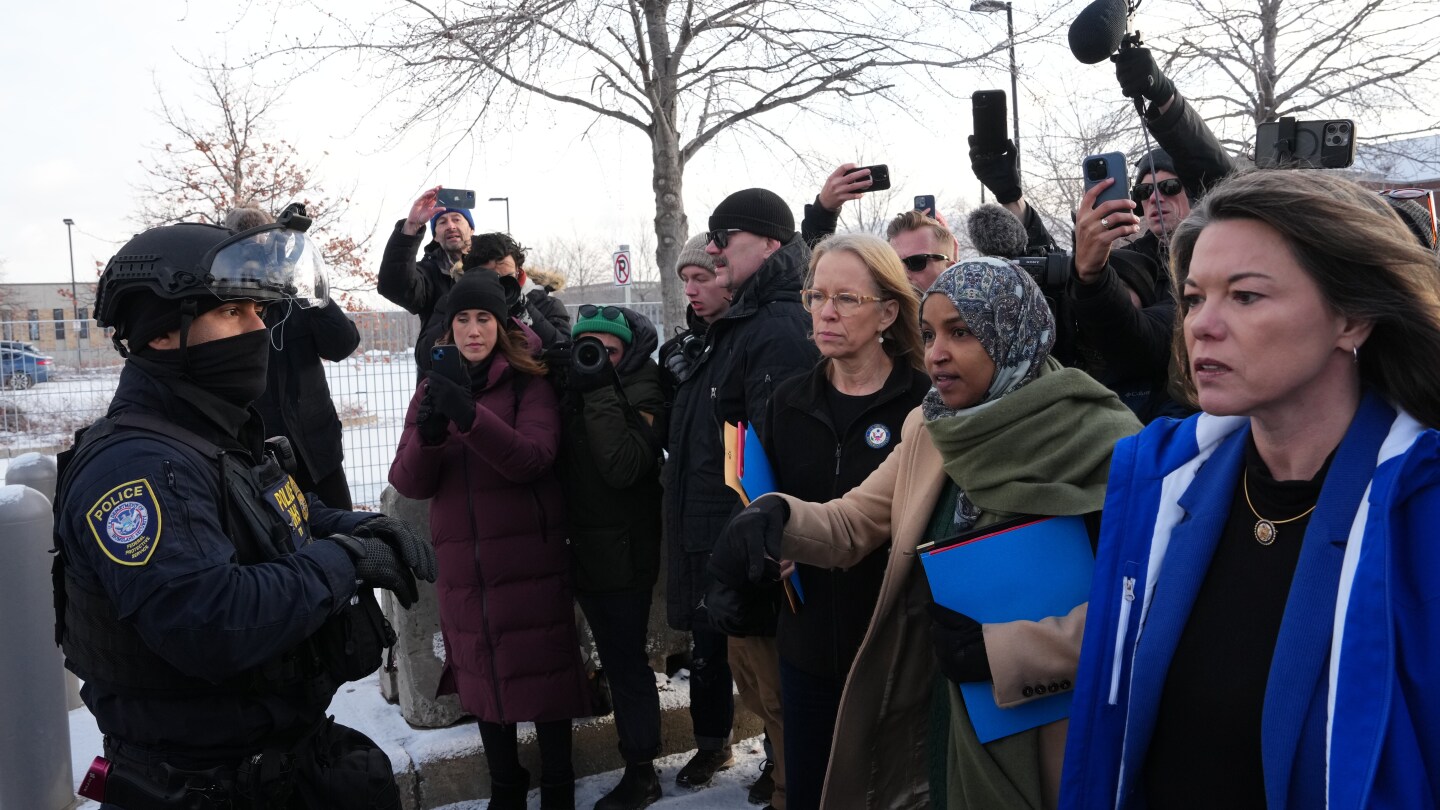
The case arose after three Democratic representatives from Minnesota – Ilhan Omar, Kelly Morrison, and Angie Craig – were barred from visiting an ICE facility in Minneapolis earlier this month. Their attempted visit came just three days after an ICE officer fatally shot Renee Good, a U.S. citizen, in Minneapolis, adding urgency to their oversight efforts.
Last month, Judge Cobb had temporarily blocked a similar administration policy, ruling on December 17 that ICE’s requirement for a week’s notice from congressional members seeking to observe detention conditions was likely illegal. However, a day after Good’s death, DHS Secretary Kristi Noem signed a new memorandum reinstating another seven-day notice requirement.
According to plaintiffs’ attorneys, DHS did not disclose this latest policy until after the Minnesota representatives were turned away from the ICE facility in the Minneapolis federal building.
“The Court emphasizes that it denies Plaintiffs’ motion only because it is not the proper avenue to challenge Defendants’ January 8, 2026 memorandum and the policy stated therein, rather than based on any kind of finding that the policy is lawful,” Judge Cobb wrote in her ruling.
Democracy Forward spokeswoman Melissa Schwartz responded that the organization is reviewing the judge’s order and “will continue to use every legal tool available to stop the administration’s efforts to hide from congressional oversight.”
The legal battle extends beyond the Minnesota representatives. Twelve other Democratic members of Congress had previously sued in Washington to challenge ICE’s visitor policies after being denied entry to detention facilities. Their lawsuit accused the Trump administration of obstructing congressional oversight during its nationwide immigration enforcement operations.
At the heart of the dispute is a federal law that prohibits DHS from using appropriated general funds to prevent members of Congress from entering DHS facilities for oversight purposes. Plaintiffs’ attorneys argue that the administration hasn’t demonstrated that none of those funds are being used to implement the latest notice policy.
“Appropriations are not a game. They are a law,” plaintiff attorney Christine Coogle stated during a hearing last Wednesday.
The timing of these restrictions is particularly significant, as members of Congress are currently negotiating funding for DHS and ICE for the next fiscal year, with DHS’s annual appropriations set to expire on January 30.
“This is a critical moment for oversight, and members of Congress must be able to conduct oversight at ICE detention facilities, without notice, to obtain urgent and essential information for ongoing funding negotiations,” the legislators’ lawyers wrote.
Government attorneys have dismissed concerns that conditions in ICE facilities might change during the required seven-day notice period as speculative. However, Judge Cobb had previously rejected that argument, writing in her December ruling that “the changing conditions within ICE facilities means that it is likely impossible for a Member of Congress to reconstruct the conditions at a facility on the day that they initially sought to enter.”
The dispute highlights ongoing tensions between congressional oversight responsibilities and executive branch immigration policies under the Trump administration, with access to detention facilities remaining a contentious flashpoint.
Fact Checker
Verify the accuracy of this article using The Disinformation Commission analysis and real-time sources.

20 Comments
This ruling is disappointing, as it appears to prioritize administrative convenience over democratic oversight. Elected officials should have unfettered access to immigration detention centers to ensure humane conditions and lawful practices.
I hope the plaintiffs will continue to pursue this issue through the courts or other channels. Transparency and accountability for ICE are essential.
This decision is concerning, as it appears to prioritize administrative convenience over the critical role of congressional oversight. Transparency and accountability should be the top priorities when it comes to immigration detention facilities.
I hope the plaintiffs will continue to pursue this issue and that the courts will ultimately rule in favor of preserving unfettered access for members of Congress.
This decision is concerning, as it appears to limit the ability of Congress to fulfill its critical oversight role. Transparency and accountability should be the priority when it comes to immigration detention facilities.
I hope the plaintiffs will continue to pursue this issue and that the courts will ultimately rule in favor of preserving congressional access to these facilities.
While I understand the need for security protocols, limiting congressional access to immigration detention facilities is concerning. Elected officials must be able to effectively monitor these facilities and address any issues that arise.
I wonder if there are any alternative approaches that could balance security concerns with the need for regular, unannounced oversight by members of Congress.
The judge’s ruling is disappointing, as it seems to create unnecessary obstacles to congressional oversight of ICE operations. Elected officials must have the ability to regularly inspect these facilities without advance notice.
I’m curious to see how this issue will play out in the courts and whether Congress will explore other avenues to assert their oversight role.
The recent shooting incident in Minneapolis underscores the need for robust oversight and transparency around ICE activities. Limiting access for members of Congress is concerning, as they play a critical role in monitoring these facilities.
I wonder if there are any legal avenues for Congress to challenge this policy and assert their right to inspect these facilities without advance notice.
The judge’s procedural ruling is disappointing, as it seems to undermine the ability of Congress to effectively monitor the activities of ICE. Elected officials must have the tools to provide robust oversight of these facilities.
I’m curious to see if this issue will be taken up by other courts or if Congress will explore alternative avenues to assert their oversight authority.
This ruling is troubling, as it appears to erect unnecessary barriers to congressional oversight. Unfettered access for elected officials is essential to ensuring transparency and accountability within the immigration detention system.
I hope the plaintiffs will appeal this decision and that the courts will ultimately rule in favor of preserving Congress’s oversight role.
This is an interesting development in the ongoing debate around congressional oversight of immigration detention facilities. While the judge’s ruling was procedural, it raises questions about the transparency and accountability of ICE operations.
Requiring a week’s notice for visits seems like a potential barrier to effective oversight. I hope Congress can find a way to ensure regular, unannounced access to these facilities.
The judge’s procedural ruling is disappointing, as it seems to undermine the ability of Congress to effectively monitor the activities of ICE. Elected officials must have the tools to provide robust oversight of these facilities.
I’m curious to see if this issue will be taken up by other courts or if Congress will explore alternative avenues to assert their oversight authority.