


Listen to the article
Federal Judge Blocks California’s Ban on Masked Immigration Officers While Upholding ID Requirement
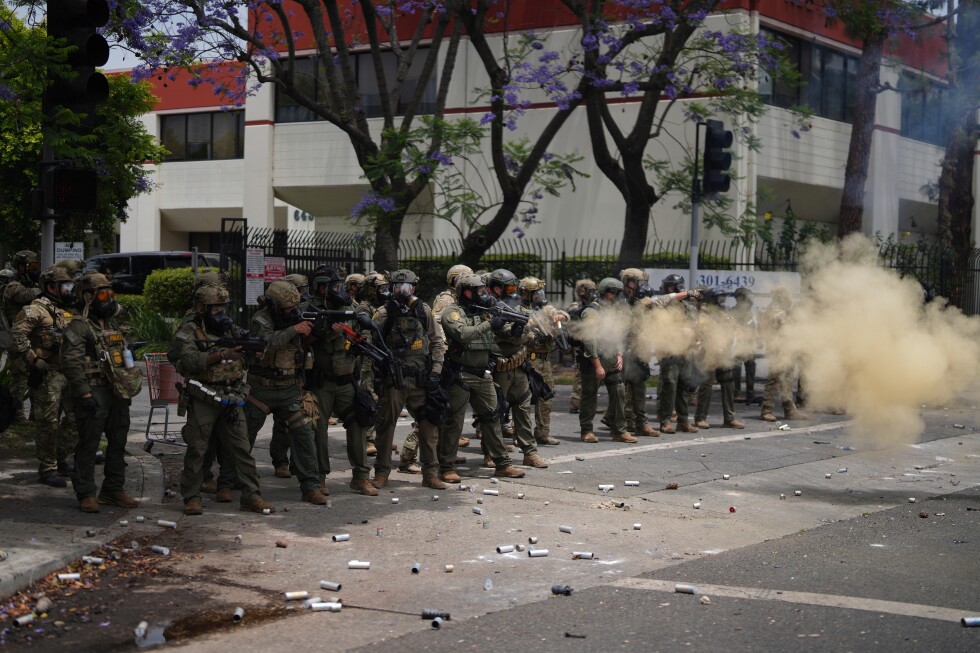
A federal judge in Los Angeles partially blocked a groundbreaking California law Monday that would have prohibited federal immigration agents from wearing facial coverings during enforcement operations. While Judge Christina Snyder halted implementation of the mask ban, she upheld a companion requirement that officers must display clear identification showing their agency and badge number.
The ruling represents a split decision in the legal battle between California and the Trump administration over immigration enforcement transparency. Judge Snyder’s decision cited discrimination concerns, noting that the law unfairly targeted federal agents while exempting state law enforcement officers from similar restrictions.
“The Court finds that federal officers can perform their federal functions without wearing masks,” Judge Snyder wrote in her ruling, which takes effect February 19. Her decision leaves open the possibility that a revised law applying equally to all law enforcement agencies could withstand legal scrutiny.
California became the first state to enact such restrictions when Governor Gavin Newsom signed the legislation in September 2023, following high-profile Immigration and Customs Enforcement (ICE) raids in Los Angeles that summer. The law was scheduled to take effect January 1 but remained on hold pending resolution of the lawsuit.
The Trump administration filed its legal challenge in November, arguing that prohibiting facial coverings would jeopardize officer safety amid what they described as increasing harassment, doxing, and violence directed at immigration agents. Federal attorneys also contended the legislation violated constitutional principles by allowing a state to directly regulate federal operations.
At a January 14 hearing, government lawyer Tiberius Davis cited Department of Homeland Security claims about significant increases in assaults and threats against federal officers. He referenced an incident in Los Angeles where three women allegedly followed an ICE agent home, livestreamed the encounter, and posted the agent’s address on Instagram.
“There is real deterrence on the officer’s safety and ability to perform their duties,” Davis argued.
California Department of Justice attorney Cameron Bell countered that no concrete evidence demonstrated federal agents couldn’t perform their duties without facial coverings. Bell cited declarations from U.S. citizens who reported being detained by masked federal agents and feared they were being kidnapped rather than legitimately apprehended.
“It’s obvious why these laws are in the public interest,” Bell said.
Governor Newsom characterized the mixed ruling as “a clear win for the rule of law” in a statement, emphasizing the importance of the upheld identification requirement.
State Senator Scott Wiener, who authored the original bill, announced he would immediately introduce new legislation to include state police in the mask ban. “ICE and Border Patrol are covering their faces to maximize their terror campaign and to insulate themselves from accountability,” Wiener said in a news release. “We will ensure our mask ban can be enforced.”
The ruling could have national implications as other states consider similar measures in response to federal immigration enforcement tactics. The federal government had warned in legal filings that allowing California’s legislation could embolden other states to impose “similar unconstitutional restraints.”
The original law contained exemptions for undercover operations, protective equipment like N95 respirators or tactical gear, and situations where masks were necessary for operational security. Judge Snyder determined these exemptions, coupled with the carveout for state law enforcement, created an impermissible double standard for federal agents.
Local authorities have also grappled with the issue. Los Angeles County supervisors passed a local ordinance banning law enforcement masks that took effect January 8, though both the county sheriff’s department and Los Angeles Police Department had indicated they wouldn’t enforce the restriction until after the court ruled on the statewide ban.
The case highlights growing tensions between federal immigration enforcement priorities and state efforts to regulate how those operations are conducted in local communities, particularly in immigrant-rich states like California that have frequently challenged federal immigration policies.
Fact Checker
Verify the accuracy of this article using The Disinformation Commission analysis and real-time sources.

9 Comments
This is a complex issue with valid concerns on both sides. Requiring clear ID badges is reasonable, but a blanket mask ban may be overly restrictive. Curious to see if the state can craft a revised law that satisfies the judge’s concerns.
The decision to uphold the ID requirement but block the mask ban suggests the judge saw merit in both California’s transparency goals and the federal agents’ operational needs. A nuanced ruling that could set an important precedent.
Interesting ruling – it seems the judge struck a balance between transparency and federal agents’ ability to do their jobs. I wonder how this will impact immigration enforcement going forward.
The mixed ruling underscores the complexity of this issue. Transparency in government is important, but federal agents must also be able to effectively carry out their duties. Finding the right balance is critical.
The partial blocking of California’s law highlights the complexities involved. While transparency is important, federal agents must also be able to effectively carry out their duties. It will be intriguing to see how this issue progresses.
This ruling highlights the delicate balance between individual rights, government transparency, and operational necessity. I appreciate the judge’s thoughtful approach in finding a middle ground solution.
This is a tricky situation with valid concerns on both sides. The judge’s decision to uphold the ID requirement while blocking the mask ban seems like a reasonable compromise. It will be interesting to see how this evolves.
An interesting ruling that reflects the nuanced nature of this issue. Upholding the ID requirement while blocking the mask ban seems like a reasonable compromise that aims to balance transparency and operational needs. I’ll be following this closely.
While the mask ban was blocked, the ID requirement is a positive step towards accountability. Curious to see if California can modify the law to address the judge’s concerns and still achieve their transparency objectives.