


Listen to the article
Jesse Jackson Jr. Seeks Political Redemption in Bid for Former Congressional Seat
As Jesse Jackson Jr. campaigns across Chicago’s south suburbs, the son of the civil rights icon confronts his past head-on. Speaking to pastors, elected officials and retirees gathered to hear his plans for economic revival, Jackson addresses the 2013 campaign fraud conviction that ended his 17-year congressional career.
“It’s now part of my story,” Jackson told the audience at a recent event in Country Club Hills. “I’ve cried enough. I’m divorced now. I’ve lost my home in foreclosure. I’ve been through everything that comes with that process.”
At 60, Jackson has launched a spirited primary campaign in the largely Black district where he began his political career. His message of redemption resonates in a political landscape where voters have increasingly accepted candidates with criminal histories. Jackson weaves personal stories about incarceration, job struggles, and caring for his ailing father, the Rev. Jesse Jackson, throughout his campaign appearances.
However, his efforts to reclaim the family political legacy have drawn criticism from opponents in the March primary who argue Jackson had his chance in a district with a troubled history of political corruption.
“What I think matters is that trust has to be earned,” Jackson acknowledged in an interview with The Associated Press. “I’m cognizant of that.”
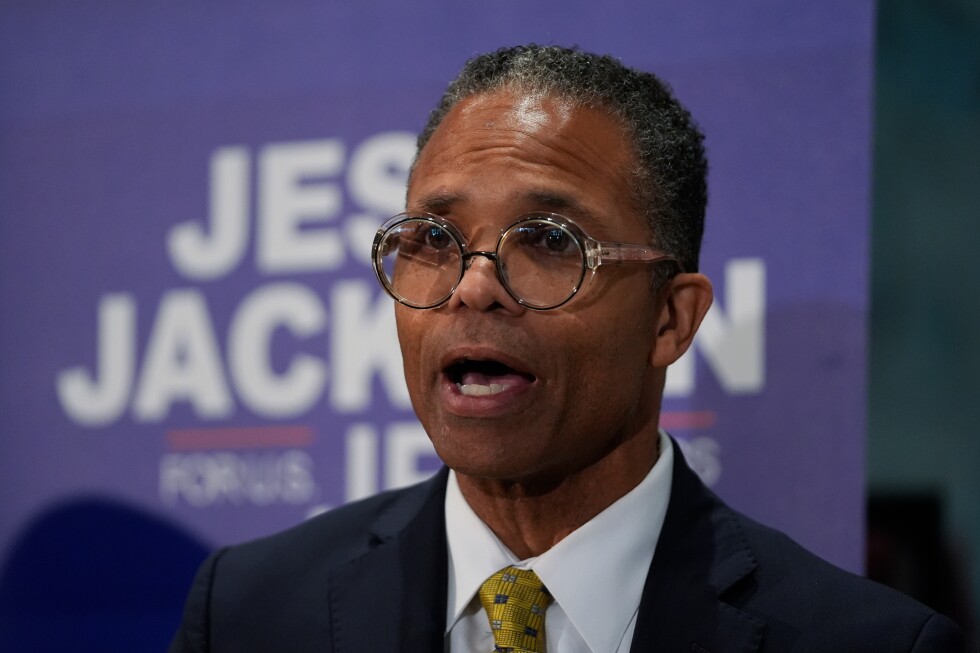
The eldest son of Rev. Jesse Jackson now sports thick circular glasses and graying hair but remains a skilled orator in his father’s tradition. At campaign events, Jackson paces energetically among poster boards outlining his vision for a third Chicago airport, a public-private partnership that has struggled to gain traction for years.
“The one thing that is missing from this congressional district is access to the global economy,” Jackson told nearly 50 supporters at a suburban school gymnasium, describing potential daily flights to destinations like Hong Kong.
His extemporaneous presentations blend Biblical references with warm acknowledgments of local attendees. Campaign materials highlight nearly $1 billion in federal funds Jackson secured during his previous tenure, while signs featuring his portrait carry the slogan “A New Hope.”
David Jones, a 52-year-old Flossmoor resident who plans to vote for Jackson, believes the former congressman has been humbled by his prison sentence. “Would it sway certain people? Probably,” Jones said. “But at the same time, to his point, we have a president that had 34 convictions and he’s still president of the United States. So if it didn’t sway people from voting in that regard, why should it sway you from voting for him?”
Jackson’s political career began promisingly with his election in a 1995 special election. He easily won reelection contests, even surviving a 2009 ethics inquiry related to former Illinois Gov. Rod Blagojevich, for which Jackson wasn’t charged.
However, in 2012, Jackson vanished from public view, missing even his reelection night celebration. He later revealed he was receiving treatment for bipolar disorder at the Mayo Clinic. By November, he had resigned amid a federal investigation that culminated in his guilty plea to charges of misusing $750,000 in campaign funds on luxury items, including Bruce Lee memorabilia. His then-wife, former Chicago Alderwoman Sandi Jackson, also pleaded guilty.
Jackson served 30 months in prison, a period he describes as isolating but educational. While incarcerated, his family withheld news of his father’s neurological disorder diagnosis, fearing he couldn’t emotionally handle the news.
Post-release, Jackson faced personal and financial struggles. His 37-year marriage ended, and his 2018 divorce filings revealed he received Social Security Disability Insurance payments. Employment opportunities proved elusive, with one university rescinding a job offer due to his conviction.
As early voting begins for the March 17 primary in the now-open 2nd District seat, Jackson faces fundraising challenges. While county commissioner Donna Miller leads the ten-candidate Democratic field with approximately $1 million on hand, Jackson has raised about $100,000.
Jackson acknowledges the fundraising difficulties but sees a path to victory through voter registration efforts and reaching disenfranchised voters, particularly Black men who have “abandoned” the Democratic party.
His personal struggles have provided new points of connection with voters. Jackson often begins events by asking who has been imprisoned or knows someone in jail, typically receiving many raised hands. He speaks openly about managing mental health, crediting his physician, social circle, and martial arts practice.
Jackson’s opponents emphasize his privileged background and past spending habits. State Sen. Willie Preston criticizes Jackson’s fashion choices, including Ferragamo shoes, as evidence that he hasn’t reformed. Jackson dismisses this critique, saying simply, “I wear shoes that fit my feet.”
Others argue the district needs a fresh start after a history of representatives leaving office under clouds of misconduct, including Mel Reynolds, who was convicted of fraud and criminal sexual assault charges before Jackson succeeded him.
“We’re ready for new chapter,” said candidate Yumeka Brown, Matteson’s village clerk. “Voters have a right to expect honesty, accountability.”
For voters like Warren Cottrell, a 71-year-old retiree from Homewood, Jackson’s familiar oratorical style evokes memories of his father. “He sounds just as eloquent as his father,” Cottrell said. “I believe in second chances.”
Jackson says his campaign represents a second chance to restore dignity to his family name, particularly for his children: daughter Jessica, who lives in France, and son Jesse III, who’s in college. Both were consulted before he decided to run.
“It’s important for them to see their father stand up and fight for the dignity of their name,” Jackson said.
Fact Checker
Verify the accuracy of this article using The Disinformation Commission analysis and real-time sources.

12 Comments
This race will be a test of voters’ willingness to forgive past transgressions, especially in a high-profile political dynasty like the Jacksons. Jackson Jr. has a lot of work to do to rebuild trust.
Absolutely. He’ll need to strike the right balance between acknowledging his past and presenting a compelling forward-looking agenda for the district.
Campaign finance fraud is a serious offense, but I respect that Jackson Jr. is being upfront about his past mistakes. Voters will need to weigh whether they believe he’s learned from this experience.
Absolutely. His personal struggles could give him a unique perspective, but he’ll need to demonstrate how that informs his policy ideas for the district.
It’s interesting to see Jackson Jr. trying to make a political comeback after his conviction. While voters may be more forgiving these days, he’ll need to convince them he’s truly reformed and can serve effectively.
Agreed. His message of redemption will be key, but he’ll have to back it up with a clear vision and concrete plans for the district.
Redemption stories can be compelling, but Jackson Jr. will need to convince voters that he’s truly learned from his mistakes and is prepared to serve with integrity. It’s a high bar, but not impossible.
Agreed. Transparency and accountability will be key. If he can demonstrate genuine remorse and a clear vision, he may have a chance at reclaiming his old seat.
I’m curious to see how Jackson Jr.’s family legacy and civil rights advocacy play into his campaign pitch. Overcoming a criminal conviction is a tall order, but his name recognition could help.
That’s a good point. His family ties and past experience could be both an asset and a liability. Voters will want to see how he differentiates himself from his father’s legacy.
It’s admirable that Jackson Jr. is being upfront about his personal struggles and conviction. Voters will want to see that he’s truly learned from this experience and is prepared to serve with integrity.
Agreed. His message of redemption could resonate, but he’ll need to back it up with a clear and compelling vision for the district that goes beyond just his personal story.