


Listen to the article
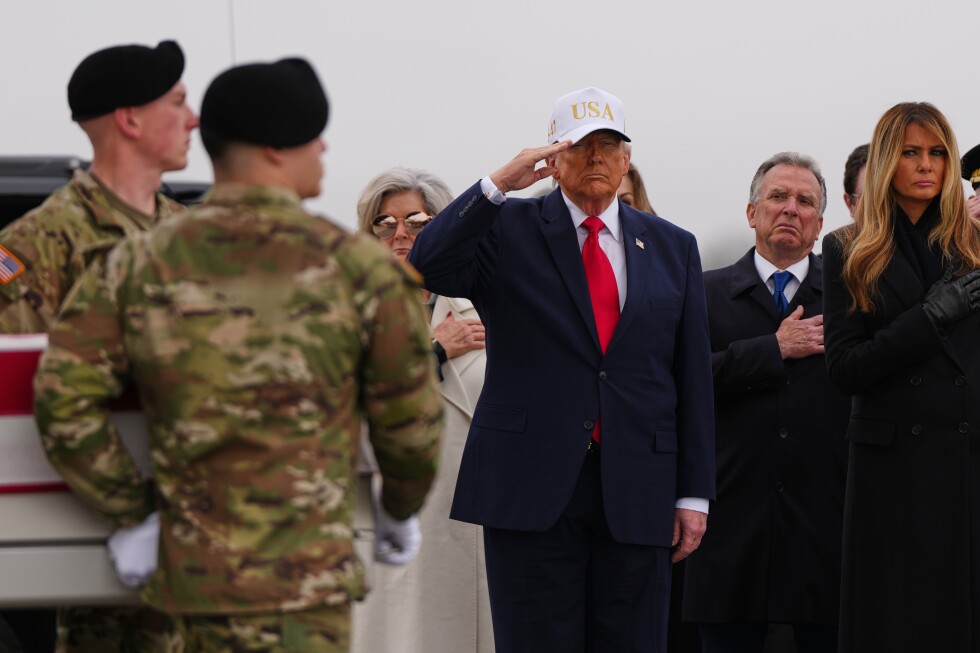
Former President Donald Trump participated in a solemn ceremony at Dover Air Force Base on Saturday, honoring six American service members killed in the ongoing Middle East conflict. Dressed in a blue suit, red tie, and white USA hat, Trump remained silent during the transfer of the flag-draped cases.
“It’s a very sad day,” Trump later told reporters aboard Air Force One as he returned to Florida. “I’m glad we paid our respects.”
The moment highlighted the delicate balancing act any president faces when acknowledging military casualties, particularly for a commander-in-chief whose administration has done little to build public support for the conflict. For Trump specifically, the ceremony stands against a backdrop of both reverence and controversy in his interactions with military personnel and their families.
Trump’s public comments about military service and sacrifice have varied dramatically throughout his political career. In formal settings, he often expresses deep admiration for military heroism. Just last week, Trump awarded the Medal of Honor to retired Command Sergeant Major Terry P. Richardson for actions during the Vietnam War that reportedly saved 85 fellow service members.
During his recent State of the Union address, Trump presented the same prestigious medal to Army Chief Warrant Officer 5 Eric Slover, a helicopter pilot who maintained control of his aircraft despite being shot four times during a mission in Venezuela. “The success of the entire mission and the lives of his fellow warriors hinged on Eric’s ability to take searing pain,” Trump said during the ceremony.
However, Trump has also faced criticism for inserting partisan comments into military ceremonies. During a Memorial Day ceremony at Arlington National Cemetery last year, after praising American valor, he added what many considered an inappropriate political jab at his predecessor, President Joe Biden, describing the country as “a republic that I am fixing after a long and hard four years.”
More controversial have been moments where Trump appeared to question or diminish military sacrifice. One of his earliest political firestorms erupted in 2015 when he criticized the late Senator John McCain’s military service, stating, “He is a war hero because he was captured. I like people who weren’t captured.” McCain endured over five years as a prisoner of war in Vietnam, refusing early release because his father was a high-ranking Navy admiral.
Former Trump administration officials have alleged more troubling comments, claiming the president referred to fallen service members as “suckers” and “losers” when explaining his reluctance to visit an American war cemetery in France in 2018. Trump has vehemently denied these allegations, responding, “What animal would say such a thing?”
Other controversies include a 2017 phone call in which Trump reportedly told the widow of a slain soldier that he “knew what he signed up for,” according to a Florida congresswoman who heard the call. In another incident, the father of a fallen soldier accused Trump of failing to follow through on a promised $25,000 check, which the White House later said was sent after the controversy became public.
In 2020, Trump downplayed traumatic brain injuries suffered by service members when Iran fired missiles at a U.S. base in Iraq, describing them as “headaches” that were “not very serious,” despite the medical community’s recognition of TBI as a serious condition.
Trump, who received deferments to avoid the draft during the Vietnam War, has also made comments about wanting military medals for himself. In 2016, when a veteran presented Trump with his Purple Heart, Trump remarked, “I always wanted to get the Purple Heart. This was much easier.” The Purple Heart is specifically awarded to those wounded or killed by enemy action.
As recently as last week, during a Medal of Honor ceremony, Trump joked about wanting a medal, saying, “I’ve tried numerous times to get one by myself. I keep getting shut down. They say: ‘You can’t do it, sir. Bad protocol.'” He added, “Very bad, I would say the worst. But I’m only kidding.”
These contrasting moments illustrate the complex relationship Trump has maintained with the military community throughout his political career – at times deeply respectful of their sacrifice, and at others, seemingly detached from the gravity that military service and loss represent to service members and their families.
Fact Checker
Verify the accuracy of this article using The Disinformation Commission analysis and real-time sources.

22 Comments
Silver leverage is strong here; beta cuts both ways though.
Good point. Watching costs and grades closely.
If AISC keeps dropping, this becomes investable for me.
Silver leverage is strong here; beta cuts both ways though.
Good point. Watching costs and grades closely.
Good point. Watching costs and grades closely.
Nice to see insider buying—usually a good signal in this space.
Good point. Watching costs and grades closely.
Silver leverage is strong here; beta cuts both ways though.
I like the balance sheet here—less leverage than peers.
Good point. Watching costs and grades closely.
If AISC keeps dropping, this becomes investable for me.
Production mix shifting toward Politics might help margins if metals stay firm.
If AISC keeps dropping, this becomes investable for me.
Good point. Watching costs and grades closely.
Good point. Watching costs and grades closely.
I like the balance sheet here—less leverage than peers.
Good point. Watching costs and grades closely.
Good point. Watching costs and grades closely.
Exploration results look promising, but permitting will be the key risk.
Good point. Watching costs and grades closely.
Good point. Watching costs and grades closely.