


Listen to the article
Iranian Ambassador Condemns U.S. Strikes on Iran at U.N. Security Council
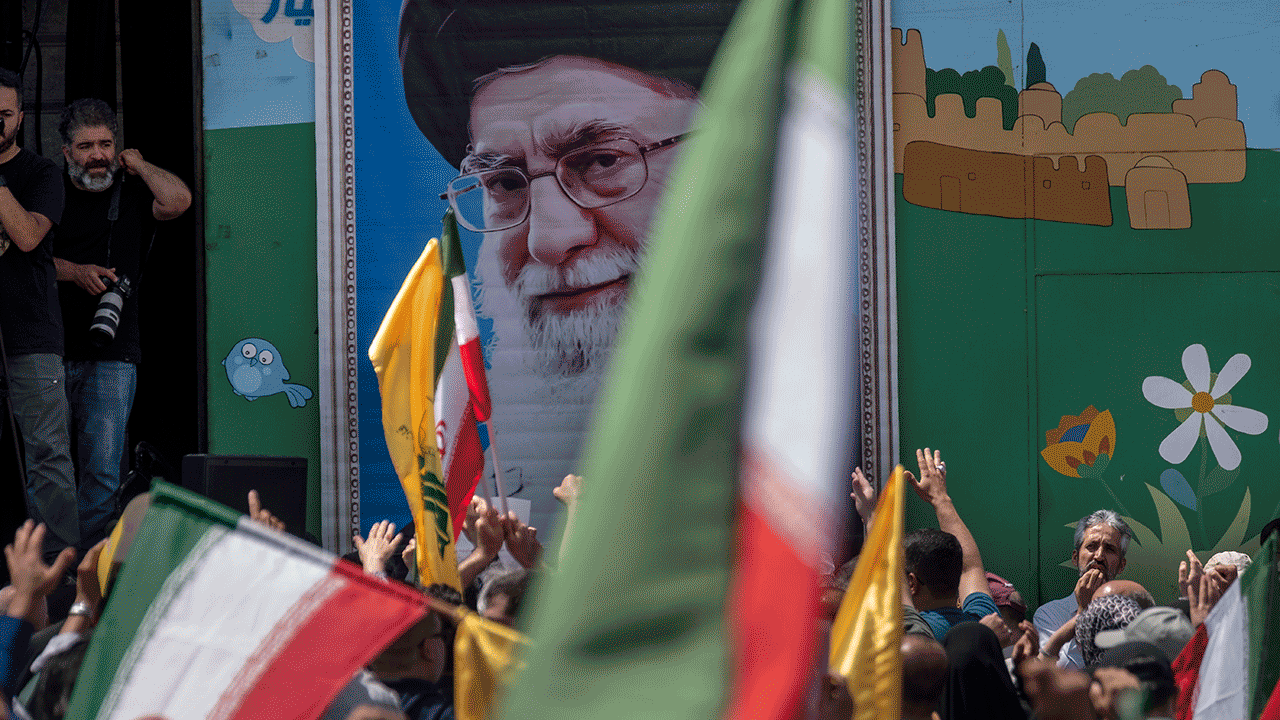
Iranian Ambassador to the United Nations Amir-Saeid Iravani delivered a forceful rebuke of U.S. military action against Iran during an emergency U.N. Security Council meeting on Saturday, following strikes that killed Supreme Leader Ali Khamenei and targeted the country’s military leadership.
Iravani characterized the American action as an “unprovoked and premeditated aggression” and the second such attack in recent months, referring to previous strikes against Iranian nuclear facilities. He adamantly rejected U.S. justifications for the military operation.
“Neither the charter nor international law recognize internal matters of a state as justification for the use of force by other states. The rule of law would be replaced by the rule of force,” Iravani stated during his address to the council.
The ambassador accused the United States of undermining its own claims of pursuing international stability while attacking a sovereign nation for what he described as “domestic” activities. He also noted that both the U.S. president and Israeli prime minister had publicly claimed responsibility for the strikes, which he interpreted as “an unmistakable admission of their intent to violate Iran’s sovereignty and territorial integrity.”
The military action, codenamed Operation Epic Fury, was ordered Saturday morning by President Donald Trump, who cited Tehran’s continued development of nuclear weapons as the primary motivation. In his remarks following the strikes, Trump emphasized his administration’s long-standing policy position.
“It has always been the policy of the United States, in particular my administration, that this terrorist regime can never have a nuclear weapon. I’ll say it again. They can never have a nuclear weapon,” Trump declared.
Trump further explained that the strikes were designed to “defend the American people by eliminating imminent threats from the Iranian regime,” adding that diplomatic efforts to convince Iran to abandon its nuclear ambitions had failed.
The U.S. position was defended at the Security Council by Ambassador Mike Waltz, who rejected Iravani’s characterization of the situation. “For 47 years, the Iranian regime has chanted, quote, ‘Death to America’ at every turn, at every opening, it has sought to eradicate the state of Israel. It has waged an unending campaign of bloodshed and mass murder,” Waltz countered.
Notably, Iravani’s remarks did not address the stalled negotiations between the U.S. and Iran regarding Tehran’s nuclear development programs, which have been a point of international tension for years. Instead, he focused on what he described as a pattern of American aggression against his country.
The strikes mark a significant escalation in the already tense relationship between Washington and Tehran, potentially reshaping the geopolitical landscape in the Middle East. Iran’s supreme leader was among the highest-profile casualties in an operation that targeted multiple military and leadership facilities across the country.
“Iran will continue to exercise its right of self-defense decisively and without hesitation until the aggression ceases in full and unequivocal terms,” Iravani promised, signaling that Tehran does not consider the matter closed.
The U.N. Security Council meeting highlighted the stark divide in international perspectives on the strikes, with member nations likely to split along familiar geopolitical lines regarding the legitimacy of the U.S. action. The exchange between the Iranian and American ambassadors represents just the beginning of what promises to be a complex diplomatic aftermath to the military operation.
The strikes come amid heightened regional tensions and ongoing concerns about nuclear proliferation, with implications that extend far beyond the immediate military impact of the operation itself.
Fact Checker
Verify the accuracy of this article using The Disinformation Commission analysis and real-time sources.

13 Comments
The Iranian ambassador’s remarks at the UN highlight the complex legal and diplomatic challenges at play. While the U.S. may have security concerns, unilateral military action sets a troubling precedent. All parties should engage in constructive dialogue to find a diplomatic solution that upholds international law.
This is a highly charged and complex geopolitical situation. While the U.S. may have justifications for the strikes, the Iranian ambassador raises valid concerns about the legality and implications under international law. Careful diplomacy is needed to de-escalate tensions and find a peaceful resolution.
The Iranian ambassador makes a fair point about the legality of the U.S. strikes under international law. Unilateral military action against a sovereign state sets a dangerous precedent, even if it was in response to domestic Iranian matters. Restraint and dialogue are needed to prevent this situation from spiraling.
Absolutely, the rule of law and respect for sovereignty must be upheld. Resorting to force, without clear international support, is a concerning development.
The Iranian ambassador’s comments raise valid questions about the legality and long-term implications of the U.S. strikes. While the details remain unclear, unilateral military action against a sovereign state is a serious matter with far-reaching consequences. Diplomacy and adherence to international law should be the priority.
This is a concerning development that underscores the fragility of the geopolitical situation in the region. The Iranian ambassador’s forceful rebuke at the UN reflects the high stakes involved. Both sides must exercise restraint and engage in earnest diplomacy to de-escalate tensions and find a peaceful resolution.
Absolutely, further conflict would be disastrous for the region and global stability. Diplomacy and respect for international law should be the guiding principles moving forward.
This is a delicate and complex situation that requires careful consideration of all diplomatic and legal implications. The Iranian ambassador’s remarks at the UN highlight the need for a measured, multilateral approach to resolving the tensions. Escalating the conflict through unilateral actions would be highly destabilizing for the region.
Well said. Diplomacy and adherence to international law should be the guiding principles to find a peaceful resolution that addresses the concerns of all parties involved.
The death of Iran’s supreme leader is a major development that will have significant ramifications. Both sides need to exercise caution and restraint to prevent the situation from deteriorating further. Diplomacy should be the priority to find a peaceful solution that respects international law.
Agreed, this is a delicate moment that requires wise and measured leadership from all parties involved. Escalating the conflict will only lead to more suffering.
This is a concerning escalation of tensions between the U.S. and Iran. While the justifications for the strikes remain unclear, the Iranian ambassador’s strong rebuke highlights the serious diplomatic implications. I hope both sides can de-escalate and find a peaceful resolution through dialogue and diplomacy.
Agreed, further conflict would be disastrous for the region. Diplomatic solutions must be explored to avoid a wider conflagration.